

Monaco: From Representation to Immersion
National pavilions have always been more than architectural statements.They reflect how nations choose to present themselves to the world.
For more than 150 years, World Expos have provided countries with a unique global stage on which to project their identity, showcase their expertise and articulate their vision of the future. From Vienna in 1873, where Monaco first participated under the reign of Prince Charles III, to Expo 2025 Osaka, Kansai, the Principality has consistently used these events to engage with the world.
Expo 1970 and Expo 2025 in Osaka mark two defining moments in the history of World Expos in Japan. As the first Asian nation to host a World Expo, Japan has since welcomed six international exhibitions under the auspices of the Bureau International des Expositions (BIE).
Expo 1970 Osaka

Designed by Takeshi Ōtaka, the logo of Expo 1970 Osaka drew inspiration from the cherry blossom, combining a powerful national symbol with a universal aspiration. Its five petals represented the world’s continents converging around a shared centre. © Takeshi Ōtaka
Expo 1970 Osaka, the first World Expo ever held in Asia, offered Japan an opportunity to demonstrate its emergence as a major industrial and technological power. Under the theme Progress and Harmony for Mankind, the Expo celebrated scientific and technological innovation as the driving force behind a shared future.
With more than 64.2 million visitors, Expo ’70 became a landmark event. Its national pavilions embodied industrial strength, technological achievement and an enduring confidence in human progress.
Alongside the national pavilions, major Japanese and international corporations assumed an unprecedented role. Companies including Hitachi, Mitsubishi, IBM, Kodak, Pepsi-Cola and Fujitsu presented spectacular pavilions that staged their own visions of tomorrow’s society, transforming technological innovation into a public spectacle.
The pavilions themselves became bold architectural experiments, ranging from inflatable structures and megastructures to metabolist modular designs. The Expo site was conceived as a vision of the city of the future, organised around a central spine that reflected the idea of a constantly evolving society. Most of the pavilions were dismantled after the Expo, as the site had been conceived primarily as a laboratory for architectural experimentation and national and industrial representation. A handful of iconic structures, including Tarō Okamoto’s Tower of the Sun, were preserved and later incorporated into the Expo ’70 Commemorative Park.
Expo 1970 Osaka, Kansai © BIE
Yet this vision of the future was not devoid of environmental concerns. It already reflected an ambition to encourage collective thinking about natural resources, the organisation of society, and the relationship between technological progress and quality of life. The real difference lies not in the ambition itself, but in the means employed. In 1970, adaptability was expressed as an architectural vision; by 2025, it had become an operational requirement grounded in circularity.
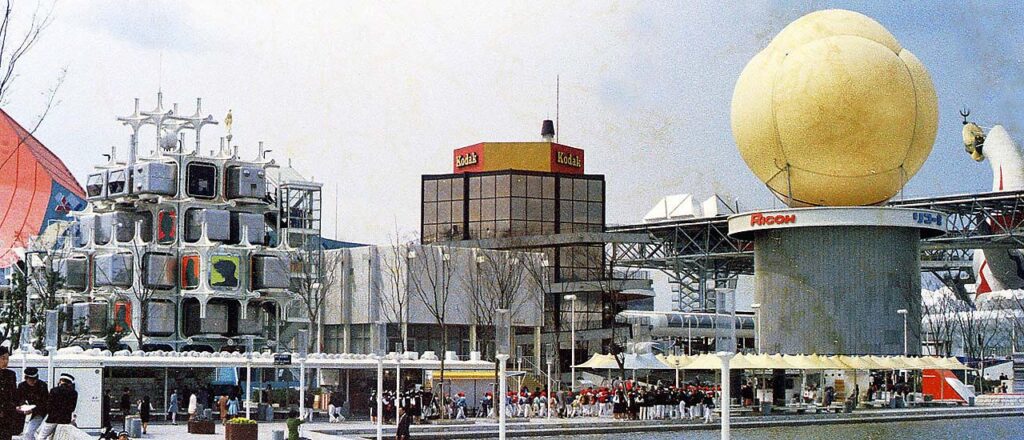
Expo 1970 Osaka, Kansai © BIE
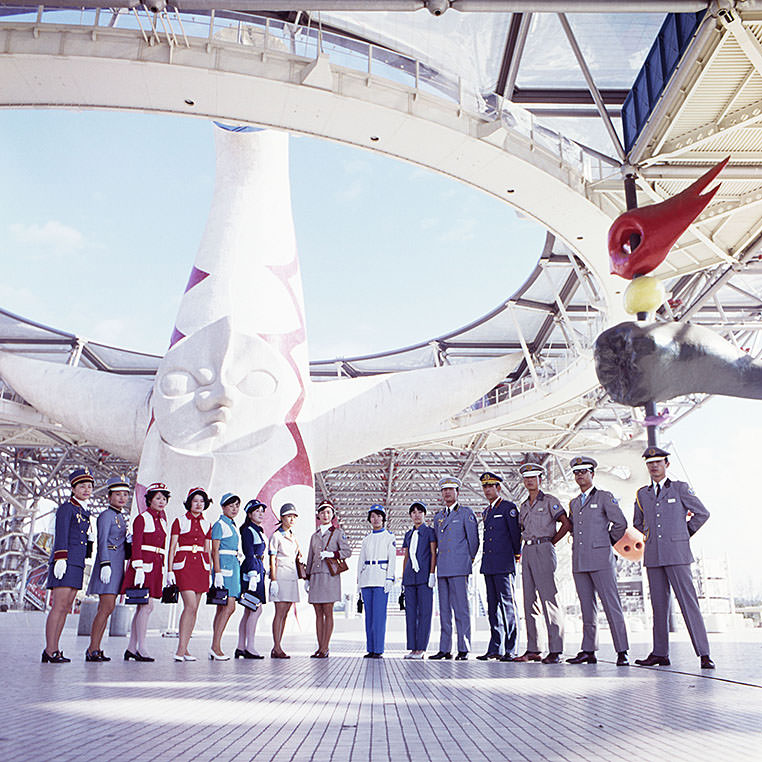
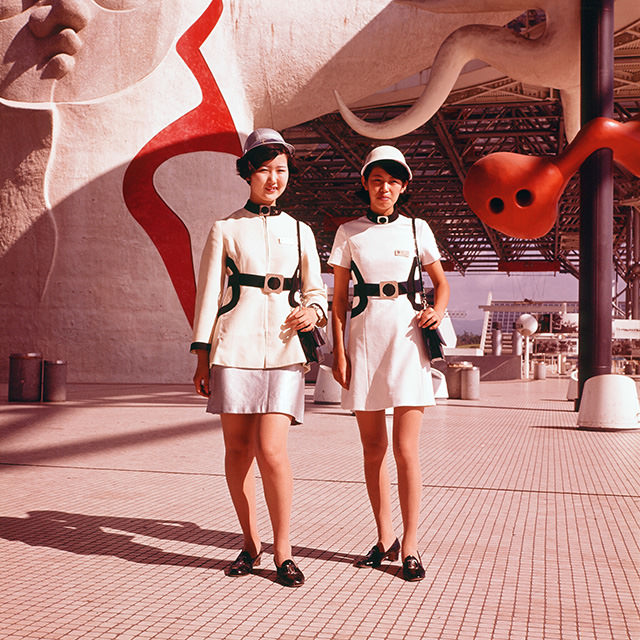
Staff of the Japan World Exposition Association © Expo ‘70 Commemorative Park
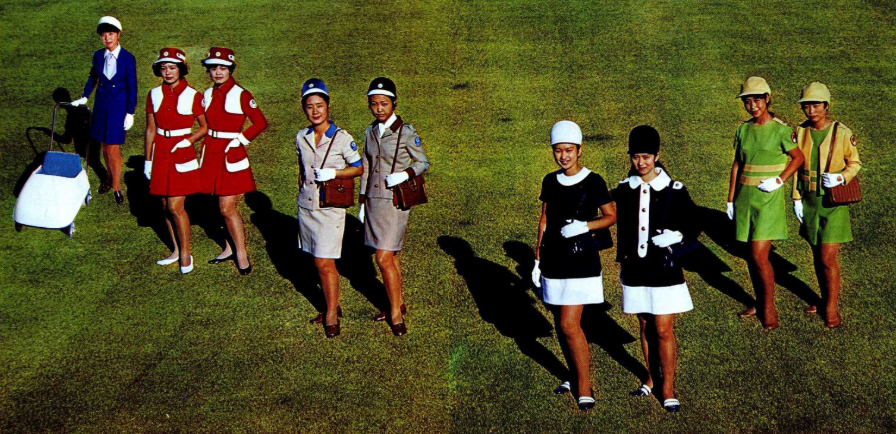
Extract from the Official Expo ’70 Guide, pages 250–251 © Internet Archive
A wide range of staff were deployed throughout Expo ’70 to ensure visitors enjoyed the best possible experience. From left to right (summer uniforms are shown on the left, winter uniforms on the right):
- Expo Angel – lending pushchairs and umbrellas. Navy-blue uniform with a white tie.
- Expo Flower – ticket control and visitor guidance. Red uniform.
- Expo Sister – guides for Expoland. Beige uniform.
- Expo Hostess – interpreters for official delegations and international visitors, as well as guides for Japanese visitors. Navy-blue uniform.
- Lost Children Service – assisting children separated from their families. Green uniform.

The Tower of the Sun (Taiyō no Tō), created by Tarō Okamoto and the enduring symbol of Expo 1970 Osaka, dominates the commemorative park in Suita, north of Osaka. It embodies the meeting point of past, present and future. © Expo ’70 Commemorative Park
Expo 2025 Osaka
Today, innovation is measured not only by what is built, but by how it is designed to endure beyond the event itself. Pavilions and their components are expected to be dismantled, relocated, reused or recycled. Expo 2025 even established a dedicated reuse marketplace for buildings, timber, technical equipment, cladding materials and furniture.
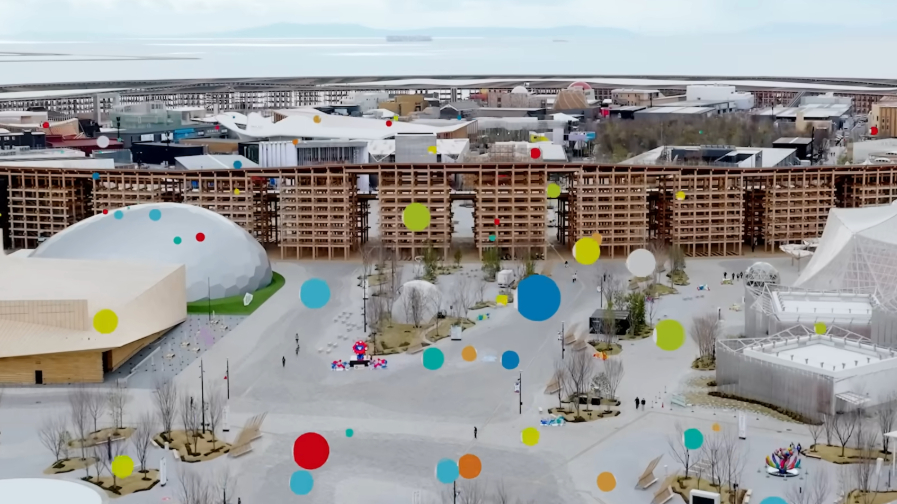
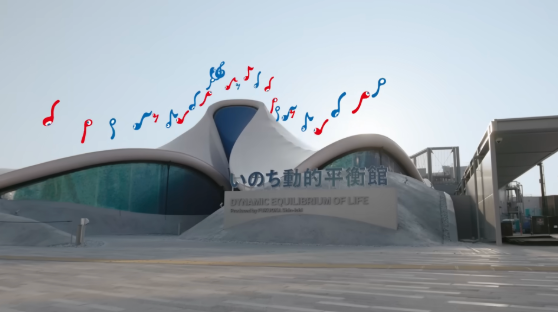
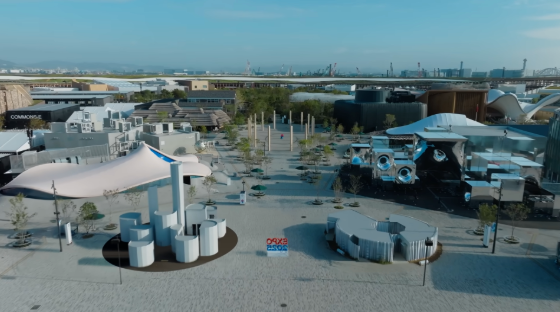
Expo 2025 Osaka, Kansai brings together 150 countries and international organisations to help shape the future. © Expo 2025
1970: building an image of the future. 2025: building without compromising the future.
The contrast, however, is less pronounced than it first appears. As early as 1970, the Japanese Metabolist movement advocated an evolving architecture capable of adapting to social transformation. Led by architects such as Kenzo Tange, Uzo Nishiyama and Kisho Kurokawa, the movement envisioned buildings designed to evolve alongside society itself. By 2025, this principle has taken on a different meaning, becoming a practical requirement centred on disassembly, material traceability and circular resource management.

Myaku-Myaku, the Expo mascot created by Kohei Yamashita (mountain mountain), performs to the official Expo theme song written and composed by Kentaro Kobuchi and Shunsuke Kuroda. © Expo 2025
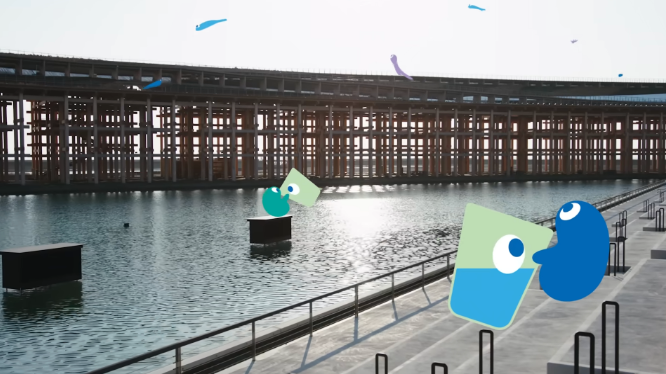
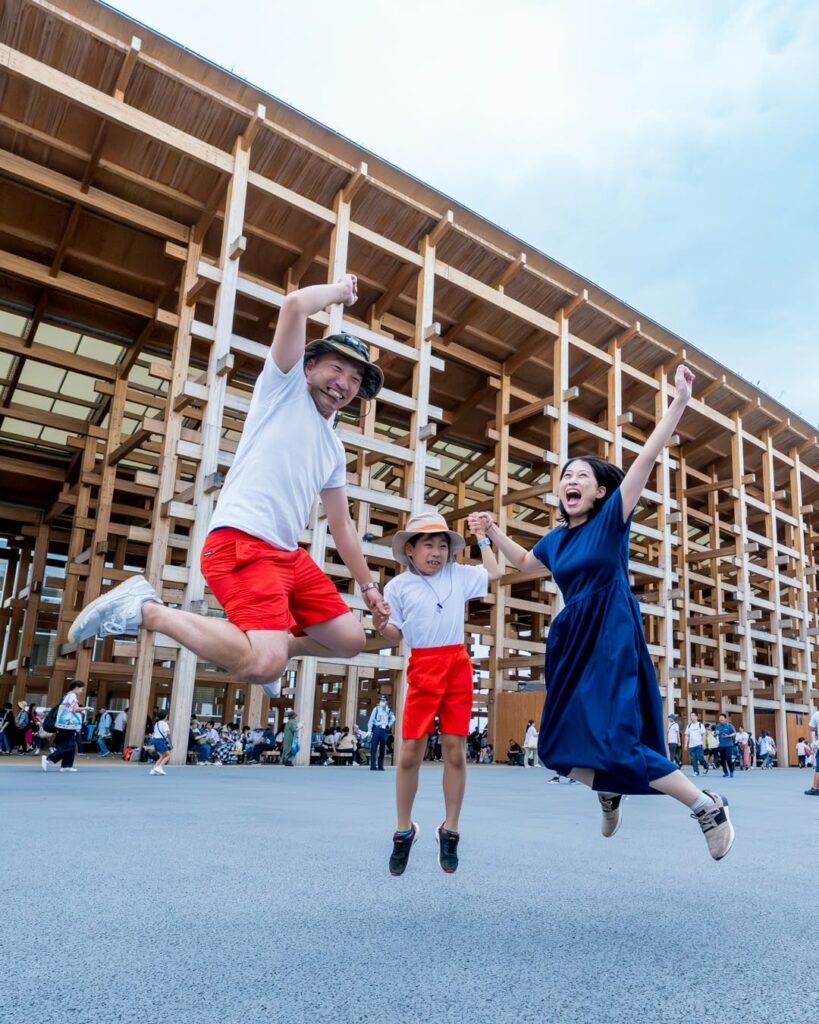
The Grand Ring was officially recognised by Guinness World Records on 4 March 2025 as the world’s largest wooden architectural structure, with a recorded surface area of 61,035.55 m² © Expo 2025
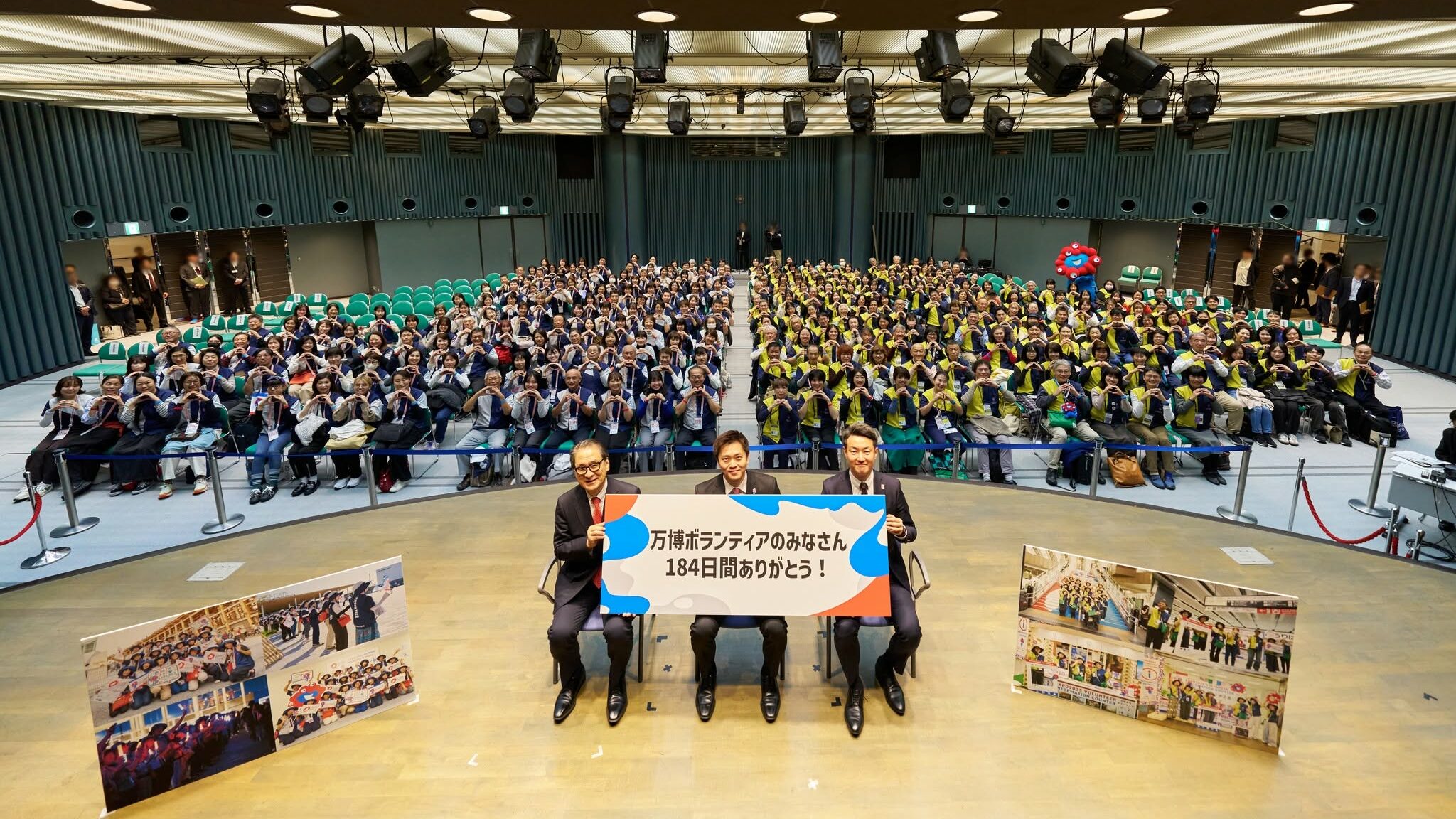
Group photograph of the Expo 2025 Osaka teams during the Closing Ceremony on 13 October 2025, bringing to an end 184 days dedicated to dialogue, cooperation and innovation. © Expo 2025 Osaka
1970: Presenting Monaco at the Heart of Modern Japan
Monaco inaugurated its first pavilion in Japan under the explicit theme “Tradition and Progress.” Through this guiding principle, the Principality sought to affirm the continuity of its history while projecting the image of a nation embracing modernisation. Against the backdrop of Japan’s period of rapid economic growth, Monaco presented a narrative that combined heritage, economic development and innovation.
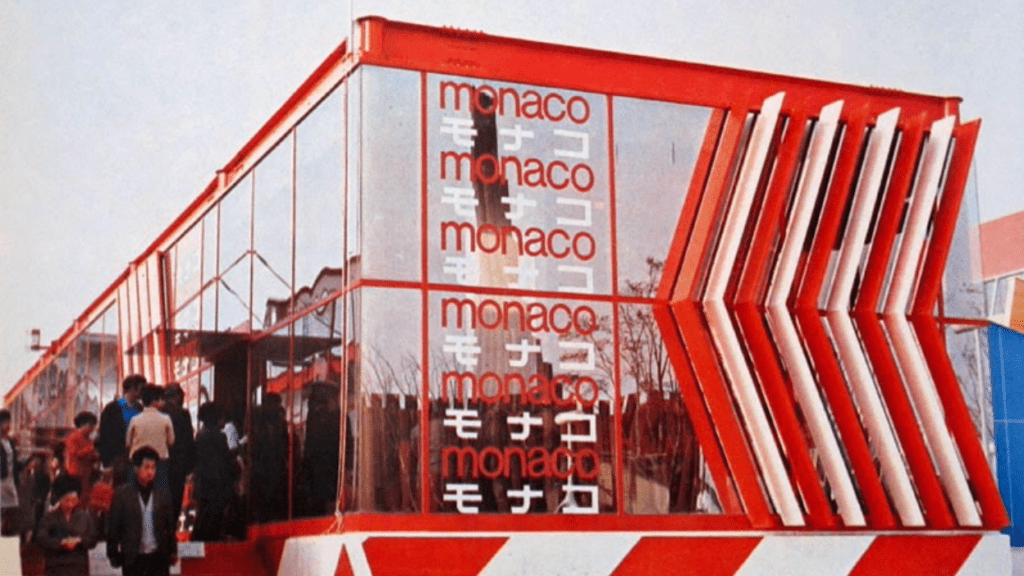
The Monaco Pavilion – Expo 1970 Osaka © DR
The architecture immediately conveyed a distinctive identity. The single-storey pavilion combined a striking red steel structure—echoing the colours of the Principality—with expansive semi-reflective glass façades.
Long before the term “nation branding” entered the international vocabulary, Monaco had already understood that architecture could serve as a powerful diplomatic medium—capable of expressing a territory, its history and its ambitions.
Inside, the exhibition offered visitors a comprehensive portrait of the Principality.
Visitors discovered the Grimaldi dynasty and the Princes of Monaco, the country’s economic development, its tourism sector, industrial achievements, philatelic collections, works of art, and the scientific work of the Oceanographic Institute of Monaco, founded by Prince Albert I.
The sea naturally occupied a central place in this narrative.
It was not simply a backdrop, but the expression of an identity rooted in scientific knowledge, exploration and international openness.
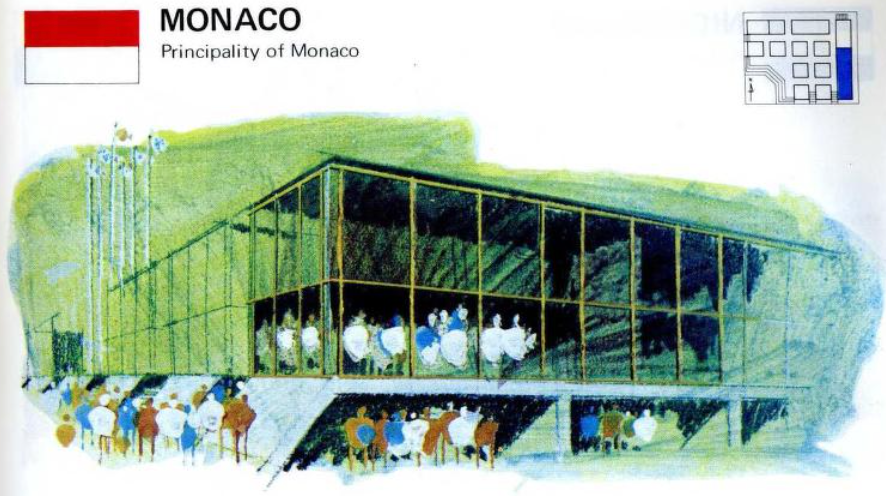
Extract from the Official Expo ’70 Guide, page 145 © Internet Archive
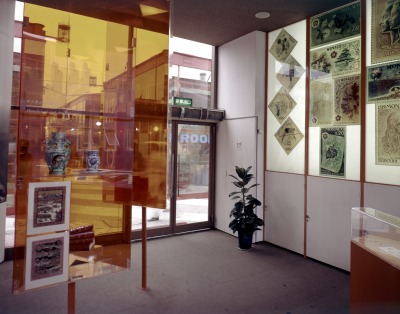
Third exhibition hall: photographs of Monaco’s postage stamps were displayed on dedicated panels, several of which commemorated the Principality’s participation in Expo ’70. © Expo ‘70 Commemorative Park
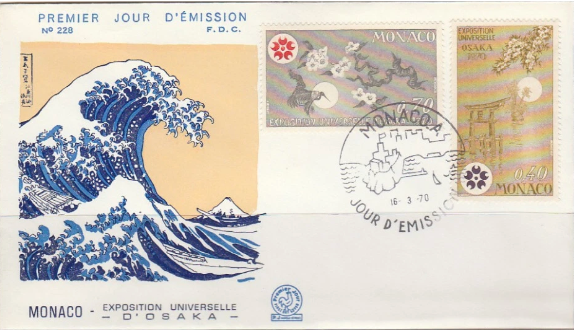
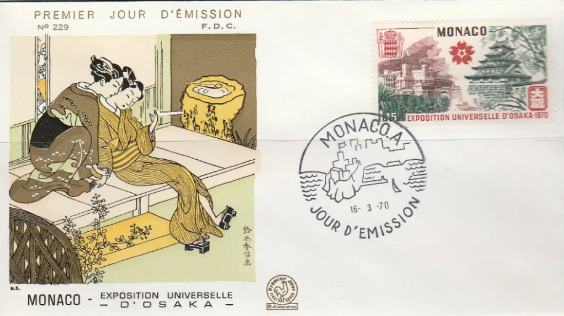
Expo 1970 Osaka First Day Covers © Monaco Philatelic and Numismatic Counter
The pavilion’s narrative was essentially explanatory: its purpose was to present Monaco, its institutions, its economy and its achievements. Fifty-five years later, this logic has not disappeared—it has evolved.
In 1970, Monaco sought to persuade through what it displayed. In 2025, it seeks to engage visitors through what they experience.
2025: Creating a Dialogue Between Two Cultures
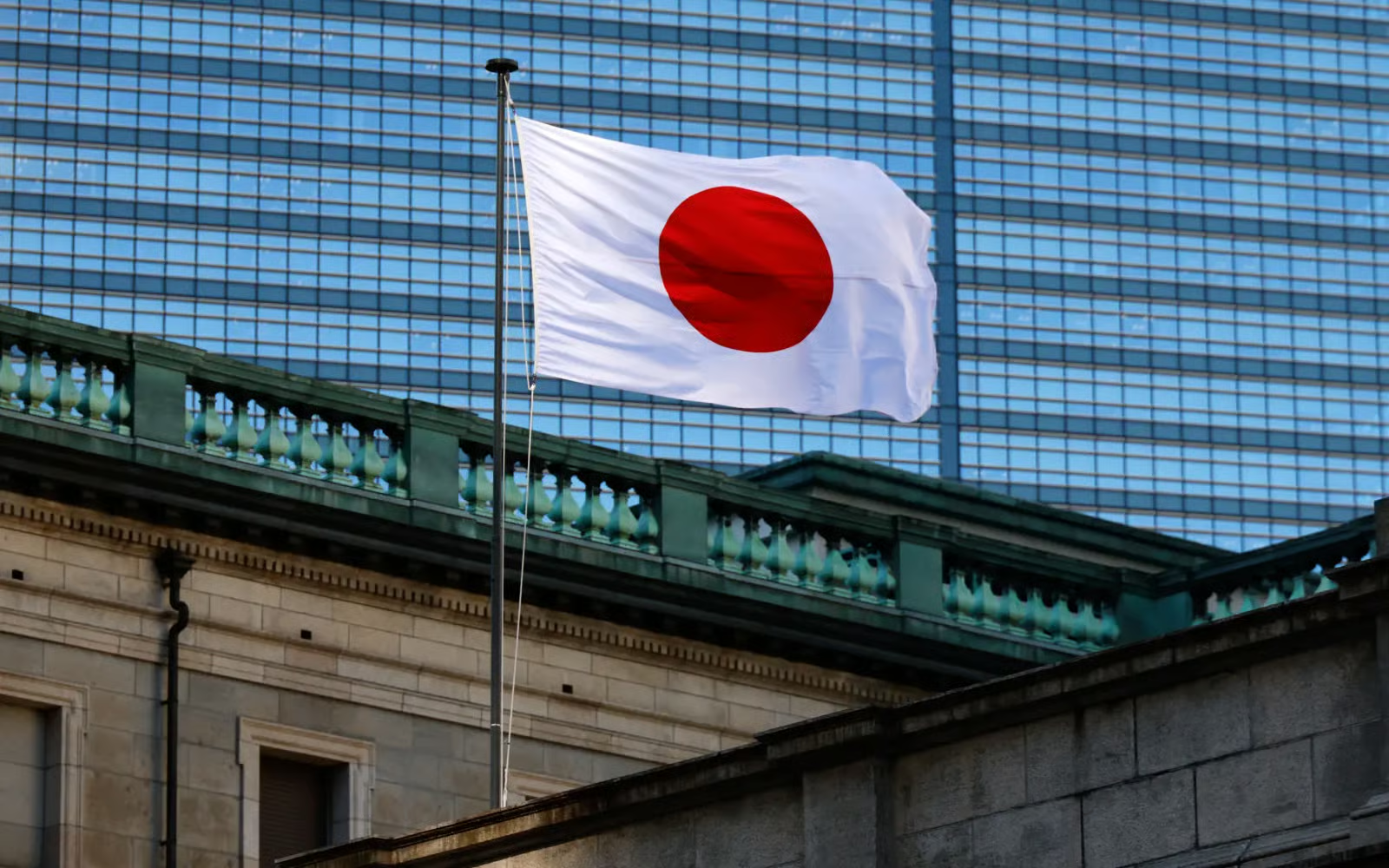
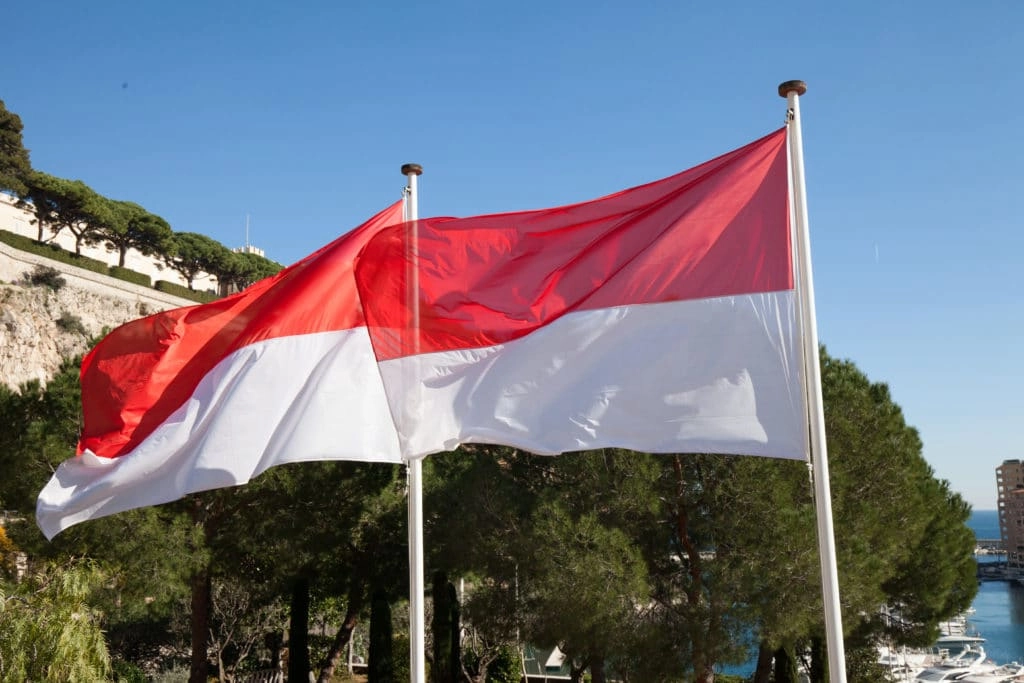
Expo 2025 Osaka, Kansai is held under the theme “Designing Future Society for Our Lives“, articulated around three overarching ambitions: Saving Lives, Empowering Lives and Connecting Lives.
The Monaco Pavilion aligns with this third ambition: building lasting connections.
Rather than reproducing Monaco’s traditional symbols, the project adopts a more universal approach. It creates a dialogue between two landscape cultures while inviting visitors to experience the Principality as a living laboratory for environmental innovation. Delivering this vision required meeting a demanding challenge: constructing a pavilion in Japan while complying with some of the world’s most rigorous environmental, technical and seismic standards.
The Mediterranean and Japanese gardens become two expressions of a shared relationship with the living world —one founded on an appreciation of the seasons, natural materials, ecological cycles and the bond between people and their environment.
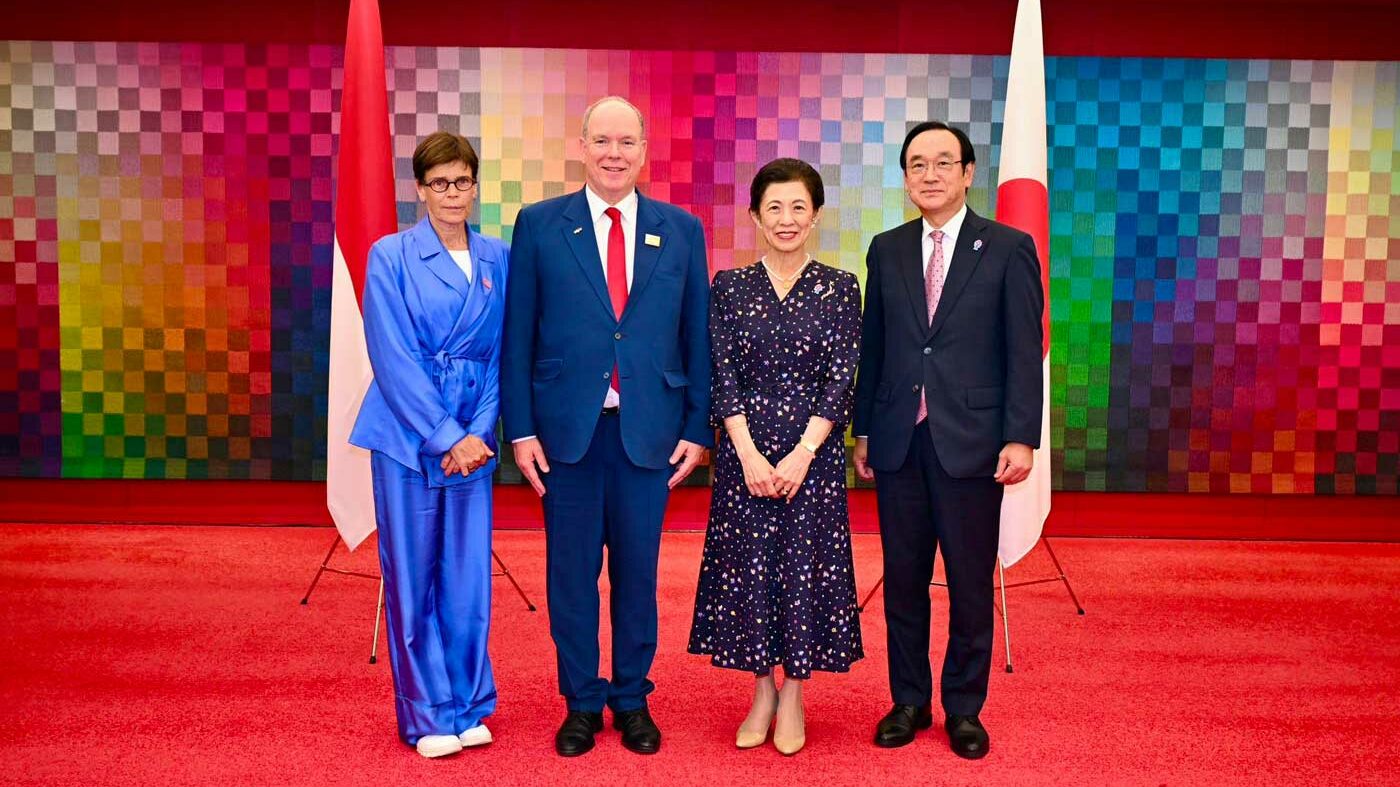
H.S.H. Prince Albert II and H.S.H. Princess Stéphanie with H.I.H. Princess Hisako of Takamado and Commissioner General Koji Haneda during the official luncheon marking Monaco National Day at Expo 2025 Osaka, 28 June. © Axel Bastello – Prince’s Palace of Monaco
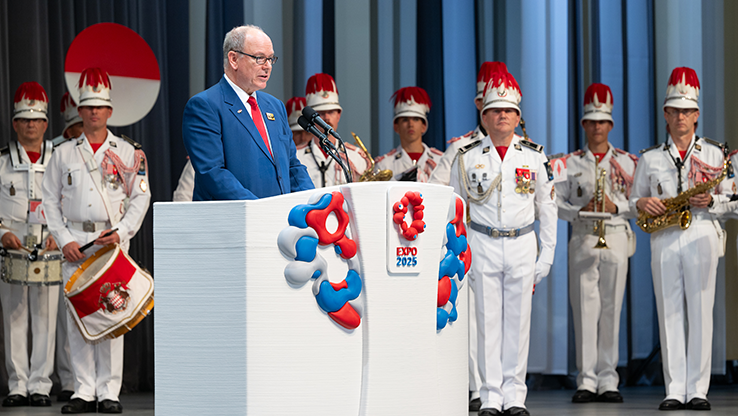
Address by H.S.H. Prince Albert II of Monaco – Expo 2025 Osaka © Axel Bastello – Prince’s Palace of Monaco
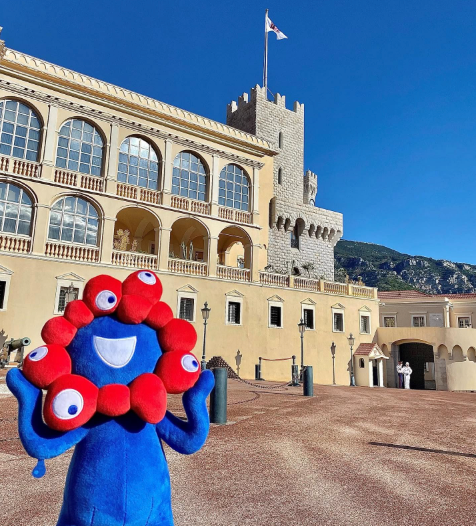
Myaku-Myaku’s visit to the Prince’s Palace of Monaco © Monaco Now
The First Story a Pavilion Tells: Its Visual Identity
Long before visitors step inside a pavilion, they encounter a symbol. The logo is often the very first point of contact between a nation and its audience.
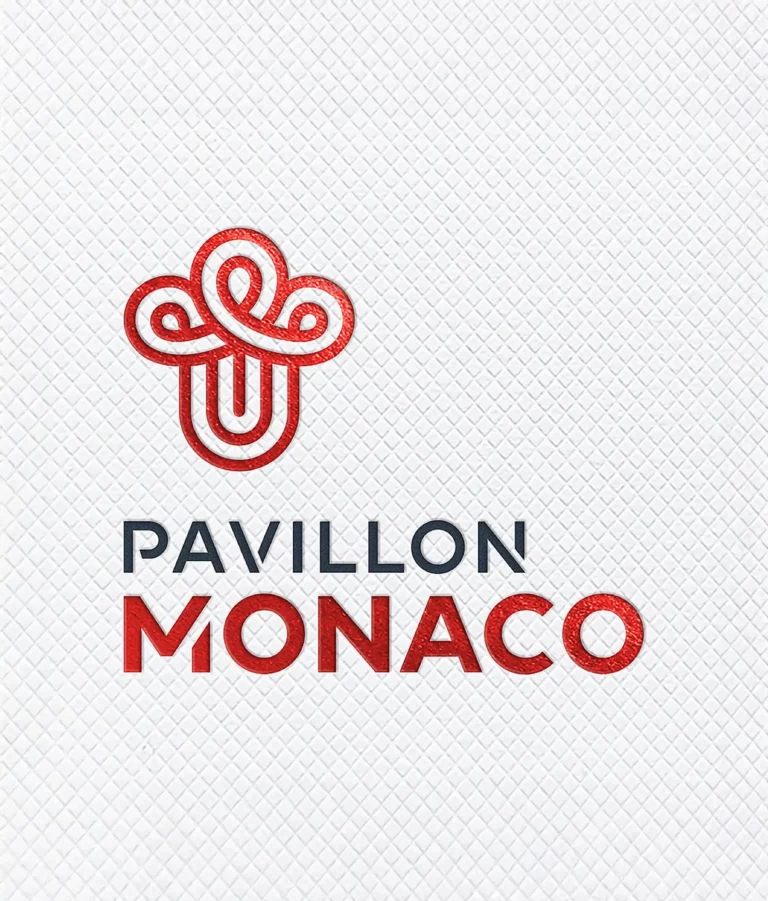
Created by Office Mikado, the visual identity of the Monaco Pavilion at Expo 2025 Osaka embodies this dialogue between two cultures. It combines the diamond motif from the Grimaldi coat of arms with circular and linear forms inspired by Japan, its national flag and the aesthetic language of Japanese gardens. Conceived as the opening chapter of the pavilion’s story, it creates continuity between communication, architecture and the visitor experience.

Unveiled six months before the opening of Expo 2025 Osaka, the pavilion’s mascot, Leeloo, was conceived and designed by Lilou Braiech as part of her contribution to the Monaco Pavilion project during her internship at Think.green. Designed as a character carrying the pavilion’s identity and values, Leeloo extends its narrative beyond architecture, creating a more immediate and engaging connection with visitors.
Dressed in Monaco’s traditional costume, Leeloo symbolises the friendship between Monaco and Japan. The character illustrates a new dimension in the language of World Expo pavilions: moving beyond institutional symbols to create figures capable of conveying identity, inspiring emotion and building meaningful relationships with audiences from around the world.
This synergy between graphic identity and narrative embodiment does more than identify a building. It creates a coherent universe in which every element—symbol, character, architecture and visitor experience—works together to tell a single, compelling story.
When Architecture Becomes Landscape
Designed by architects Jérôme Hein (The A Group) and Nicolas Fedoroff (Atelier Pierre), the Monaco Pavilion does not seek to assert itself as a standalone architectural object. Instead, its scenography, conceived by Simmetrico under the creative direction of Daniele Zambelli, extends this vision by transforming architecture into the framework for an immersive experience.
Its reflective metallic surfaces capture changing light, mirror the surrounding vegetation and gradually draw visitors into the landscape itself. Inspired by both Mediterranean and Japanese gardens, the pavilion’s steel canopy evokes an artificial woodland canopy, where architecture and nature merge into a single composition.
Monaco Pavilion at Expo Osaka 2025 © SIMMETRICO
Architecture no longer simply houses an exhibition; it becomes part of the narrative itself, engaging visitors through materials, light, sound and its continual dialogue with the landscape.
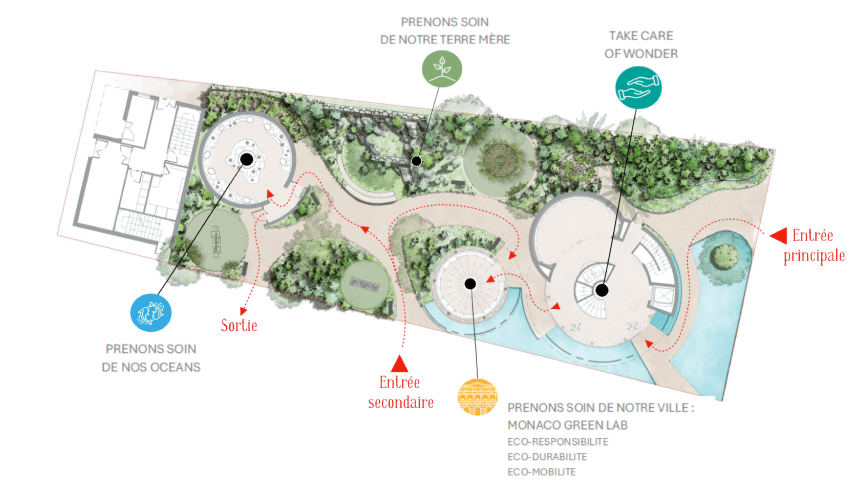
The visitor journey begins with a series of interactive installations before unfolding across a Mediterranean calade centred around a centuries-old olive tree. Visitors then pass through a succession of micro-landscapes designed by landscape architect Julien Rossignol, where Mediterranean and Japanese plant species coexist within a shared environment.
The pavilion’s signature, Take Care of Wonder, reinforces this approach. Beyond its environmental commitment, it invites visitors to rediscover nature as something extraordinary—something to cherish, understand and protect.
Over the past fifty-five years, the narrative has shifted profoundly. Without diminishing the importance of science, the pavilion now places emotion and landscape at the heart of engagement, using architecture not simply to inform but to inspire.
The Monaco Pavilion’s delicate steel canopy creates a journey suspended between architecture and nature. © Monaco Pavilion
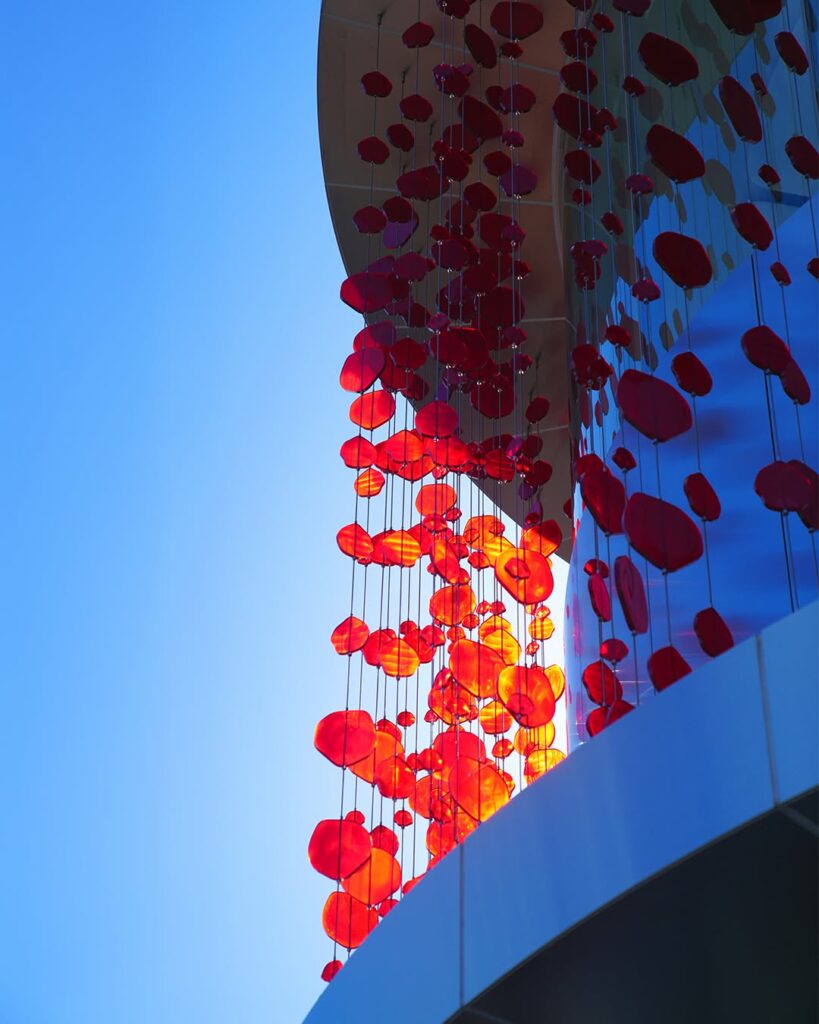
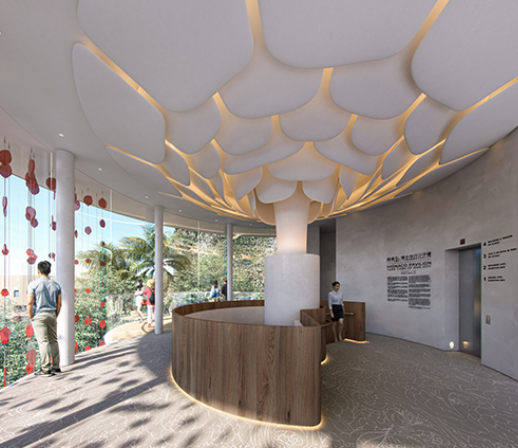
Certain details of the façade and the belvedere ceiling subtly evoke the petals of a rose, a symbolic tribute to the flower so closely associated with Princess Grace. © Jérôme Hein Architecte & Atelier Pierre
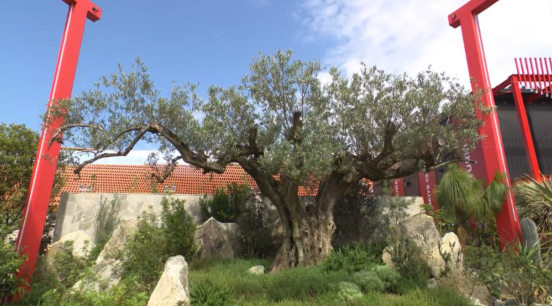
The pavilion’s architectural language draws directly on the traditions of Mediterranean and Japanese gardens. © Expo 2025
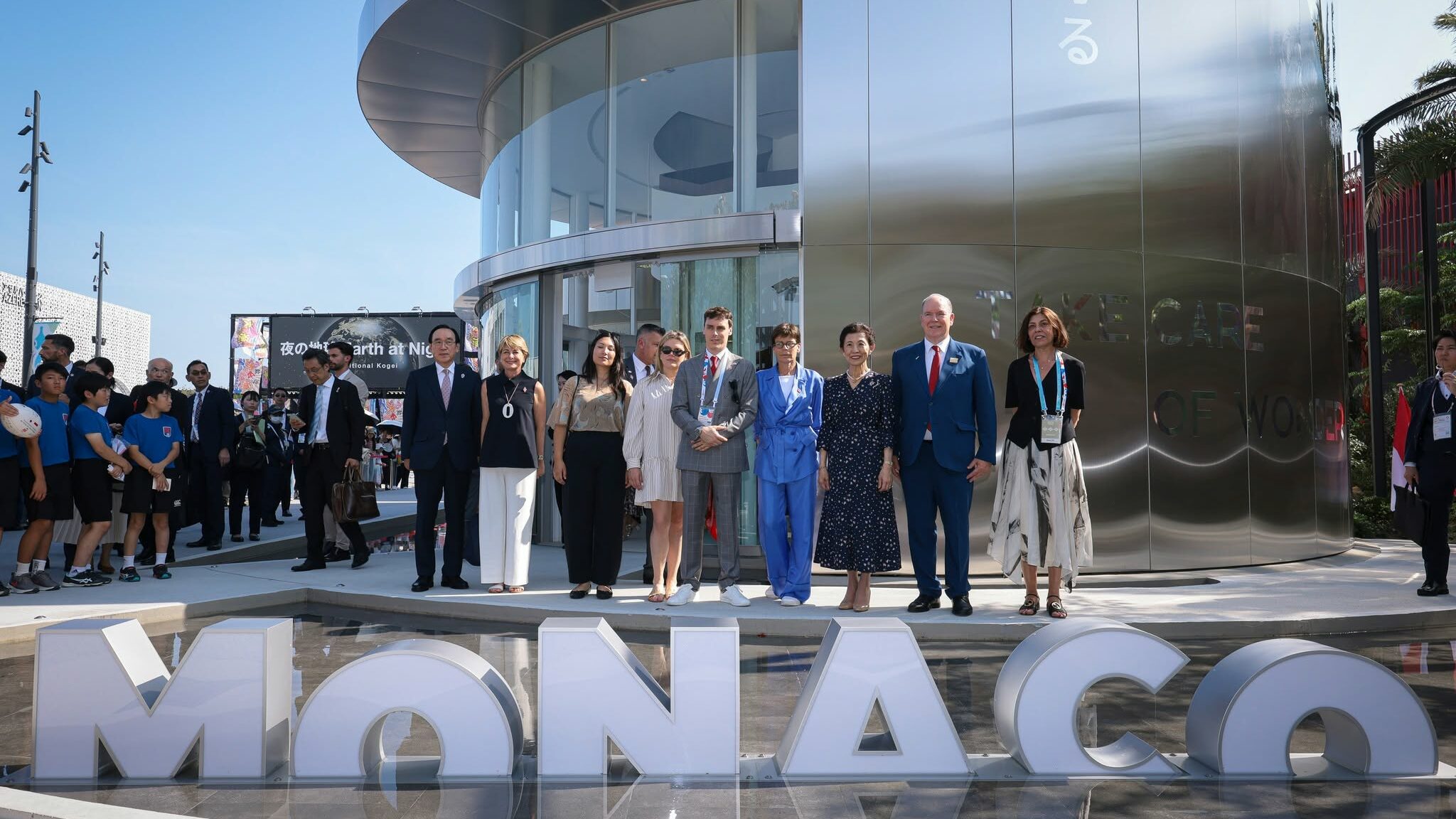
H.S.H. Prince Albert II, accompanied by members of the Princely Family. The Monaco Pavilion sign appears partially immersed in water, reflecting the idea that human beings themselves are immersed in nature. © Manuel Vitali
Take Care of Wonder: for six months, thirteen young Monegasques serve as ambassadors for their country, inviting visitors to protect nature while discovering the landscapes, culture and way of life of the Principality. © L’Œil du Raddar – TV Monaco

Myaku-Myaku in front of the Monaco Pavilion. © Think.green
Beyond the Expo: What Remains
By definition, a World Expo is temporary. Pavilions are dismantled and visitors return home, yet the stories they tell continue to shape perceptions long after the event has ended.
At Expo 2025 Osaka, this idea takes on a new dimension. Sustainability is no longer simply one of the Expo’s themes—it has become a fundamental organising principle. The event is underpinned by a comprehensive sustainability policy, an action plan, a carbon neutrality strategy, a circular economy framework and a responsible procurement code designed to guide every participant. Within this framework, the life cycle of each pavilion, the reuse of materials and the reduction of environmental impact become integral design criteria.
The Monaco Pavilion fully embraces this approach. Conceived to minimise its environmental footprint, it has been designed so that its principal components can be reused after the Expo, extending the environmental commitments that have shaped the project from the outset.
The legacy of a pavilion can therefore no longer be measured solely by its architecture or visitor numbers. It also lies in its ability to communicate a vision, inspire new practices and leave a lasting impact that extends well beyond the duration of the Expo.
From Osaka to Osaka: One Enduring Ambition, A New Language
Over the past fifty-five years, Monaco’s ambition has remained remarkably consistent. The Principality continues to champion knowledge, dialogue between cultures, innovation and the preservation of the living world. What has fundamentally changed is the way that ambition is expressed.
In 1970, visitors entered a building to discover Monaco. The pavilion presented what the Principality possessed, produced and represented.
In 2025, visitors move through a landscape, engage with a narrative and become part of an experience. The pavilion no longer simply presents a country; it invites visitors into a lasting relationship with it.
This evolution extends far beyond Monaco. It reflects a broader transformation in the language of World Expos themselves, where nations no longer come merely to display their achievements, but to share visions, commitments and new ways of inhabiting the world.
The Monaco Pavilion provides a particularly compelling illustration of this shift. Moving from demonstration to experience, and from representation to interaction, it embodies a deeper transformation in the role of national pavilions.
In the twenty-first century, their purpose is no longer simply to represent a country. Their role is to foster enduring relationships between nations, their values and the people they engage.
These international gatherings will undoubtedly continue to evolve. Technologies will change. Architecture will evolve. Yet their essential purpose will remain unchanged: to enable nations to tell their stories and define their place in the world.
Ultimately, it is those narratives—not architecture alone—that shape how nations are perceived and remembered.