

A three-micrometre bacterium capable of capturing nanoplastics. Magnetic microrods moving through contaminated water. Enzymes carried to the surface of a polymer to break its chemical bonds.
Researchers are developing microscopic devices that can propel themselves, assemble into coordinated groups and carry the materials needed to capture or degrade pollutants.
Their movement addresses a physical constraint: dispersed contaminants must encounter an active surface before they can be captured or broken down. Mobility can increase the frequency of these encounters, improve mass transfer and accelerate certain chemical reactions.
In 2025, a study published in ACS Nano showed that magnetic guidance increased microplastic removal by 33 percentage points. Two papers published in 2026 explored related mechanisms: mobile porous adsorbents in Environmental Science: Nano and enzyme-carrying microrobots capable of degrading polymers in Communications Materials.
Living bacteria capture microplastics
Magnetospirillum magneticum combines two properties useful in microrobotics. Its flagella provide propulsion, while its magnetosomes, intracellular structures containing magnetite crystals, allow the bacterium to orient itself in a magnetic field.
In July 2025, researchers at VSB–Technical University of Ostrava in the Czech Republic used these bacteria as living microrobots to collect microplastics and nanoplastics.
Exposed to a rotating magnetic field, the bacteria form coordinated three-dimensional swarms. As they move through water, plastic particles adhere to their cell surfaces.
The study, published in ACS Nano by ACS Publications, compared removal efficiency with and without collective magnetic guidance.
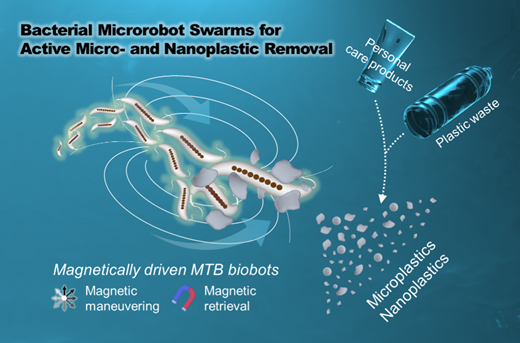
Under a 5-millitesla field rotating at 0.5 hertz, 83% of polystyrene microplastics were removed, compared with 50% when the bacteria relied on natural propulsion alone.
Three-dimensional organisation of living microrobots, resembling the coordinated movement of fish shoals. © ACS Nano, 2025
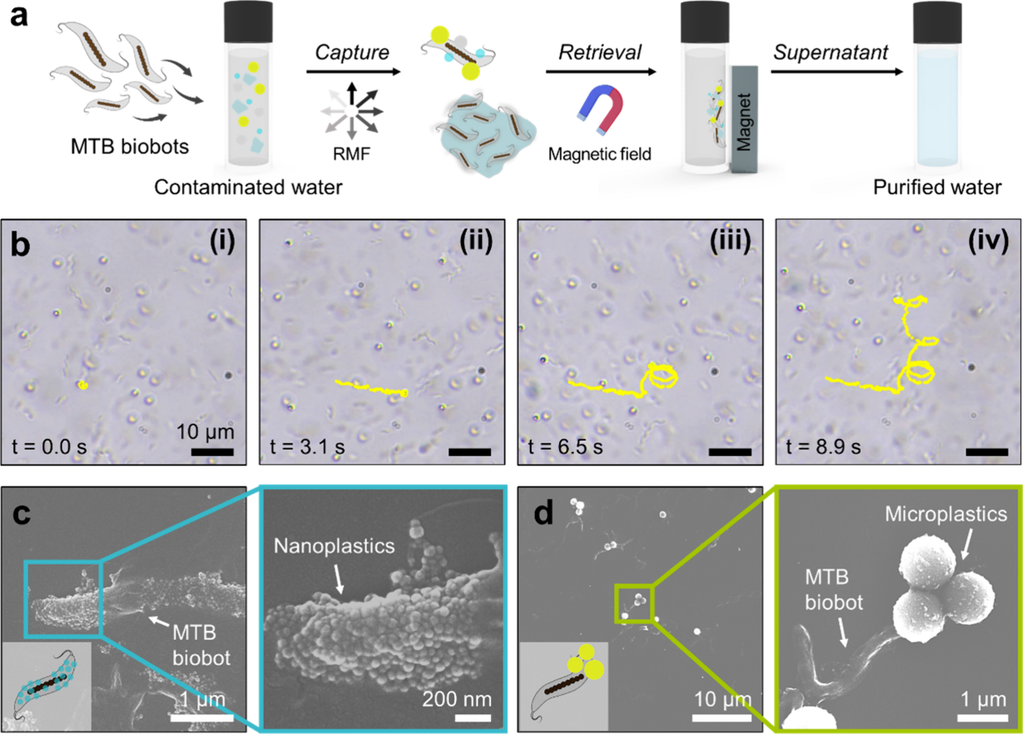
Capture of polystyrene microplastics and nanoplastics by magnetotactic bacteria.
a – Experimental procedure. b – Trajectory of a microplastic particle during capture. c, d – Scanning electron microscopy images of captured particles. © ACS Nano, 2025
The effect varies with particle size and surface properties. Removal of 50-nanometre nanoplastics reached 89%, but magnetic guidance offered a smaller additional benefit because the particles already adhered readily to the bacterial surface.
The researchers also achieved 79% removal of model microplastics in tap water and 77% in river water. Following treatment, the bacteria and captured plastics were collected by magnetic separation.
The findings demonstrate that movement can improve capture without altering the composition of the active material. The extent of that improvement depends on the contaminants being treated.
Magnetic microrobots target nanoplastics
On 7 April 2026, researchers at Brno University of Technology published a study in Environmental Science: Nano, from the Royal Society of Chemistry, describing a synthetic microrobot design known as MILBots.
The microrobots are produced by thermally converting iron-based metal–organic frameworks into porous rods containing carbon and iron oxides.
Their surfaces provide sites for adsorption, while their magnetic properties allow controlled movement under a rotating field.
The researchers reported 78% removal of 30-nanometre polystyrene nanoplastics, alongside a maximum adsorption capacity of 229 milligrams per gram of material. Supplementary experimental data also indicate approximately 48% adsorption after ten minutes. These figures represent different measurements, rather than a direct comparison between moving and stationary particles.
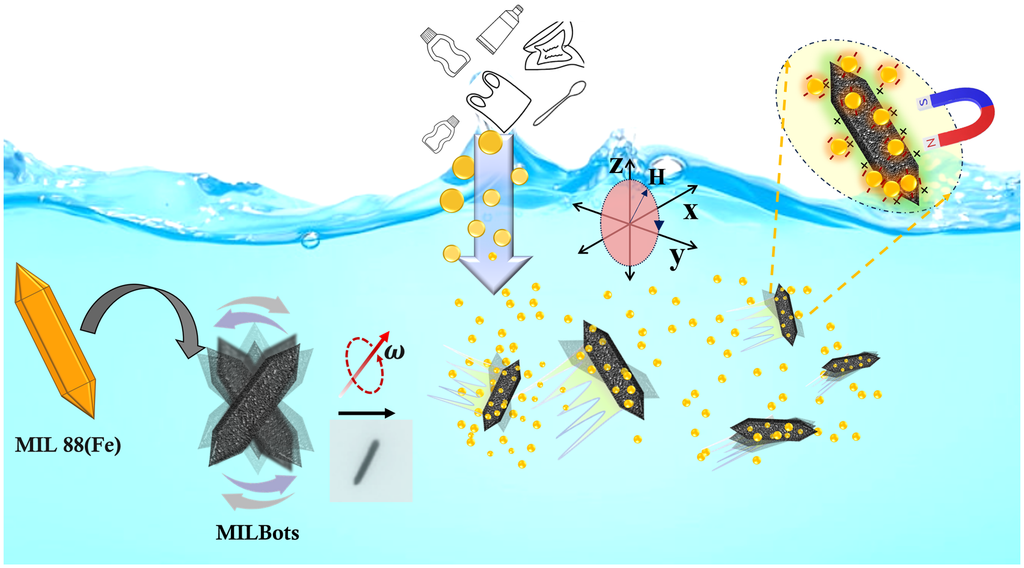
Structure of synthetic microrobots made from iron oxides and porous carbon, produced through thermal conversion of a metal–organic framework. © Environmental Science: Nano, 2026
MILBots combine the adsorption properties of a porous material with controlled magnetic locomotion.
Their ability to capture model nanoplastics has been demonstrated in aqueous suspension, but their performance in wastewater treatment has yet to be established.
Magnetically controlled movement of MILBots microrobots. © Environmental Science: Nano, 2026
Mobile enzymes break down plastics
Capturing plastic particles allows them to be removed without necessarily changing their chemical composition. Other microrobots carry enzymes capable of breaking bonds within the polymer itself.
On 9 October 2026, researchers from Italy’s National Research Council (CNR) published a study in Communications Materials, part of Nature Portfolio, describing biohybrid microrobots made from gold-decorated cubic haematite particles functionalised with enzymes.
In darkness, the particles assemble into filament-like structures. Blue light causes these assemblies to disperse, releasing self-propelled microrobots.
The researchers investigated their ability to degrade polylactic acid (PLA), a polyester used in some bio-based plastics.
As the microrobots disperse, their enzymes gain greater exposure to the polymer surface and make contact with new areas. Hydrolysis of certain ester bonds produces soluble molecular fragments, identified through mass spectrometry. Scanning electron microscopy also revealed localised erosion of the plastic surface.
The study demonstrates enzyme-mediated degradation enhanced by particle movement and reorganisation, although complete breakdown of the PLA was not established.
Light therefore offers a way to control where the active enzymes are distributed. Catalysts initially clustered together become mobile, gaining access to different parts of the polymer.
Light-controlled transition of biohybrid microrobots from collective assemblies to individual movement. © Communications Materials, 2026
Capturing pollutants, recovering the material
Water-remediation microrobots remain experimental. Any industrial application would depend on recovering the active particles after treatment while maintaining their performance over repeated cycles.
Magnetic separation tested in wastewater treatment
In Spain, Captoplastic has developed a reusable magnetic agent that binds to microplastics, promotes their aggregation and allows them to be extracted from water.
In January 2026, the company and Canal de Isabel II commissioned a pilot installation at the Arroyo del Soto wastewater treatment plant in Móstoles, near Madrid.
The installation can process up to 100,000 litres of wastewater per hour. Earlier trials using a smaller system, with a capacity of 5,000 litres per hour, had achieved approximately 90% microplastic removal. The larger pilot will assess capture performance and the reuse of the magnetic agent at higher flow rates.
Captoplastic uses a magnetic capture agent to extract microplastics from water and recover the material used in the separation process. © Captoplastic
Irish inventor Fionn Ferreira, founder of Fionn & Co., has developed another method using a ferrofluid whose magnetic particles bind to microplastics.
In 2023, the European Patent Office documented a prototype that removed more than 85% of the particles in a single pass, with most of the ferrofluid recovered. The results do not establish performance under continuous industrial operation.
Neither process uses locomoting microrobots. Both demonstrate how magnetic materials brought into contact with contaminants can be separated from water and recovered, although neither establishes the commercial viability of microrobotics.
Neither process uses locomoting microrobots. Both demonstrate how magnetic materials brought into contact with contaminants can be separated from water and recovered, although neither establishes the commercial viability of microrobotics.
The limits of mobility in real wastewater
Active materials dispersed in water must be recoverable without introducing further contamination. Their stability, particle losses and any substances released during treatment need to be assessed over repeated cycles.
Water composition can also affect performance. Organic matter may occupy adsorption sites, dissolved salts can alter interactions between particles, and turbidity can restrict the activation of light-responsive materials.
Locomotion offers less benefit when contaminants already adhere readily to bacterial surfaces.
Mobile materials may therefore prove useful in confined treatment volumes where pollutants are dispersed and infrequent contact with fixed adsorbents limits removal efficiency. Their value will depend on the improvement achieved for comparable amounts of material and energy, as well as the ability to recover the particles after treatment.
The bacterial experiments reveal a key finding: the same collector can achieve different removal efficiencies depending on how it moves.
These experiments highlight a new factor in water remediation: even with an unchanged chemical composition, the movement of a material can influence how much contamination it captures.