



At 100 decibels, sound intensity is about 0.01 watt per square metre. Even in a noisy environment, the acoustic energy available in the air remains limited, but usable.
That energy can be enough to power a local sensor, record a measurement or transmit data intermittently.
Recent research is bringing together acoustic attenuation, energy harvesting and local sensing.
Noise barriers are now being studied as structures that could power some of their own sensors using the very noise they are designed to reduce.
Concentrating sound before converting it
Given the low energy density of sound, some resonant architectures concentrate the wave before converting it.
In 2025, a team from the Technical University of Munich, UNSW Sydney, University of Technology Sydney and Bosch used bound states in the continuum, or BICs, to substantially increase acoustic pressure inside a resonant cavity.
The experimental harvester produced 822 nanowatts, roughly ten times the power output of the reference Helmholtz resonator, with a conversion efficiency of close to 10%. Coupling several resonant states increased the voltage to as much as fifty times that generated by an isolated BIC. The results were published in Nature Communications.
Their bandwidth remains narrow compared with the variable acoustic spectra found in road and industrial environments.
Trapping sound through geometry
In March 2026, researchers published an energy harvester based on a sonic black hole. The geometry of the duct progressively concentrates the wave towards its end, where a piezoelectric sheet converts the resulting deformation into electric current.
The device combines energy harvesting and acoustic absorption across a broader frequency range than a single resonance.
The geometry of the duct contributes directly to the energy conversion process.
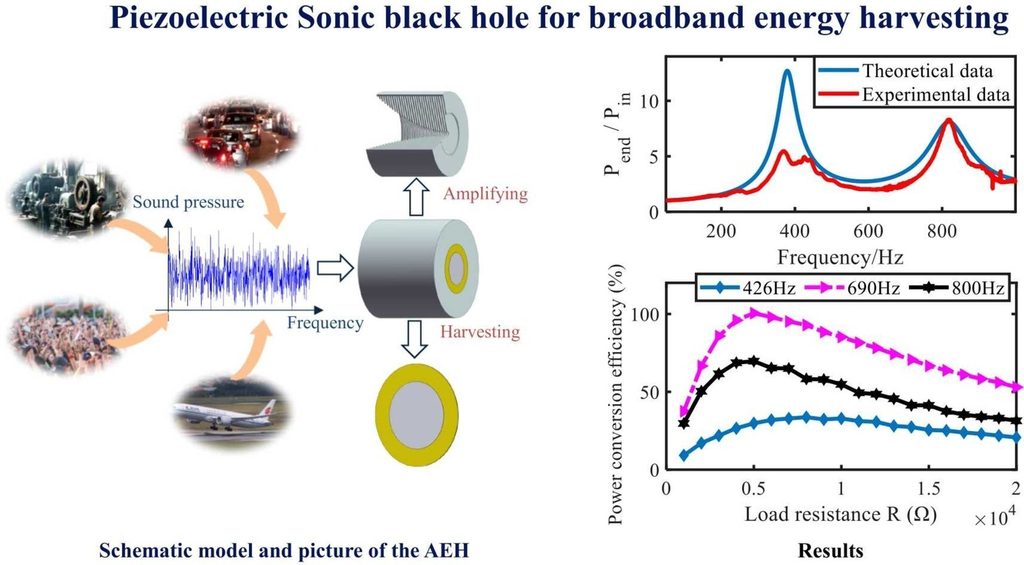
The prototype is 90 mm long and incorporates 30 rings whose inner diameter varies progressively along the duct, ending in a piezoelectric composite sheet. © Peng, Mao, Chen, Hu & Cai, Sensors and Actuators A: Physical, 2026, Elsevier
When sound insulation becomes a generator
In May 2026, a team from Tiangong University published a study in ACS Applied Engineering Materials on a membrane made from PVDF and polysulfone fibres combining piezoelectric and triboelectric effects.
In testing, a five-layer structure reduced the transmitted sound level from 110 to 82.8 dB at 100 Hz, a difference of 27.2 dB. At an excitation level of 115 dB, it delivered up to 449.5 microwatts in its parallel configuration.
These values were measured under high-level experimental excitation. They do not represent the performance of a barrier installed alongside a motorway.
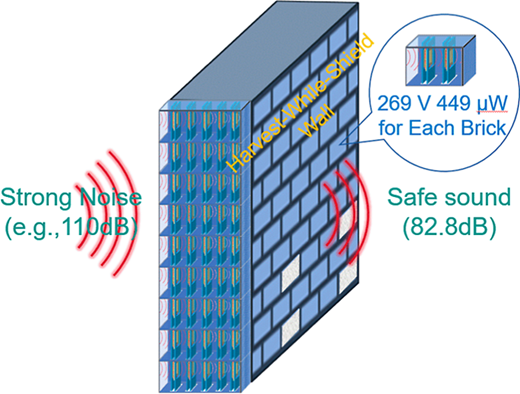
The sound-attenuating surface can simultaneously act as the transducer, harvesting a fraction of that energy.
The active layer of the experimental device covers 12 cm² and is approximately 50 µm thick. The hybrid fibres have an average diameter of 1.02 ± 0.15 µm. © Qiu et al., ACS Applied Engineering Materials, 2026. © 2026 American Chemical Society
Reducing road noise while harvesting its energy
Since July 2026, City University of Hong Kong has been running, under the direction of Wenbin Kang, a project focused on self-powered piezoelectric metamaterial barriers for road traffic noise. Their structure is designed to reduce traffic noise while piezoelectric elements convert a fraction of the vibrations into electricity. The project remains at the research stage, and its institutional page reports no performance data for a full-scale barrier.
At the scale of an individual sensor, a few milliwatts can remove the need for a dedicated power supply, cabling or regular battery replacement.
Across linear infrastructure with numerous monitoring points, the economic case may depend more on avoided maintenance work than on the electricity generated.
This still needs to be demonstrated on full-scale installations over several years and under real-world acoustic profiles.
Industrial vibrations
In industry, energy can be harvested before it becomes airborne sound, directly from the mechanical vibration that generates the noise.
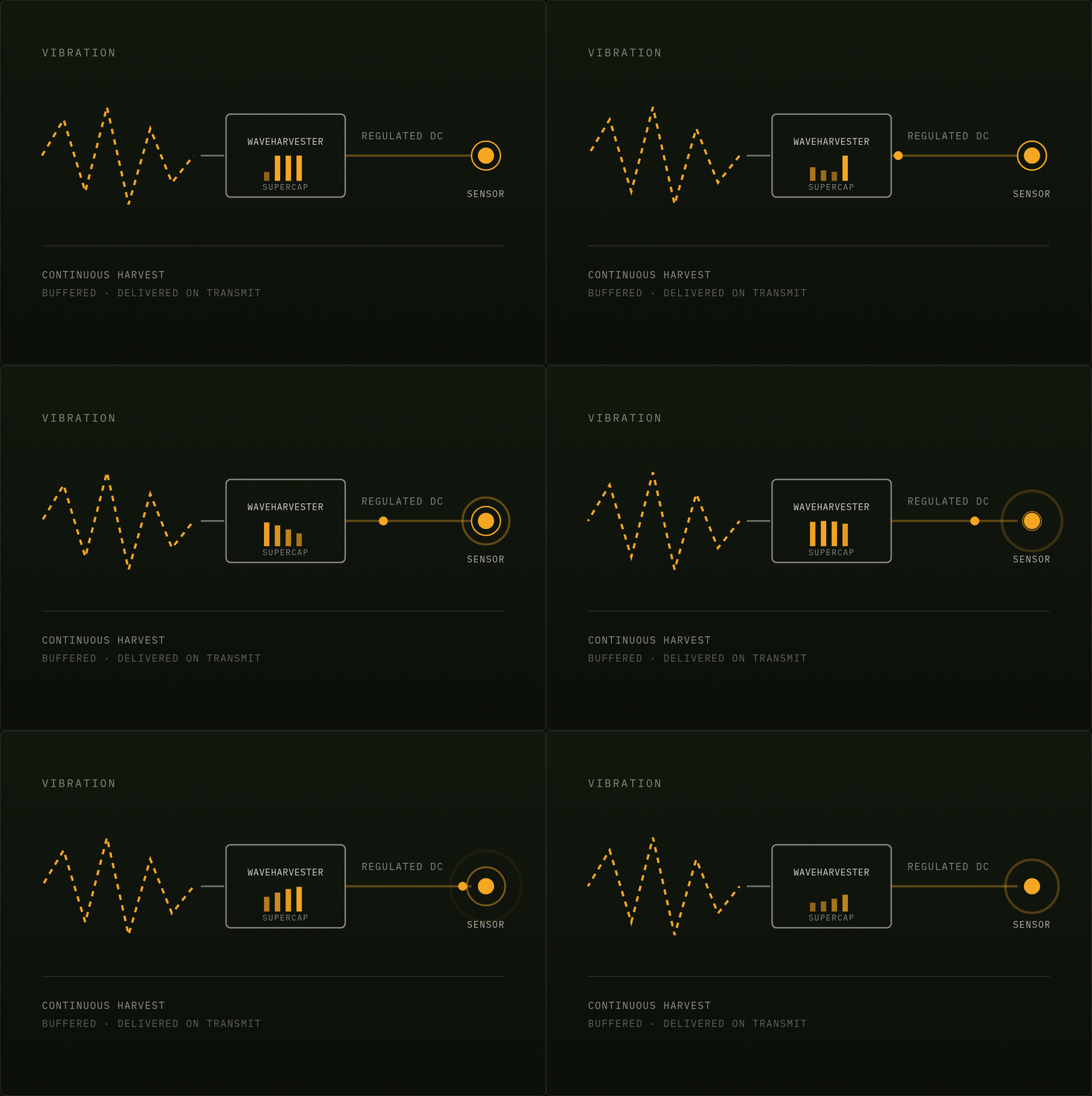
Dutch company LV Energy is developing its WaveHarvester to power sensors from vibrations produced by motors, fans, pumps and compressors. The company reports several industrial pilots in Italy, Vietnam and the Netherlands.
Conversion chain of the WaveHarvester, from captured vibration to regulated energy available to the sensor. © LV Energy B.V., 2026
LV Energy has also tested the conversion of sound itself. In Japan, the company says it has completed a pilot with Koshidaka in which its modules convert acoustic energy from karaoke booths into electricity for integrated systems.

Karaoke Manekineko, Koshidaka, Japan. © Koshidaka Co., Ltd.
Swedish company ReVibe Energy commercialises self-powered sensors that draw energy directly from machine vibration. Its VS1 combines a patented electromagnetic generator with a wireless vibration sensor designed for vibrating screens, feeders and other mechanically vibrating equipment.
ReVibe ANURA™ uses vibrations from screens and other mechanical equipment to power wireless monitoring and detect anomalies that may indicate an impending failure. © ReVibe Energy
Microwatts and autonomous operation
Following its acquisition of Perpetuum, Hitachi Rail integrated vibration energy harvesting into rail asset monitoring. Self-powered sensors use train vibrations to monitor wheels, bearings and bogies.
With intermediate energy storage, a few microwatts or milliwatts can be enough to support the measurement, processing and transmission cycles of low-power electronics.
Maturity will be judged by bandwidth, conversion efficiency under real-world sound levels, material ageing, output stability, device cost and the number of maintenance interventions avoided.