

Part 1 of 4
This article was a natural choice for Think.green, as it resonates so deeply with our editorial focus: Curiosity.
Far from being a mere inclination of the mind, curiosity is here the primary driver of innovation. It is what drives our engineers and startups to look toward the Moon not as a distant celestial body, but as a mirror of our earthly challenges. Focusing on Artemis II means applying this active curiosity to the search for survival solutions in extreme environments—such as those needed for a future lunar base—including the management of scarce resources, comprehensive recycling, and energy self-sufficiency—in order to better adapt them to our own biosphere.
It is through this four-part journey that we rediscover planet Earth. By exploring the lunar unknown, Think.green deciphers the pivotal technologies that are shaping a more sustainable and resilient future here on Earth.
Artemis II: Return from a Historic Mission
The recent success of the Artemis II mission marks a historic milestone for space exploration, confirming the reliability of the technologies to which France and Europe contribute.
A Perfect Splashdown
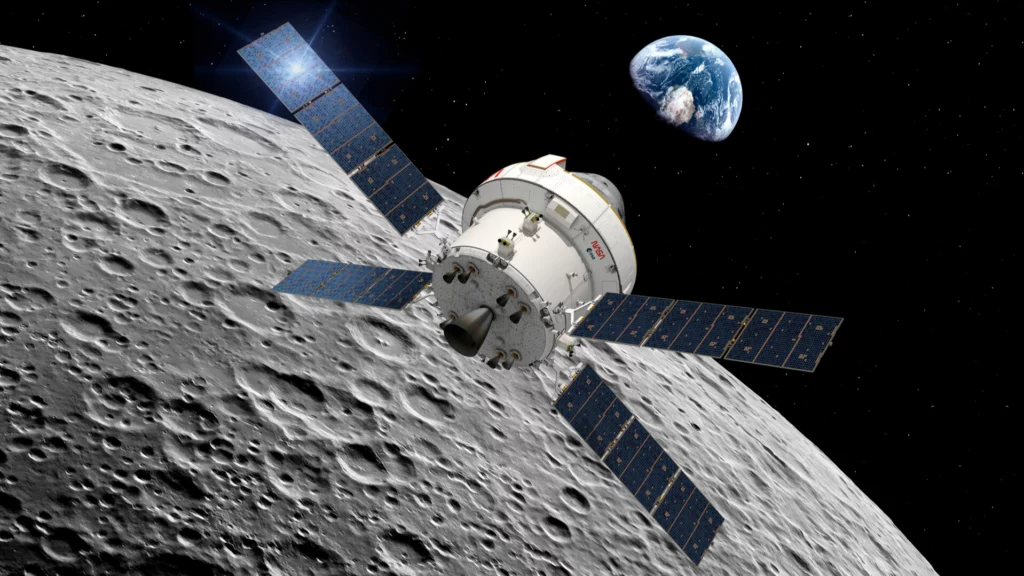
On April 10, 2026, at 5:07 p.m. local time, the Orion Crew Module successfully splashed down in the Pacific Ocean off the coast of California. This return marks the end of a historic ten-day journey around the Moon.
- Safety confirmed: despite a planned six-minute radio blackout during atmospheric reentry, communications were successfully reestablished, confirming the integrity of the heat shield.
- Crew recovery: Commander Reid Wiseman, along with Victor Glover, Christina Koch, and Jeremy Hansen, were winched onto the USS John P. Murtha.
A distance record for humanity
- 2026 record: the crew ventured as far as 406,771 km from Earth, the farthest distance ever reached by human beings.
- Before re-entry, the capsule separated from the European Service Module (ESM). This module, the centerpiece of the spacecraft’s propulsion and the crew’s survival, fulfilled its mission 100%, demonstrating the industrial excellence of the European Space Agency and its French partners.
Artemis II: around the Moon in 10 days © ESA
The cislunar space is reaching a turning point and is becoming a structured area of economic expansion. The Artemis II program is the prime example of this. This international initiative aims to establish a sustainable human presence on the Moon, prepare the future lunar base, and exploit its resources to pave the way for exploration of Mars. Driven by this momentum and the guidelines of the European Space Agency (ESA), France is seeing the emergence of an ecosystem of startups developing sovereign value chains. This article explores how these players are transforming the challenges of extreme exploration into major industrial opportunities for Earth.
“Space has become a domain of global competition. Our ability to act freely there is a prerequisite for our national and European sovereignty.” — Emmanuel Macron, President of the French Republic.
A New Era in Diplomacy
International Coalition
While the National Aeronautics and Space Administration (NASA) serves as the prime contractor, the ESA is the critical partner without whom the mission could not technically take place. Beyond this core partnership, the coalition includes:
- Canada: The Canadian Space Agency (CSA) is providing the Canadarm3, an intelligent robotic system essential to the Gateway space station. This essential contribution secured a seat for the national agency. Astronaut Jeremy Hansen, selected for his expertise and outstanding track record, has been designated to represent the country as part of the Artemis II crew.
- Japan: The Japan Aerospace Exploration Agency (JAXA) is responsible for several components of the Gateway station’s habitat, including the i-Hab. JAXA is developing, in collaboration with Toyota, a revolutionary pressurized rover called the Lunar Cruiser, which will allow astronauts to live and work on the Moon without spacesuits for several days.
- The United Arab Emirates: The Mohammed Bin Rashid Space Centre (MBRSC) is providing the Gateway station’s Airlock transfer module, thereby securing its place in the lunar adventure.
Diplomacy and Law: The Artemis Accords, a Club of 61 Nations by 2026
The Artemis Accords provide a diplomatic framework for the peaceful and sustainable exploration of space. The goal is to harmonize rules regarding the use of resources, debris management, and the protection of historic sites (such as those from the Apollo missions).
By signing the agreement in June 2022, France is able to influence future standards for deep space regulation and the governance of an international lunar base.
- The regulatory and ethical framework: France is advocating for a lunar “traffic code” guaranteeing equitable access to resources and the protection of the historical heritage of exploration.
- Technological soft power: by providing critical components such as MAÅGM seismometers or pressurized habitats, France secures a decision-making role within the international coalition.
“France’s joining the Artemis exploration program marks a new milestone in our space cooperation with the United States,” said Philippe Baptiste, CEO of the National Center for Space Studies (CNES), on the occasion of the signing.
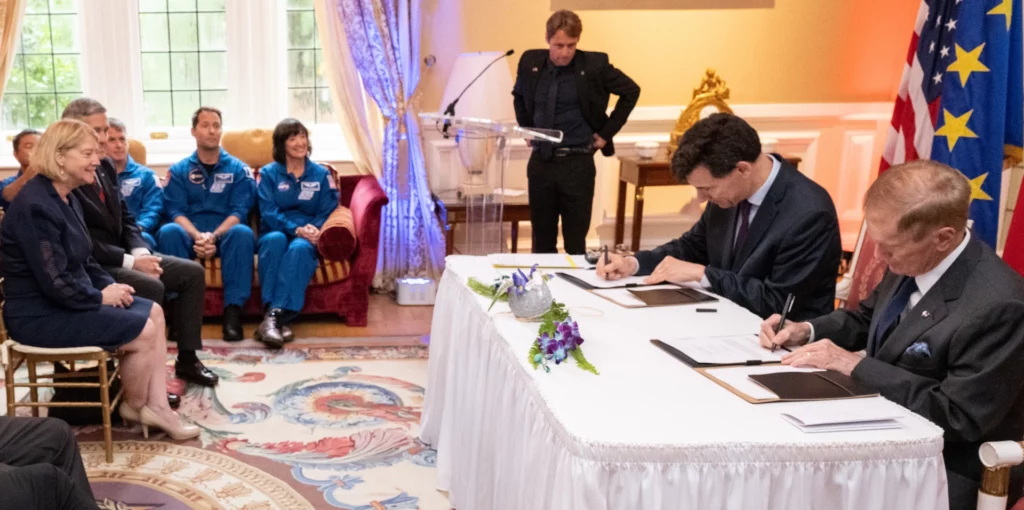
June 2022: CNES CEO Philippe Baptiste and NASA Administrator Bill Nelson (right) sign the Artemis Accords. France officially became the 20th nation to accede to the international cooperation agreement. © Cropped by Cité de l’espace from an original NASA photo by Keegan Barber
Scientific Diplomacy: The IAU Sanctuary
Lunar exploration presents an unprecedented scientific opportunity for astronomy. Under the auspices of the International Astronomical Union (IAU), the international community is working to preserve the far side of the Moon, considered the “quietest” site in the solar system for radio astronomy.
- Radio Protection: France, through the CNES, actively supports the establishment of protected zones to ensure the integrity of future observations.
- Dark Age of the Universe: This project aims to install radio telescopes capable of detecting waves dating back to the origins of the cosmos, which are undetectable from Earth.
- Combating interference: Designating this territory as a sanctuary isolates fundamental research from growing technological interference, ensuring exceptional precision.
Legacy & Continuity: 60 Years of French Presence
France’s expertise in lunar exploration is rooted in a historical legacy spearheaded by Charles de Gaulle, who, by founding the CNES in 1961, affirmed France’s commitment to strategic independence. This ambition was realized by Robert Aubinière, the first director general of CNES and the technical architect of the Diamant rocket, enabling France to become the world’s third-largest space power in 1965.
From laser reflectors for the Soviet Lunakhod missions (still operational for measuring the Earth-Moon distance) to the biological experiments of the Apollo program, France has maintained an uninterrupted scientific presence.
This spirit of exploration continues today with the DORN (radon detection) instrument on the Chang’e 6 mission and the provision of a state-of-the-art seismometer to NASA, thereby consolidating our role as an indispensable partner to the major space powers. Through Artemis II, France is already positioning itself within the value chain of the future lunar base.