

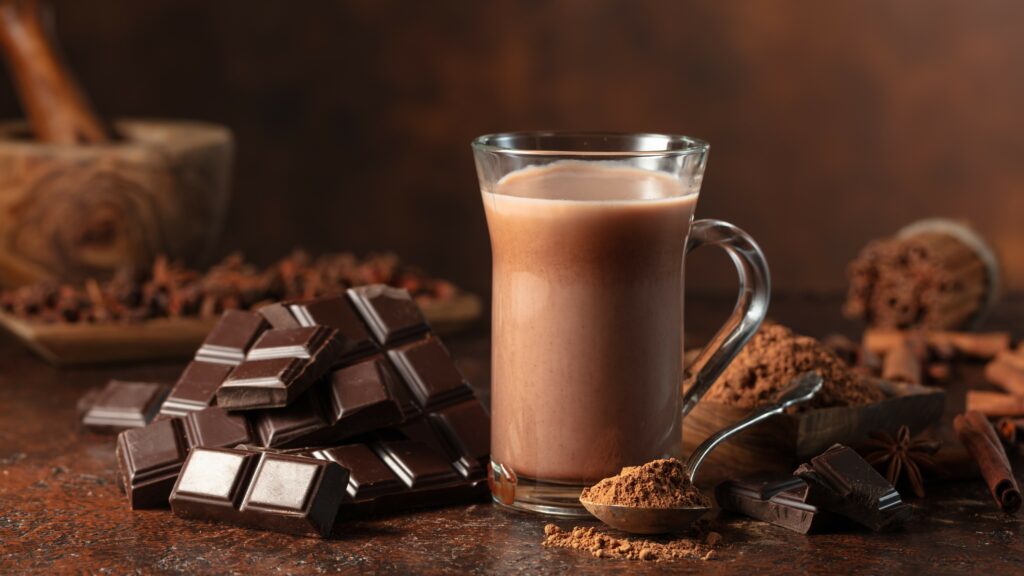
Cocoa ingredients can now be produced in a bioreactor. Cells from Theobroma cacao are isolated, selected and propagated in a liquid medium to generate biomass from which ingredients for chocolate production can be extracted.
Conventional cocoa production depends on the tree, its pods, the harvesting of the beans, fermentation and drying. Plant cell culture produces certain cocoa components directly by propagating the plant cells that synthesise them.
The volumes remain far removed from those of conventional cocoa production. In its August 2026 bulletin, the International Cocoa Organization (ICCO) estimated global production for the 2024/2025 crop year at 4.73 million tonnes, with 4.65 million tonnes of cocoa grindings and a surplus of 37,000 tonnes. The previous crop year had ended with a revised deficit of 489,000 tonnes.
Cultivating the useful biomass rather than the whole tree
Plant cell culture predates the recent pressures on cocoa supply. In 2018, researchers at the Zurich University of Applied Sciences (ZHAW) had already cultivated Theobroma cacao cells in a 20-litre single-use bioreactor.
After sixteen days, around 300 grams of fresh biomass had been harvested, separated from the culture medium and freeze-dried. The material was then used to produce three 70% dark chocolate bars.
Their work, published in Applied Microbiology and Biotechnology, established the biological feasibility of the process, not its industrial viability.
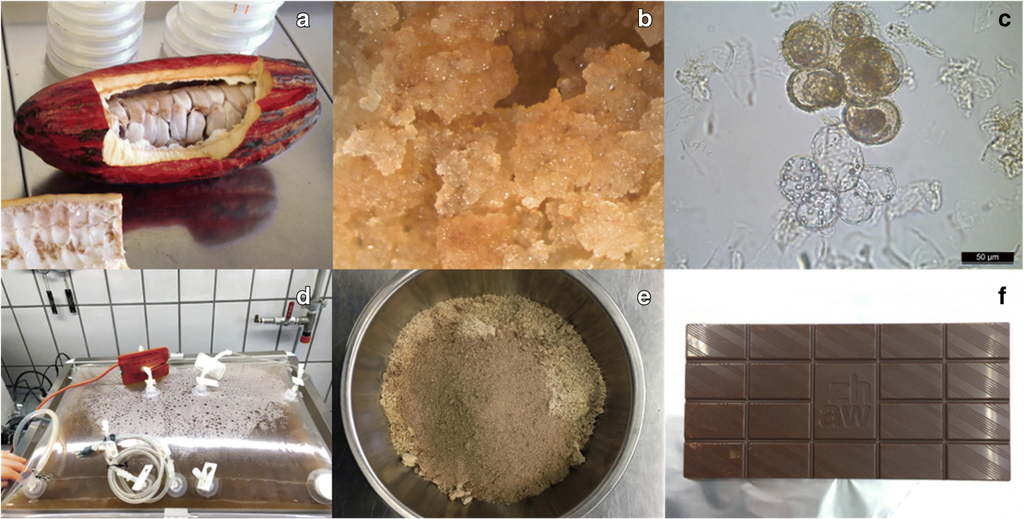
Main stages in the production of chocolate from Theobroma cacao suspension cells.
a – Cocoa pod used to induce seven callus cell lines from the beans.
b – Established callus culture of the ICS-45 clone.
c – Microscopic image of T. cacao suspension cells growing in shake flasks, clone ICS-45.
d – Mass culture of T. cacao suspension cells in a 20-litre Flexsafe bag.
e – T. cacao cells after freeze-drying.
f – Chocolate produced from the cell culture.
© Eibl, Meier, Stutz, Schildberger, Hühn & Eibl, Applied Microbiology and Biotechnology, 2018, CC BY 4.0
From a few cells to cocoa biomass
Cells collected from the plant are first used to establish callus tissue, which is then transferred to a liquid medium. The cells can subsequently be propagated in suspension under controlled conditions.
The culture medium can influence what the cells produce. A study published in Plant Physiology and Biochemistry showed as early as 2017 that culture conditions could alter fatty acid synthesis in cocoa cells. Adding biotin increased fatty acid production without reducing cell growth or viability.
Bioreactor conditions can therefore shape the production of lipid compounds that determine the properties of the resulting material.
Producing cocoa butter and powder separately
Celleste Bio™ cultivates cells from different cocoa varieties to produce cocoa butter and powder. The company reports cultivation cycles of 7 to 10 days.
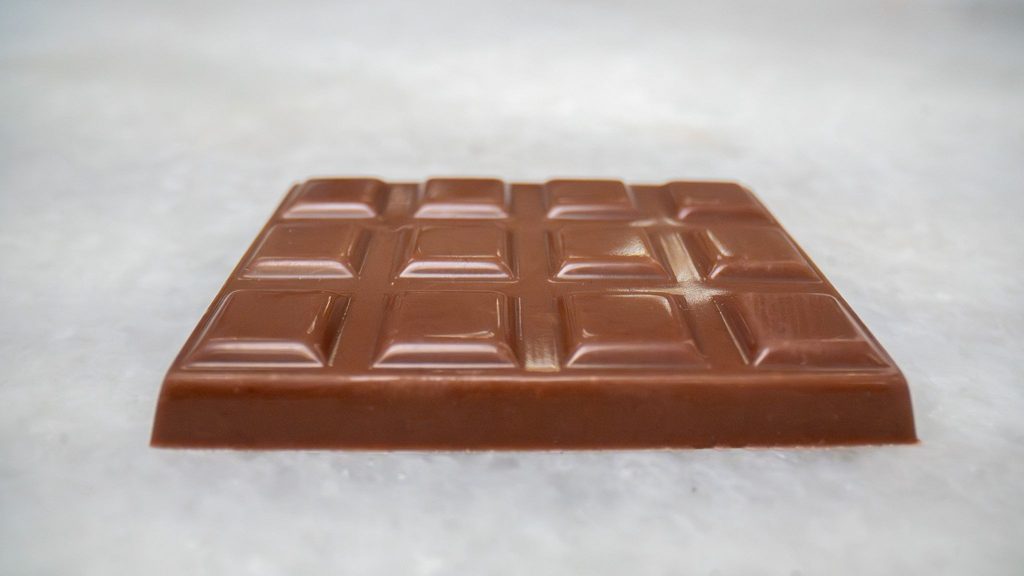
In April 2026, Celleste announced that Mondelēz International had used its cell-cultured cocoa butter to produce nearly a dozen milk chocolate bars. According to Celleste, the products met Mondelēz’s internal product integrity and consumption criteria.
Continuous production depends on maintaining a stable cell line. As early as 2022, Celleste identified the ability to keep cells in culture without repeatedly returning to the plant as one of the process bottlenecks.
© Celleste Bio™
From cell culture to industrial scale
Moving beyond laboratory scale
Swiss company Food Brewer develops cocoa from Theobroma cacao cells.
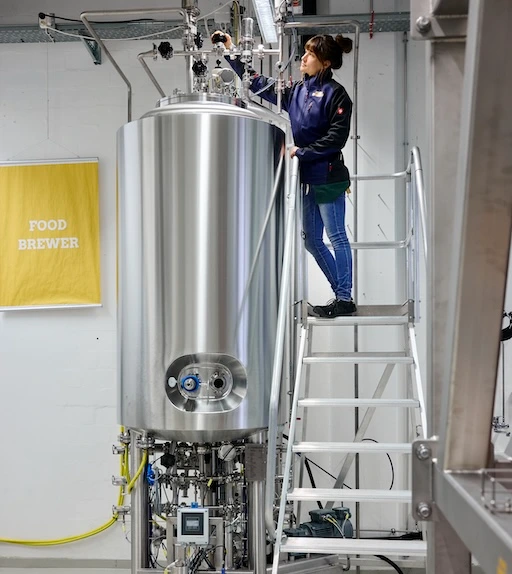
Its pilot facility has a capacity of more than 6,000 litres and is designed to increase culture volumes, transfer the process to larger scales and reduce production costs.
The company already offers samples of cell-cultured cocoa powder and is developing cocoa liquor and cocoa butter. This remains pilot-scale capacity.
Isolated Theobroma cacao cells are propagated in vessels under controlled conditions without depending on plantation growing conditions. © Food Brewer
Testing performance in food formulations
Kokomodo is testing how its ingredients perform in existing formulations. In February 2026, the company began trials with Cargill, through a programme co-funded by EIT Food, across beverages, dairy products and confectionery. The trials assess the ingredients’ functional and sensory properties and their behaviour in Cargill formulations.
Kokomodo received the Gold Award de MassChallenge Switzerland in 2025. In 2026, the company presented and offered tastings of its cocoa formulations at Future Food Tech San Francisco.
Funding the next stage of scale-up
GALY estimates that its process reduces overall resource use by 80%, based on a calculation covering land, water, energy and emissions. The company also reports pesticide-free production and traceability from cell to finished product.
In April 2026, the Massachusetts Technology Collaborative, through the Massachusetts Manufacturing Innovation Initiative (M2I2), authorised up to €654,000 in public funding to support the scale-up of GALY’s cell-cultured cocoa using low-cost modular bioreactors.
A few weeks later, GALY’s Biocrafted Cocoa & Cotton platform received the 2026 Silver Edison Award in the Consumer Food Innovations category.
© GALY
At 10,000 litres, the bottleneck remains the process
The European COCO AI programme, coordinated by Fraunhofer IME and launched on 1 May 2026, has a total budget of €6.3 million. The consortium brings together nine partners, including Fraunhofer, Wageningen University, the Centre for Process Innovation, Université Laval, Kokomodo and Celleste Bio.
Accelerating cell and culture-medium selection
The programme aims to identify the cellular characteristics that facilitate the transition from callus to suspension culture, accelerate the selection of culture media and growth conditions, and scale cultures up to 10,000-litre bioreactors.
COCO AI plans to develop six ingredient formulations and two prototype chocolate bars. Artificial intelligence will be used to analyse biological data and culture parameters, reducing the number of experiments required to optimise cell lines.
A 10,000-litre scale remains a research target for the project, not a demonstrated production capacity.
Making cell-cultured cocoa cost-competitive
Rapid cell propagation does not in itself make the resulting material economically competitive.Une cellule peut se multiplier rapidement sans que le kilogramme obtenu soit compétitif.
Culture media, sterile equipment, biomass recovery, extraction, energy use, batch reproducibility and volumetric productivity all determine the real cost of the process. Food Brewer lists price competitiveness among the objectives of its pilot facility. COCO AI is devoting four years to process development.
Increasing volume must be achieved without compromising cell growth, biomass composition, batch stability or production costs.
Securing authorisation for food use
In March 2026, researchers at Wageningen University & Research published an article in Trends in Biotechnology examining foods derived from plant cell cultures. They described cocoa, coffee and other products as approaching commercialisation while calling for case-by-case pre-market safety assessments.
In the European Union, the Novel Food Regulation explicitly includes foods derived from plant cell or tissue cultures. A food product based on cultured apple cells received a specific EU authorisation in 2023.
Entering an industry measured in millions of tonnes
Du laboratoire aux grandes scènes du cacao
The World Cocoa Conference, established by the ICCO, is the sector’s principal global forum. Its most recent edition, held in Brussels in 2024, brought together more than 1,000 participants from 75 countries, spanning producers, governments, traders, processors, brands, retailers and financial institutions.
The Salon du Chocolat de Paris is presented as “the world’s largest event dedicated to chocolate, cocoa and pastry”. The 2026 edition is scheduled to take place from 28 October to 1 November at Paris Expo Porte de Versailles. Some 96,000 visitors are expected over five days, alongside more than 500 professionals and contributors from 28 countries.
Five days of indulgence, creativity and emotion. © Salon du Chocolat
The next test is commercialisationLa commercialisation devient le prochain seuil
In February 2026, Puratos announced that it was developing a professional chocolate product with California Cultured containing cultivated cocoa. The group plans to make it available to US customers towards the end of 2026.
In 2026, no documented cell-culture capacity comes close to the millions of tonnes produced by conventional agriculture.
For certain ingredients derived from Theobroma cacao, however, the cocoa bean is no longer the only route to production. From an initial biological sample, a cell line can be maintained and propagated outside the plantation.
Plant cell culture changes the role of the natural resource itself: the plant becomes a biological source from which the desired material can be reproduced.