

On 8 October, World Octopus Day highlighted an animal whose anatomy is increasingly influencing robotics: eight arms with no rigid skeleton, hundreds of sensory suckers, and around two-thirds of its approximately 500 million neurons located outside the central brain.
An industrial robotic arm concentrates movement within a series of joints connected to motors, transmissions, sensors and control systems. The octopus arm distributes bending, twisting, extension, adhesion and sensing across a continuous structure.
From the octopus to the continuous robotic body
As early as 2009, the European OCTOPUS programme, coordinated by the Scuola Superiore Sant’Anna, sought to reproduce the octopus’s sensorimotor capabilities in an eight-armed robot. Soft actuators, distributed tactile sensors, variable-stiffness materials and decentralised control formed the project’s main technological building blocks, supported by €7.6 million in European Union funding.
This research continued with CFD-OctoProp, carried out between 2011 and 2014. The project focused on cephalopod-inspired pulsed propulsion: a soft envelope contracts and expels water through a nozzle, based on the mechanical action of the octopus mantle.
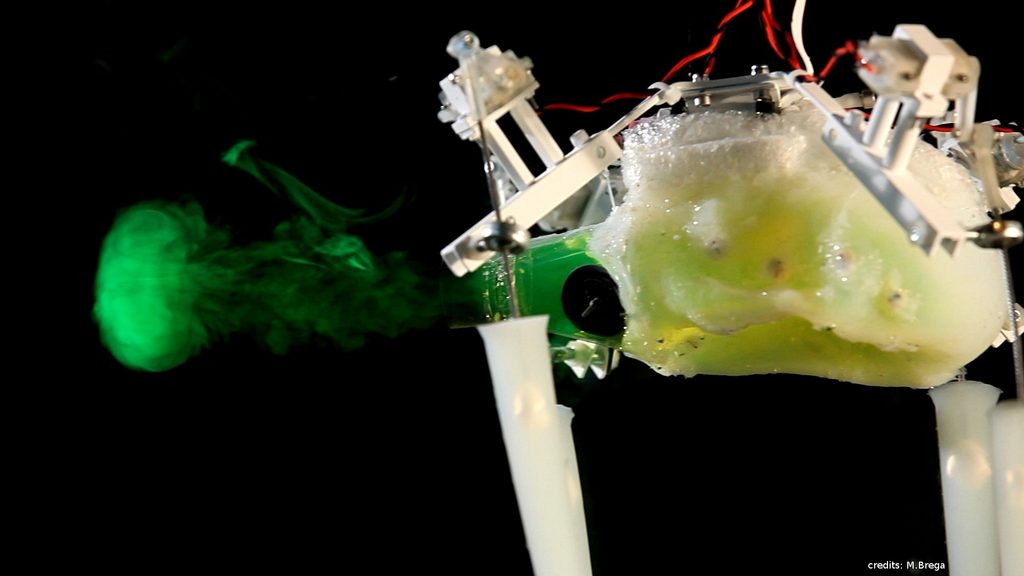
PoseiDRONE illustrates the transition from the deformable cephalopod body to an underwater robotic architecture in which the structure itself contributes directly to locomotion. © CORDIS / CFD-OctoProp.
Distributing movement throughout the structure
In May 2026, a team from the Istituto Italiano di Tecnologia published a 410 mm soft arm in Nature Machine Intelligence. The conical arm is driven by three tendons and equipped with ten artificial suction cups. Pulling a tendon deforms several regions simultaneously, while pneumatic lines and embedded components contribute to the arm’s variable stiffness.
The ten suction cups are grouped into four pneumatic circuits to reduce the number of tubes running through the structure. The prototype therefore distributes both actuation and sensing along a single deformable body.
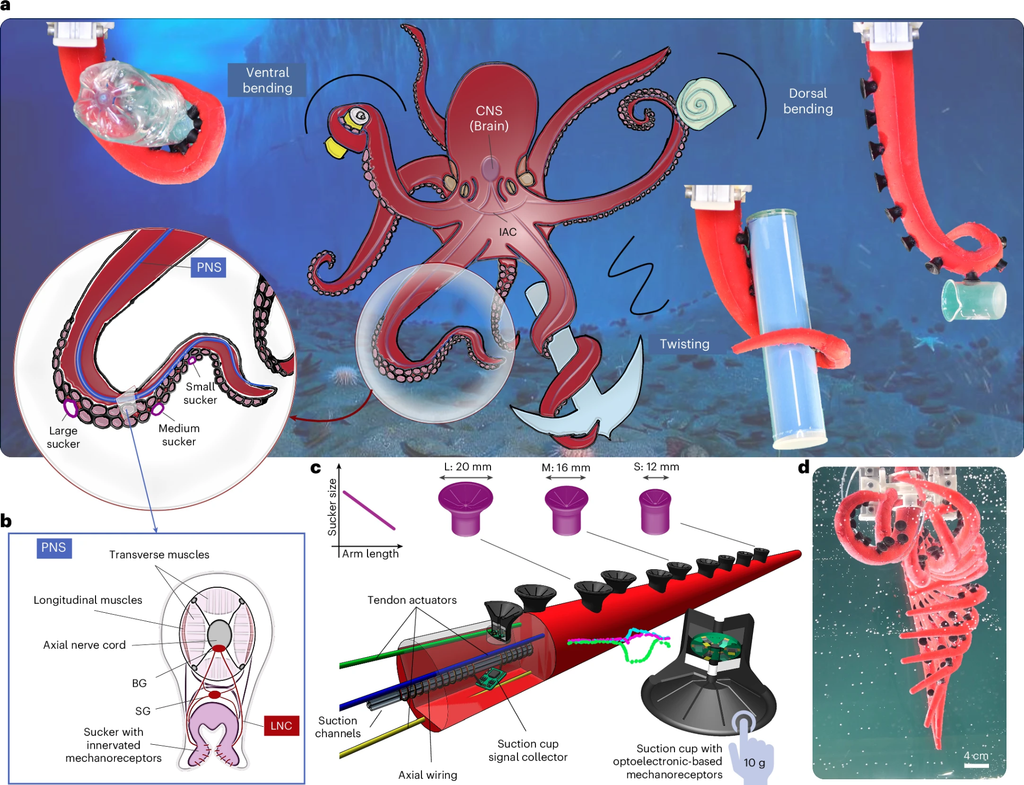
The biological model and its robotic counterpart reveal the same distributed organisation: sensing along the arm, peripheral processing and central coordination. © Nature Machine Intelligence.
A study published in Cyborg and Bionic Systems in March 2026 adds variable stiffness to this architecture. Its underwater gripper has six arms containing shape-memory polymers. The material softens to conform to an object, then stiffens to maintain the grip.
The surrounding water contributes to the cooling required for this change of state. In some experimental configurations, stiffening more than doubled the gripping force.
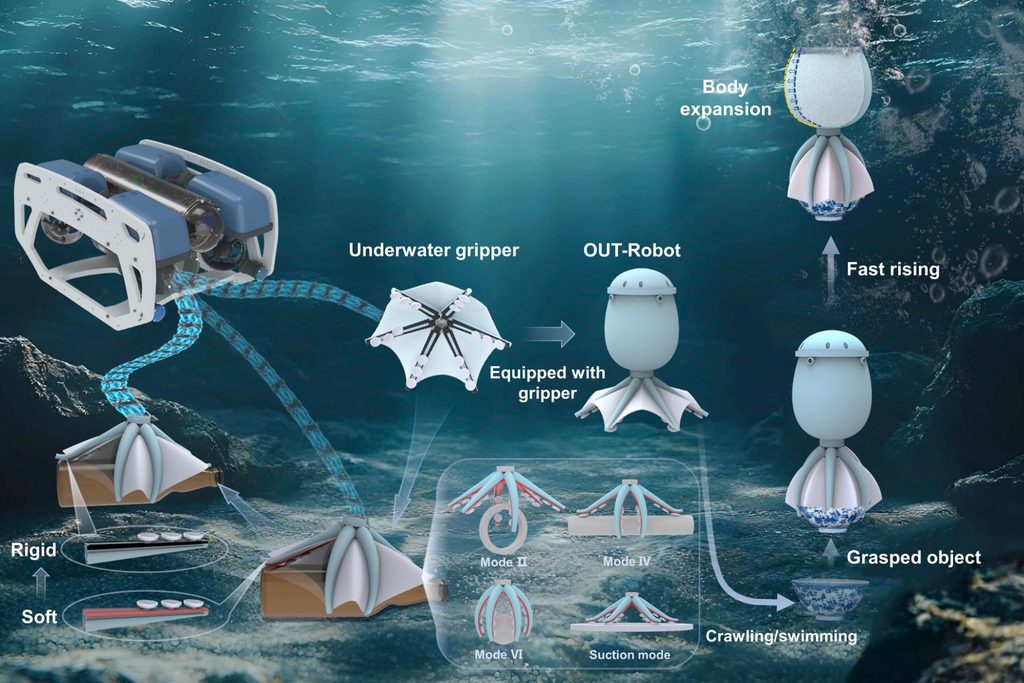
The gripper is integrated into an underwater robot capable of jet propulsion, arm-based locomotion and buoyancy adjustment throughout the grasping cycle. © Cyborg and Bionic Systems.
SpiRobs brings octopus-inspired spiral geometry into robotics
At the University of Science and Technology of China, Zhanchi Wang, within Professor Nikolaos M. Freris’s team and alongside researcher Xi Wei, developed SpiRobs, a family of soft robots described in Device. Their geometry reproduces the logarithmic spiral found in several animal appendages, including octopus arms, while their grasping strategy draws on the progressive wrapping motion of an octopus arm around an object.
The structure is 3D-printed and actuated by two or three cables. In published tests, a 38.4 g SpiRob carried a 10 kg load, approximately 260 times its own weight, and grasped objects spanning more than two orders of magnitude in size.
The researchers adapted the same principle into a miniature gripper, a one-metre manipulator mounted beneath a drone, and arrays of multiple SpiRobs capable of wrapping around objects.
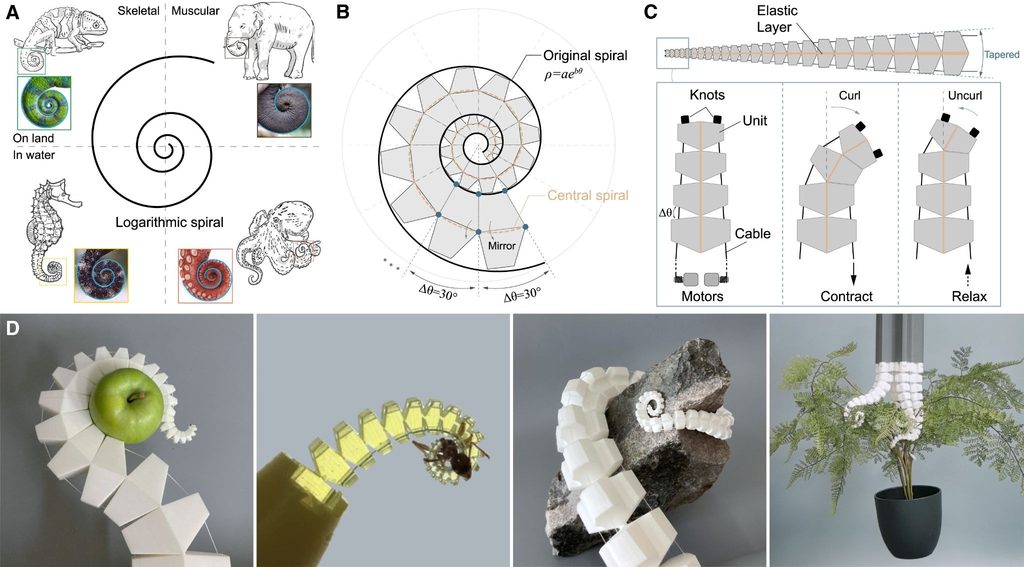
From a miniature gripper to a drone-mounted manipulator, SpiRobs retains the same grasping principle across different scales. © Zhanchi Wang.
Festo brings the tentacle into automation
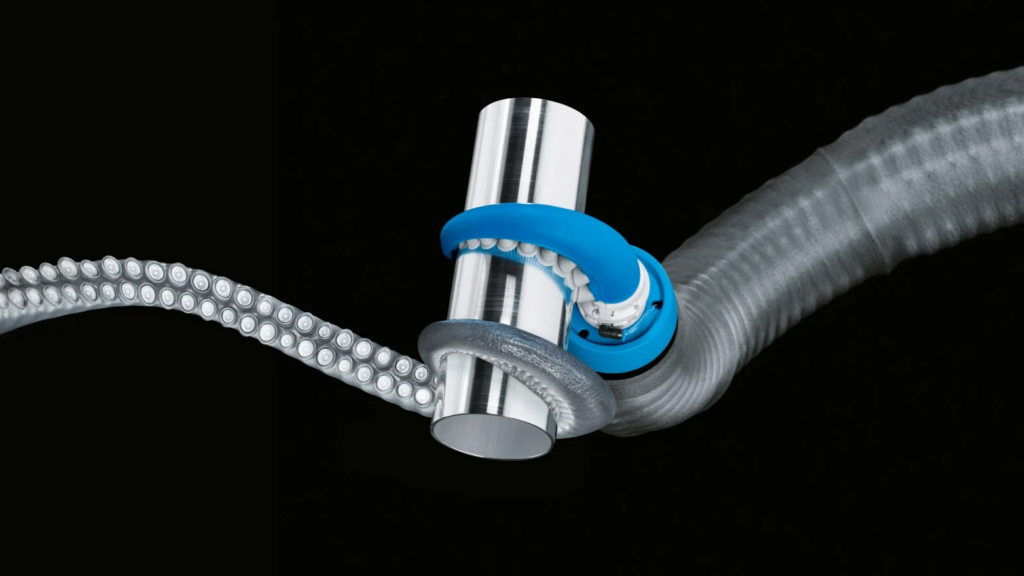
German industrial company Festo developed its TentacleGripper inspired directly by the octopus tentacle. A pneumatic silicone structure curves around the object. Two rows of suction cups complete the grip: smaller cups operate passively, while larger ones can be activated under vacuum.
Developed within Festo’s Bionic Learning Network, the demonstrator grasps objects with different geometries, including delicate objects, through the combination of arm deformation and distributed adhesion across its surface.
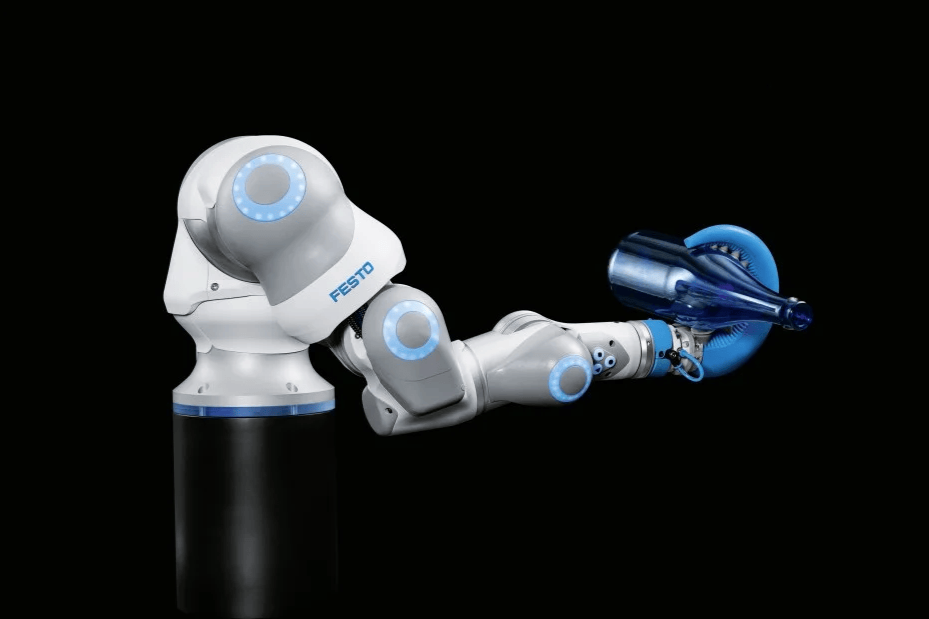
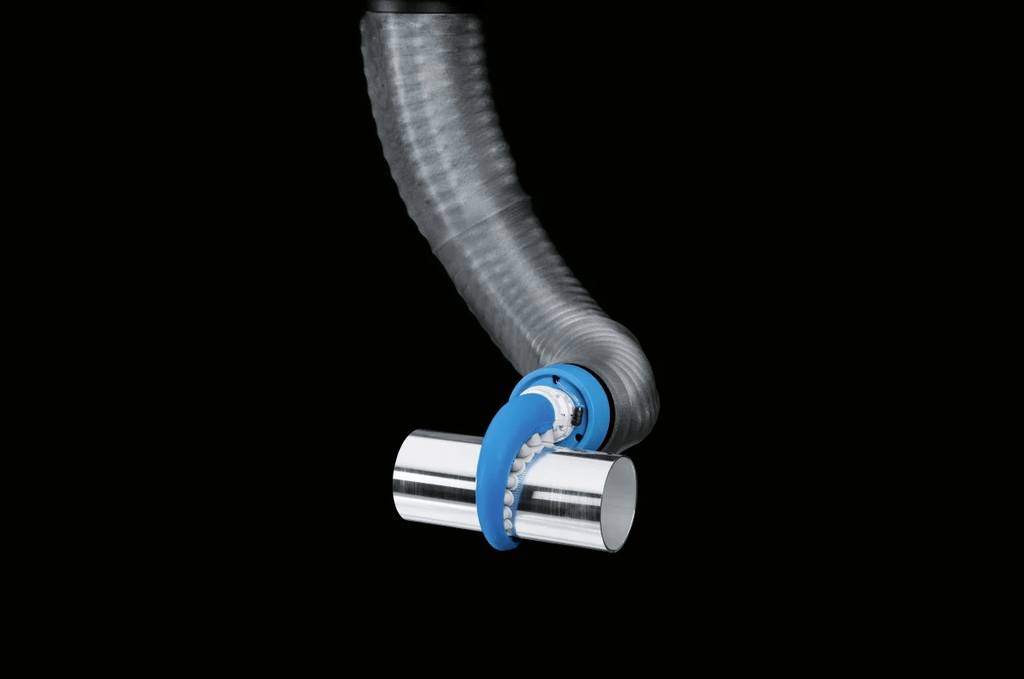
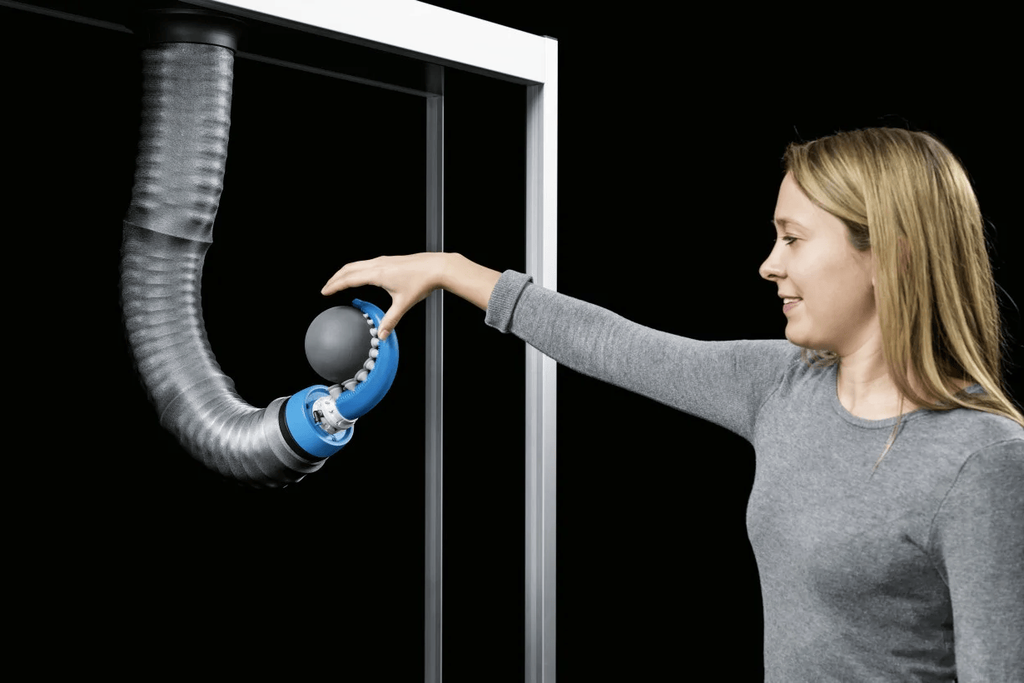
The TentacleGripper handling objects of different shapes. © Festo.
The suction cup becomes a sensor at the point of contact
Adhere, sense and trigger the grasp
Each suction cup on the Italian prototype contains three LEDs and three phototransistors embedded in silicone. Pressure changes its internal geometry and the amount of light received.
Each suction cup on the Italian prototype contains three LEDs and three phototransistors embedded in silicone. Pressure changes its internal geometry and the amount of light received.
The tactile information feeds the underwater control system without external visual guidance. Suction can be triggered locally upon contact, while signals transmitted to the peripheral controller determine tendon actuation.
The Bristol Robotics Laboratory takes this integration further by embedding sensing into the fluidic network itself. A study published by the University of Bristol in May 2025 uses the circulation of air or water through the same network to provide adhesion, detect the environment and control certain robotic responses.
Pressure variations allow the system to distinguish different contacts, identify certain surface properties and estimate the traction applied to the suction cup. Part of the mechanical response is therefore generated locally by the fluidic network.
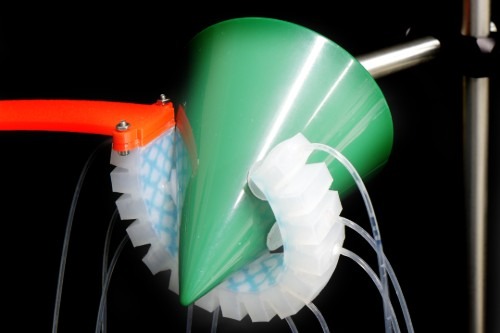
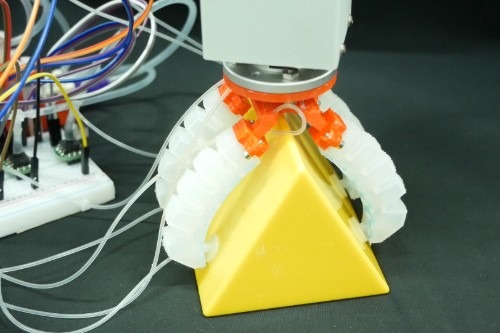
Grasping relies on a network of suction cups whose pressure directly provides the information needed to adapt contact with the object. © Tianqi Yue / University of Bristol.
In September 2026, a study published in the Chemical Engineering Journal integrated conductive sensors directly into an octopus-inspired suction cup. Their deformation makes it possible to monitor the state of the grip and automatically adjust the vacuum. The authors report more than 2,300 cycles in testing and a response time of 571 ms.
MIMETICS brings micro-suction to the skin

South Korean startup MIMETICS uses the internal microstructure of octopus suction cups for skin adhesion and transdermal delivery. Its Micro Vacuum platform reproduces three-dimensional structures capable of generating localised negative pressure without a conventional adhesive layer.
The technology builds on research conducted at Sungkyunkwan University, where Professor Changhyun Pang’s team published an adhesive patch in Nature in 2017 inspired by the internal protrusions of octopus suction cups. Hyoungki Park, now CEO of MIMETICS, later contributed to research applying these micro-suction architectures to transdermal delivery.
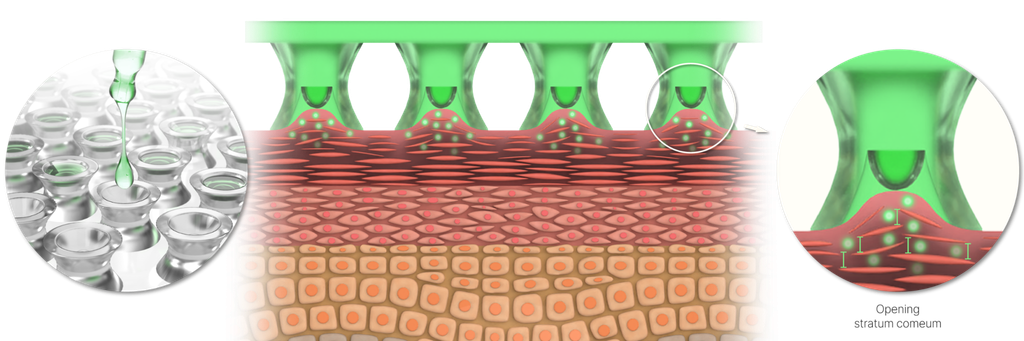
In January 2026, MIMETICS and Sungkyunkwan University presented a dual-layer patch based on this architecture. The company is involved in evaluating applications and commercialisation. It states that it has completed four university technology transfers and filed more than 30 patents in South Korea and internationally. It also presented its platform at VivaTech 2026 in Paris.
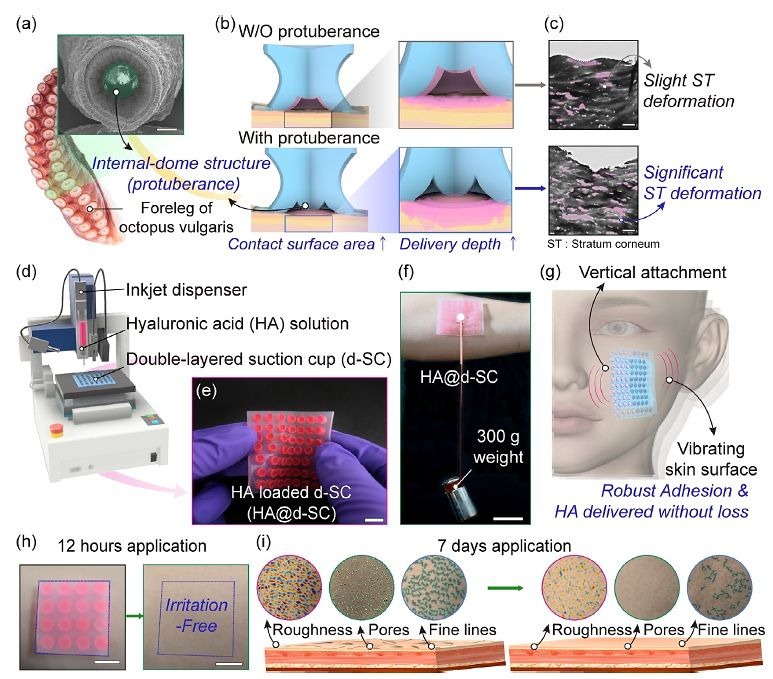
In reported tests, the patch supported a vertical load of 300 g and maintained adhesion under vibrations reaching 3G. © MIMETICS.
From changing skin to reconfigurable surfaces
Stanford programmes colour and texture into a single film
Octopus skin can modify both its appearance and its topography. Muscular papillae create or remove surface structures across different parts of the body.
In January 2026, a team at Stanford University published flexible polymer films in Nature explicitly inspired by the dynamic modulation of cephalopod skin.
The conductive polymer expands or contracts differently depending on the dose of electron irradiation received. Localised exposure encodes the film’s future topography, later revealed through chemical or electrochemical stimulation.
The researchers also integrated the polymer into Fabry-Pérot optical cavities. As its thickness changes, so do the reflected wavelengths. A multilayer architecture allows the modification of surface relief and optical response to be partially decoupled.
The Stanford Office of Technology Licensing offers the technology for licensing and references patent application WO2025137278.
Electron-beam programming, response speed, durability over large numbers of cycles and large-area manufacturing remain to be demonstrated at industrial scale.
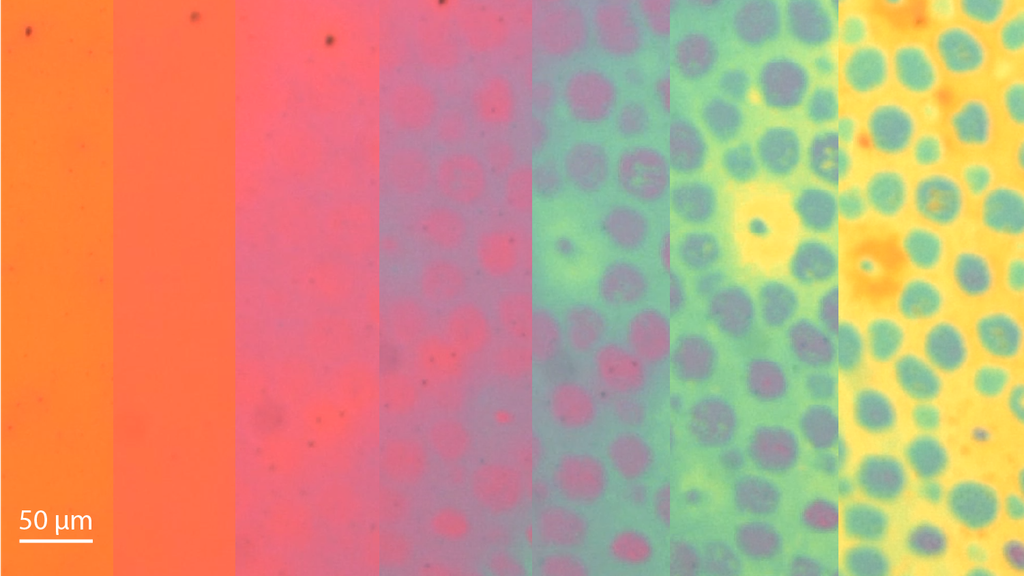
At Stanford, an octopus-inspired material changes colour and texture. Here, the evolution of colour patterns in a sample of flexible photonic skin. © Siddharth Doshi / Stanford University.
morph turns adaptability into robotic cells
London-based company morph, founded in 2024, unveiled a platform of soft robotic cells in June 2026 that, according to the company, can sense their environment and change their shape and stiffness. morph explicitly cites octopus adaptability as an inspiration.
These cells combine deformable materials, physics simulation and reinforcement learning. The company initially targets applications related to human movement, injury prevention and mobility assistance.
No large-scale commercial production is documented in the sources consulted.
Morph launches a platform of soft robotic cells capable of changing shape to adapt their behaviour to different physical applications. © Morph.
Manufacturing a body that performs multiple functions
The suction cups developed by the Istituto Italiano di Tecnologia were subjected to 20,000 indentation cycles, while the arm underwent 10,000 actuation cycles in published tests. These measurements demonstrate the prototype’s repeatability under experimental conditions, without establishing an industrial service life.
Integrating movement, sensing or adhesion into a soft structure requires simultaneous control of elasticity, fatigue, electrical connections, fluidic lines, sealing and moulding reproducibility. A deformation that enables movement can disrupt a sensor, line or connection embedded within the same material.
In the octopus, the structure itself contributes directly to movement, touch and adaptation. The industrial challenge is now to preserve these functions when they must be manufactured at scale, reproduced consistently and maintained within the material itself.