



An egg seems almost elemental: a shell, a white, a yolk.
At industrial scale, that apparent simplicity conceals a remarkably complex functional system. Eggs foam, emulsify, bind, gel, coagulate and provide structure. These properties explain their presence in products as varied as meringues, mayonnaise, pastries and pasta.
According to the latest agricultural production statistics published by the FAO, global egg production reached 100 million tonnes in 2024, 94% of which came from hens.

In Bhutan, the FAO-supported “One Child, One Egg” initiative now provides eggs to 32,000 pupils across 343 schools, while creating a reliable market for small local producers.
In Bhutan, nearly one in five children under five is affected by stunting, around 9% are underweight and more than one-third of adolescent girls are affected by anaemia.
© FAO / Choki Wangmo
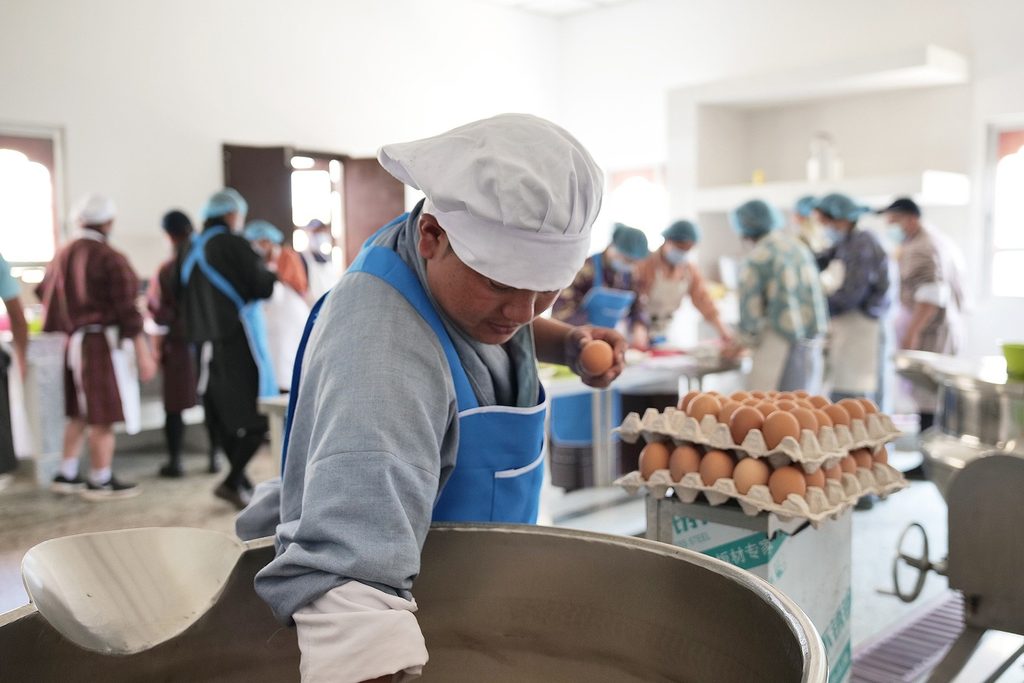
Bhutan’s “One Child, One Egg” programme also supports 280 cooks across 20 districts, with training in recipes and good food safety practices.
© FAO / Sonam Phuntsho
Elsewhere, at another moment in the calendar: on 9 October 2026, the egg will celebrate the 30th anniversary of World Egg Day, established in Vienna in 1996 and celebrated on the second Friday of October each year. This anniversary edition, themed “Protein that Powers and Protects”, highlights the egg’s complete proteins, which provide all nine essential amino acids, and their contribution to nutrition throughout life.
Eggwin, the World Egg Organisation’s mascot, brings a smile to World Egg Day celebrations around the world. © World Egg Organisation

Cultural, culinary and industrial, the egg is also becoming a subject of biological engineering.
Precision fermentation makes it possible to produce some of its proteins using microorganisms and incorporate them into targeted food formulations.
Its industrial value can therefore be understood through the properties and performance those proteins are able to deliver.
The egg as a functional system
From shell calcite to egg white proteins
A porous mineral shell, shell membranes, the protein matrix of the white and the lipoprotein-rich phase of the yolk: each compartment contributes to the egg’s physical and functional architecture.
The shell alone is a complex biomaterial. Around 0.3 mm thick, it can withstand a static load of several kilograms while being formed in less than twenty hours.
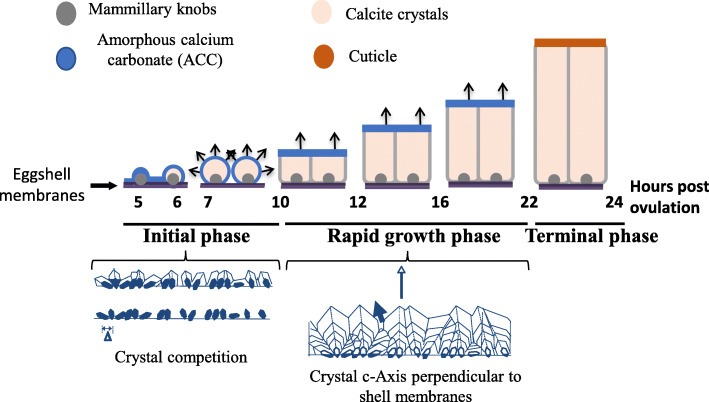
In less than twenty hours, the shell develops from a deposit of amorphous calcium carbonate into an architecture of oriented calcite crystals, before the final cuticle is deposited. © Hincke et al., 2021
Research brought together in this review of eggshell structure and formation shows that its strength derives from an architecture composed primarily of calcium carbonate and an organic matrix that helps organise crystal growth.
The same body of research identified more than 900 proteins during shell formation, revealing the complexity of the biomineralisation process.
The shell is also crossed by several thousand pores. A recent study of eggshell porosity estimates their number at around 6,000 to 10,000, enabling the exchange of gases and water vapour with the surrounding environment.
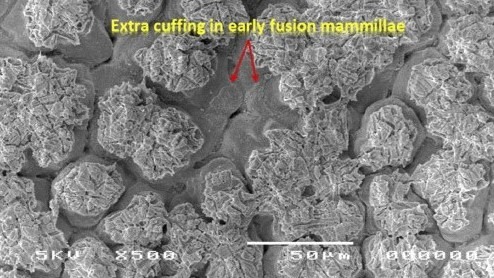
Even at the level of its shell, the egg combines mechanical strength, protection and gas exchange.
At the microscopic scale, the shell reveals an architecture of mineral columns undergoing late fusion, with persistent clefts between adjacent columns. © Poultry Science, 2025.
Egg white contains several proteins of technological interest. Ovalbumin accounts for around 54% of egg white protein and contributes to foaming, gelation and emulsification, as detailed in this scientific review of its functional properties.
These properties arise from specific physicochemical phenomena: thermal denaturation, interactions with water, adsorption at interfaces, protein network formation and phase stabilisation.
For formulators, ingredient composition and ingredient behaviour are inseparable.
Precision fermentation takes that same logic down to the molecular level.
Producing egg functionality through fermentation
Ovalbumin as a biotechnology target
Precision fermentation uses microorganisms as expression systems to produce defined molecules. Yeasts, bacteria and fungi can be selected and engineered according to the target protein.
The FAO is now devoting specific work to precision-fermentation products and their regulatory frameworks internationally, reflecting the growing attention being paid to these processes in food and health policy.
For ovalbumin, Trichoderma reesei is one of the hosts under investigation. The fungus can be engineered to express the protein, which is then recovered following fermentation through separation and downstream processing.
This is the technology on which Onego Bio was built. Spun out of the VTT Technical Research Centre of Finland in 2022, the company develops Bioalbumen®, an ovalbumin produced through precision fermentation using T. reesei.

Bioalbumen®, Onego Bio’s precision-fermented ovalbumin. © Onego Bio
Within the European Bioalbumen, coordinated by Onego Bio and supported by almost €2.5 million in EU funding, the technology is being developed as an industrial route to ovalbumin production using Trichoderma reesei.
Its transition from molecule to food ingredient is also documented. In September 2025, the FDA responded to GRAS Notice 1249 with a “no questions” letter for Onego Bio’s ovalbumin. The notified uses include bakery products, sauces, pasta, confectionery and egg analogues, with functions including foaming, gelation and binding.
The protein retains its biological identity and the associated allergenic implications, irrespective of its production route.
From molecule to industrial value chain
Industrialising the process
Expressing a protein is the first step. Its economics at scale depend on the titre achieved, strain productivity, fermentation time, inputs, equipment and downstream recovery.
In a VTT study published in Food Research International, researchers achieved an ovalbumin titre of 2 g/L using T. reesei in 2023. They also observed foaming and gelling properties, alongside differences in performance compared with hen-derived ovalbumin.
The 20 g/L titre reported by the Bioalbumen project in 2026 illustrates the optimisation work carried out on both the strain and the process. Differences in experimental protocols mean that the 2023 and 2026 results should be interpreted separately.
Scale-up also brings specialised bioprocess engineering players into the value chain. 21st.BIO provides the technological infrastructure required to move from laboratory development to production, from strain optimisation through process piloting, scale-up and downstream operations.
The value chain is becoming increasingly specialised, spanning molecule development, strain engineering, fermentation, downstream processing and formulation.
EVERY commercialises OvoPro™, a fermentation-derived ovalbumin designed for applications requiring binding, gelation, whipping and foaming.
In June 2026, EVERY and Huvepharma announced a fourfold increase in production capacity, using Biovet’s infrastructure in Bulgaria.

In Bulgaria, Biovet’s fermentation infrastructure, part of Huvepharma, is supporting EVERY’s scale-up. The partnership announced in June 2026 increases production capacity for OvoPro™, its precision-fermented ovalbumin, fourfold. © EVERY / Huvepharma
A 2026 review in the Annual Review of Food Science and Technology highlights the contribution of recovery and purification to the final cost of proteins produced through fermentation.
Processes inherited from the pharmaceutical industry, particularly certain chromatographic steps, can be difficult to reconcile with the economics of high-volume food proteins. The authors therefore advocate optimising for required functionality rather than maximum purity.
From molecule to formulation
Protein sequence is one dimension of technological performance. Production history and molecular environment are equally important determinants of how the protein behaves.
The microbial host, glycosylation, post-translational modifications, partial degradation and residual compounds can all influence ingredient performance.
The VTT study of ovalbumin produced using Trichoderma reesei illustrates this clearly. The protein showed good foaming properties and formed heat-induced gels. These gels were weaker than those formed by the hen-derived ovalbumin used as a control, a difference the researchers associated in part with partial degradation and the presence of other host proteins.
Equivalence is therefore characterised both by molecular sequence and by the way the protein performs within a food matrix under thermal, mechanical and physicochemical stresses.
A meringue requires whipping capacity and foam stability. A sauce relies on interfacial properties. Pastry combines structure, heat, moisture and interactions with other ingredients.
The finished product becomes the real proving ground.
This is where DeepTech development meets the realities of food manufacturing.
In March 2026, Onego Bio and Sigma Foods announced a collaboration covering feasibility studies, prototyping and trials of Bioalbumen® in market-relevant food formulations.
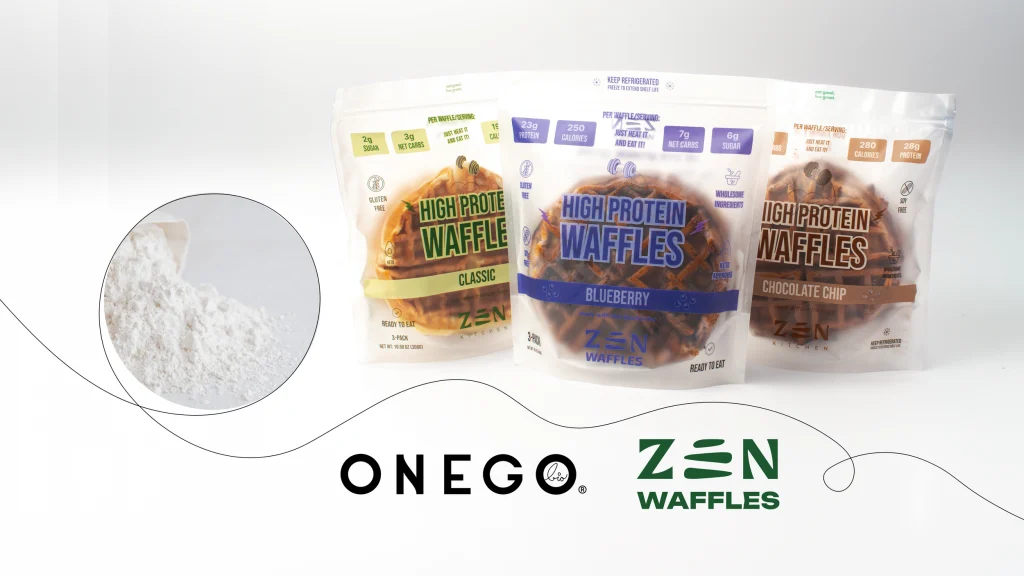
On 9 September 2026, Onego Bio also entered into a commercial partnership with Zen Waffles to incorporate Bioalbumen® into its products.
Onego Bio × Sigma Foods: Bioalbumen® enters the prototyping and application testing phase. © Onego Bio / Sigma Foods
Onego Bio × Zen Waffles: Bioalbumen® moves into commercial application in high-protein waffles. © Onego Bio / Zen Waffles
These early commercial integrations extend the value chain into prototyping, formulation and commercialisation.
Strain engineering, fermentation, recovery, formulation and market access are becoming distinct industrial disciplines.
Towards a library of food functionalities
When origin and function decouple
The egg naturally brings together numerous proteins within a single biological system. Industry can now consider some of them independently, according to the performance required in a given formulation.
Ovalbumin becomes a functional ingredient in its own right, with its own parameters for foaming, gelation, solubility, stability, nutritional value and cost.
A 2026 review of food applications for precision fermentation describes the same shift beyond poultry, from dairy proteins to enzymes and flavour molecules, at the intersection of microbial engineering, bioprocess optimisation, formulation and regulation.
This is giving rise to a specialised value chain spanning strain engineering, fermentation, downstream processing, formulation and market access.
The egg can then be read as a biological specification, with individual functions becoming accessible independently of the system that originally supplied them.
For FoodTech, a new logic is emerging: select, produce, industrialise and combine the properties that underpin an ingredient’s value.