


“Water is part of the common heritage of the nation. Its protection, enhancement and the development of usable resources, while respecting natural balances, are matters of general public interest.” — Article L210-1 of the French Environmental Code
For decades, water was primarily viewed as an environmental resource to be protected. Today, it is increasingly becoming a strategic asset underpinning the economies of the future.
The United Nations World Water Development Report 2026 – Water for All People: Equal Rights and Opportunities highlights that the availability, quality and equitable access to water are fundamental determinants of food security, ecosystems, economic resilience and social stability.
Artificial intelligence is often presented as the ultimate expression of an immaterial economy. Yet its expansion increasingly depends on one of the most tangible resources on Earth: water.
Since the 1980s, global freshwater demand has increased by approximately 1 % per year. In 2024, 2.1 billion people still lacked access to safely managed drinking water services, while none of the targets set under Sustainable Development Goal 6 on water are currently on track to be achieved by 2030.
At the same time, the expansion of digital technologies is intensifying water demand through semiconductor manufacturing, data centre cooling and the production of electronic equipment.
According to Aqueduct, the global water risk atlas developed by the World Resources Institute (WRI), 25 countries representing around one quarter of the world’s population face extremely high levels of water stress every year.
Water itself has not changed. What has changed is that the technology-driven economy has exposed its strategic significance.
Water is no longer merely an operational concern. It is becoming a decisive factor in investment decisions and industrial location strategies, alongside energy, semiconductors and critical minerals.

United Nations World Water Development Report 2026 © UNESCO World Water Assessment Programme
Water enters the investment equation
For decades, industrial location strategies were largely shaped by three parameters: labour costs, access to energy and logistics infrastructure.
Water was generally assumed to be abundant, stable and readily available.
Recurring droughts and the rapid expansion of digital infrastructure are challenging this assumption.
Agriculture accounts for 72% of global freshwater withdrawals, ahead of industry (15%) and domestic and municipal uses (13%).
When a physical input becomes scarce, it ceases to be simply a production cost and becomes a strategic asset.
It determines whether a factory can be built, whether supply chains can remain resilient, and which regions will capture the next wave of technological growth.
DeepTech confronts the reality of its physical foundations
Artificial intelligence, cloud computing and high-performance computing create the impression of an economy detached from physical constraints.
Yet none of these technologies operate in isolation from the material world.
Semiconductors and data centres form the physical backbone of artificial intelligence. Their supply chains depend on critical minerals, chemical inputs and significant volumes of water.
As computing power continues to expand, these dependencies are becoming increasingly visible.
Semiconductors: water as a foundation of technological sovereignty
Few industries reveal this physical dependency as clearly as microelectronics.
The fabrication of advanced semiconductors requires ultra-pure water, controlled at molecular level, for wafer cleaning and precision manufacturing processes.
TSMC, the world’s leading manufacturer of advanced chips, withdrew 128,8 million cubic metres of water in 2024,
illustrating the extraordinary water intensity of advanced semiconductor production.
The drought episodes that affected Taiwan in recent years have demonstrated how deeply global semiconductor supply chains depend on secure water availability.
This vulnerability reveals a new reality: digital sovereignty also depends on the water sovereignty of the territories hosting critical industrial capabilities.
Faced with this challenge, Intel has set a water positive target for 2030. The company aims to conserve and restore nearly 227 million cubic metres of water while deploying more than 40 water restoration projects across several regions worldwide.
This dependence on water is no longer limited to manufacturing sites. It now extends to the digital infrastructures enabling the rapid expansion of artificial intelligence.

The West Clear Creek Pipeline Project in Arizona, supported by Intel in partnership with The Nature Conservancy, restores water availability in the Verde River basin through irrigation infrastructure upgrades and smarter agricultural water management. © Intel
AI reshapes industrial geography
This additional demand does not emerge within a system where water is abundant. It is concentrated in regions where the resource is already under pressure from agriculture, industry and domestic consumption.
The challenge is therefore not only the volume of water used, but the geographical concentration of that demand — often in territories where competing essential needs are already creating tension.
Data centres accounted for approximately 1.5% of global electricity demand in 2024, equivalent to 415 TWh.
According to the International Energy Agency (IEA) in its 2025 Energy and AI report, data centre electricity demand is expected to reach nearly 945 TWh by 2030, representing just under 3% of global electricity consumption. This expansion, driven primarily by artificial intelligence and accelerated computing infrastructure, corresponds to average annual growth of around 15% — more than four times faster than electricity demand growth across other sectors.
To support this increase, the IEA estimates that renewable energy sources will provide nearly half of the additional electricity generation required, complemented by natural gas, nuclear power, energy storage and grid reinforcement.
The challenge is therefore no longer limited to securing electricity supply. It lies in the ability of territories to simultaneously provide energy capacity, grid infrastructure, suitable land and reliable water resources.
The global race for AI leadership is no longer defined solely by algorithms or access to advanced chips. It is increasingly shifting towards regions capable of combining three essential conditions: low-carbon electricity, available land and long-term water security.
Major technology companies are also adapting their water strategies.
Microsoft has expanded its water restoration commitment to account for the full volume of water withdrawn by its data centres, moving beyond a narrow focus on cooling-related consumption.
This reflects a broader strategic transition: operational water efficiency is gradually giving way to a territorial approach to water stewardship.
According to its 2025 Environmental Report, Google states that its water stewardship projects replenished nearly 17 million cubic metres of freshwater in 2024, representing 64% of its annual freshwater consumption, compared with 18% in 2023.
The company aims to replenish 120% of its freshwater consumption by 2030.
Beyond hyperscale cloud providers, digital infrastructure operators are also integrating water constraints into their strategies.
Equinix monitors the water performance of its data centres through the Water Usage Effectiveness (WUE) indicator, which measures the volume of water used for cooling relative to the energy consumed by IT equipment.
In 2024, its global portfolio recorded an average WUE of 0.95, highlighting the growing importance of water efficiency in the design and operation of digital infrastructure.
As part of its Future First initiative, Equinix is developing data centres that integrate renewable energy, liquid cooling technologies and responsible water management practices to support the continued expansion of artificial intelligence. © Equinix
See, understand, act: three new capabilities for water resilience
The real adaptation lies in the ability to observe water systems, anticipate future pressures and optimise every available litre.
This transformation is opening a new field of innovation for DeepTech.
The organisations mentioned below do not represent an exhaustive overview of the market. They have been selected because each clearly illustrates one of these three emerging capabilities.
See: making invisible resources visible
Before a resource flow can be optimised, it must first be measured.
Leaks in urban networks, groundwater variations and hidden infrastructure losses have historically remained difficult to detect.
Hydrosat uses thermal satellite imagery and artificial intelligence to measure soil water stress and monitor water resources at scale.
By transforming spatial data into operational indicators, the company enables water managers, farmers and public authorities to anticipate pressures on resources and make more informed decisions.
Understand: turning data into anticipation
A resource shaped by rainfall patterns, temperatures and agricultural or industrial demand forms a complex interconnected system.
Taken individually, these parameters provide only fragmented insights.
Combined through artificial intelligence and geospatial analytics, they make it possible to model future pressures and anticipate physical risks. Kayrros, now integrated into Energy Aspects for its civil activities, combines satellite observation, artificial intelligence and geospatial data analytics to assess climate-related physical risks and support data-driven decision-making by both public and private stakeholders.
This approach reflects a principle increasingly recognised by international institutions: strengthening observation capabilities and governance frameworks has become a prerequisite for water security.
Industries and governments are gradually moving from reactive management towards anticipatory planning.
The objective is no longer simply to repair failures after they occur, but to predict where and when pressure on resources will emerge.
Arbitrer : produire plus de valeur avec moins de volume
Expanding supply indefinitely is not a viable strategy. Water productivity is therefore becoming a critical competitive lever.
The challenge is no longer only to secure additional resources, but to maximise the value generated by every litre used.
Gradiant, specialised in advanced water treatment technologies, combines membrane processes, artificial intelligence and industrial treatment solutions to reduce consumption, recycle water and enable reuse in highly demanding sectors such as semiconductors, energy and pharmaceuticals.
Wastewater is no longer simply a discarded output. It becomes a resource stream reintegrated into a circular economy.
NX Filtration develops hollow-fibre nanofiltration membranes capable of directly treating surface water and treated wastewater while removing micropollutants, PFAS, pharmaceutical residues and microplastics.
Its technologies significantly reduce energy consumption and chemical inputs compared with conventional treatment processes, while facilitating water reuse for industrial and municipal applications.
The objective is no longer to extract more water, but to generate greater value from every litre.
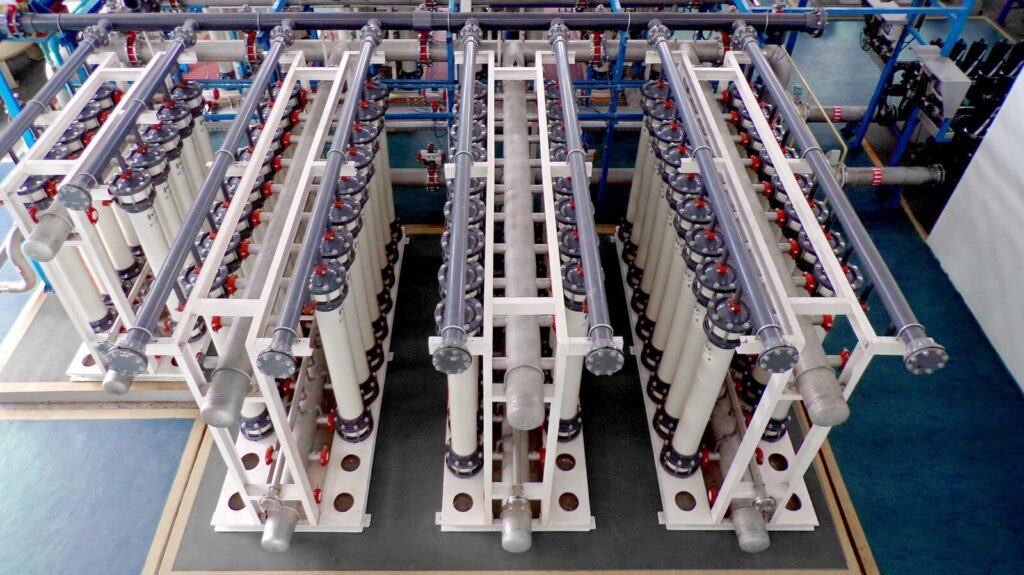
The Dumai plant in Indonesia illustrates the contribution of direct nanofiltration technology in producing drinking water from surface water while significantly reducing chemical use and environmental impact. © NX Filtration
Territories as a competitive advantage
These technologies only create value when they are integrated into a coherent ecosystem.
A standalone innovation cannot resolve a structural water imbalance. It requires the alignment of physical networks, regulatory frameworks, agricultural practices and private investment.
Singapore has demonstrated this approach.
With limited groundwater resources and a historical dependence on Malaysia for part of its water supply, the city-state transformed a structural vulnerability into a strategic advantage.
Under the leadership of PUB National Water Agency, it developed a diversified water strategy based on four complementary sources: rainwater collection, imported water, desalination and advanced water recycling through the NEWater programme, one of the four pillars of the country’s Four National Taps strategy.
Treated wastewater undergoes a series of advanced processes, including membrane filtration, reverse osmosis and ultraviolet disinfection, to produce ultra-pure water primarily used for industrial applications, particularly in microelectronics and semiconductor manufacturing.
The Singapore model goes beyond hydraulic performance alone.
It demonstrates that the resilience of an industrial ecosystem depends on a territory’s ability to synchronise data, infrastructure, investment capacity and governance.
This approach is already becoming relevant for other strategic resources, including low-carbon energy, critical minerals and land availability.
The regions capable of securing these dimensions simultaneously will gain a decisive competitive advantage in attracting the industries of the future.
The territory itself is becoming an infrastructure.
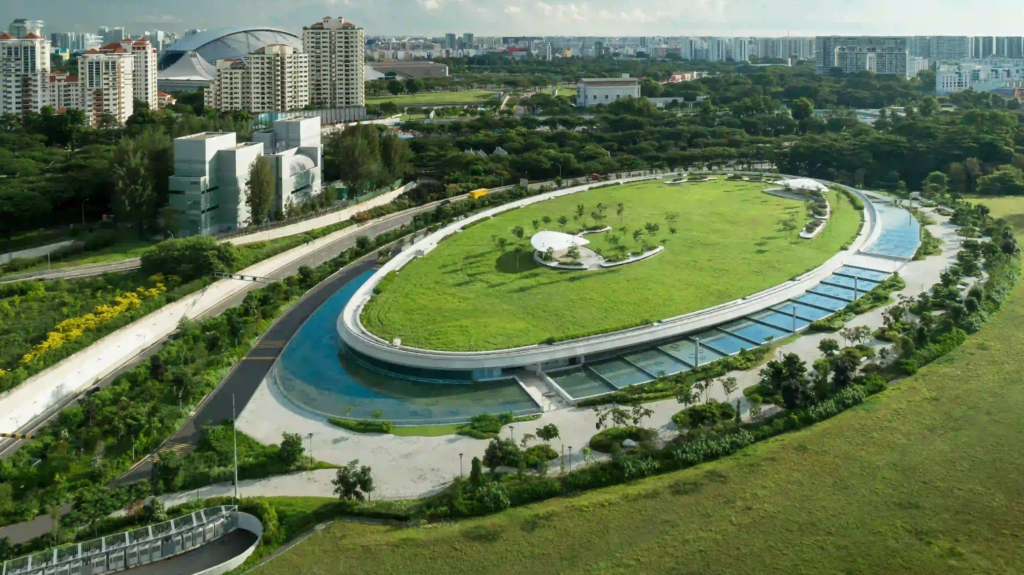
Opened in 2020, the Keppel Marina East Desalination Plant is Singapore’s first dual-mode desalination facility, capable of treating seawater during dry periods and freshwater from the Marina Reservoir during rainy conditions. It was awarded “Desalination Plant of the Year” at the Global Water Awards 2021. © PUB
A new economy of innovation
Three structural forces are combining to drive this transformation.
The acceleration of digital technologies is increasing demand for physical resources. Climate change is making rainfall patterns and temperatures less predictable. Governments, increasingly aware of supply chain vulnerabilities, are reshaping strategic production capacities.
For decades, technological progress relied on an implicit assumption: physical resources would remain affordable, accessible and available when needed.
Water challenges this assumption.
It sits at the intersection of climate adaptation, industrial sovereignty and digital transformation.
The same structural constraints are already emerging around the critical materials required for batteries, quantum technologies and advanced manufacturing capabilities.
DeepTech is entering a new stage of maturity.
The next generation of technologies will not be judged solely by their computational performance. They will be assessed according to the value they create within a world defined by physical constraints.
The true breakthrough will no longer lie only in what algorithms make possible, but in the ability of engineers, companies and policymakers to make innovation itself sustainable over time.
The future of technology will depend not only on computational power, but on the ability of territories to secure — sustainably and competitively — the resources that make innovation possible.