



Type 2 diabetes is emerging as a major application area for medical DeepTech.
Continuous sensors, artificial intelligence, computational models, automated insulin delivery systems and biotechnology are converging around a common development: describing individual metabolic function with greater precision and using that information to tailor care.
Glucose can now be monitored over time, correlated with diet, physical activity and other physiological parameters, then analysed by models capable of identifying individual responses. Automated delivery systems use this information to adjust insulin therapy. Other approaches seek to represent metabolism more broadly, while some biotechnologies are exploring direct intervention in its underlying mechanisms.
Diabetes is therefore becoming a field in which measurement, modelling, therapeutic decision-making and biological intervention are beginning to operate as parts of a single technological chain.
From glucose monitoring to metabolic profiling
A global disease, individual trajectories
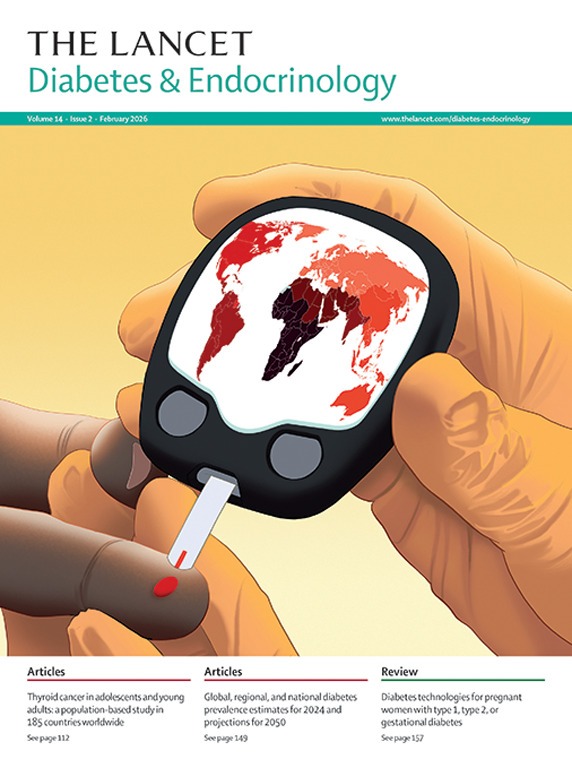
The IDF Diabetes Atlas 2025 published by the International Diabetes Federation, whose estimates have been published in The Lancet Diabetes & Endocrinology, estimates that in 2024, 589 million adults aged 20–79 were living with diabetes, representing 11.11% of this population. Assuming current trends continue, this figure is projected to reach 853 million by 2050. The analysis draws on 246 data sources covering 215 countries and territories.
According to the World Health Organization, type 2 diabetes accounts for more than 95% of all diabetes cases.
Patients present highly diverse physiological profiles. Responses to diet, physical activity and treatment can vary considerably between individuals.
Longitudinal data therefore take on particular significance: they make it possible to observe change rather than an isolated state.
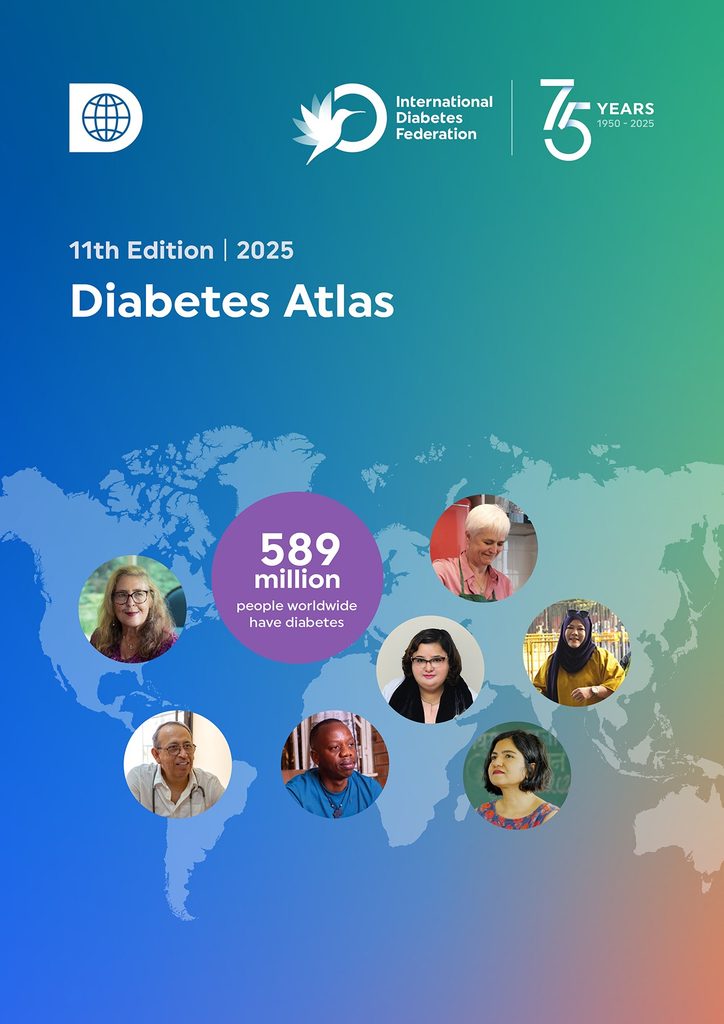
Cover of the IDF Diabetes Atlas, 11th edition, 2025
© International Diabetes Federation, 2025
Cover of The Lancet Diabetes & Endocrinology, Volume 14, Issue 2, February 2026
Cover image by Daniel Garcia © 2026 Elsevier Ltd
From biomarkers to continuous monitoring
Glycated haemoglobin (HbA1c), which reflects average blood glucose levels over the preceding few months, remains a key marker for monitoring.
Continuous glucose monitoring (CGM) provides a more detailed view of glucose dynamics through measures such as time in range, time above range, time below range, the glucose management indicator and coefficient of variation.
The American Diabetes Association (ADA)’s Standards of Care in Diabetes—2026 give increasing prominence to CGM and automated insulin delivery (AID) systems. For adults with type 2 diabetes using multiple daily injections, the ADA considers AID systems the preferred method of insulin delivery. They may also be considered for selected patients using basal insulin who are not meeting their glycaemic targets.
CGM therefore provides a time series that can be combined with other physiological and behavioural information.
Continuous glucose data are becoming a foundation for metabolic modelling.
January AI: building a metabolic profile
January AI illustrates this development.
In a study published in npj Digital Medicine in 2023, Zahedani et al. studied 2,217 participants with normal glucose regulation, prediabetes or type 2 diabetes. The programme combined 28 days of CGM data with dietary intake, physical activity, body weight and wearable-device data to generate personalised recommendations.
The authors reported improvements in several metabolic measures, including glucose levels and body weight.
The study design does not, however, establish the long-term effect of care based on these predictions. Several authors were affiliated with January AI.
Predictive capability is one building block. Its clinical utility still has to be established.
Twin Health: modelling individual response

AI digital twin™ for personalised metabolic modelling © Twin Health
Twin Health takes this approach towards a broader representation of metabolism.
In a randomised trial published in 2023, 319 people with type 2 diabetes were assigned to either a digital-twin-based intervention or standard care. The system used, among other inputs, post-prandial glucose responses to personalise diet, physical activity and sleep.
After one year, HbA1c had fallen by 2.9 percentage points in the intervention group versus 0.3 points with standard care. Diabetes remission was reported in 72.7% of participants in the intervention group.
After one year, HbA1c had fallen by 2.9 percentage points in the intervention group versus 0.3 points with standard care. Diabetes remission was reported in 72.7% of participants in the intervention group.
The significance of the approach lies in moving from a series of measurements to a model capable of guiding a personalised intervention.
From prediction to intervention
Insulet: closing the therapeutic loop
Insulet illustrates a further stage in this development: automated insulin delivery. Its Omnipod 5 system combines continuous glucose monitoring, an adaptive algorithm and insulin delivery in a continuous control loop. For adults with type 2 diabetes, the system uses CGM values and trends to automatically increase, decrease or pause insulin delivery every five minutes.
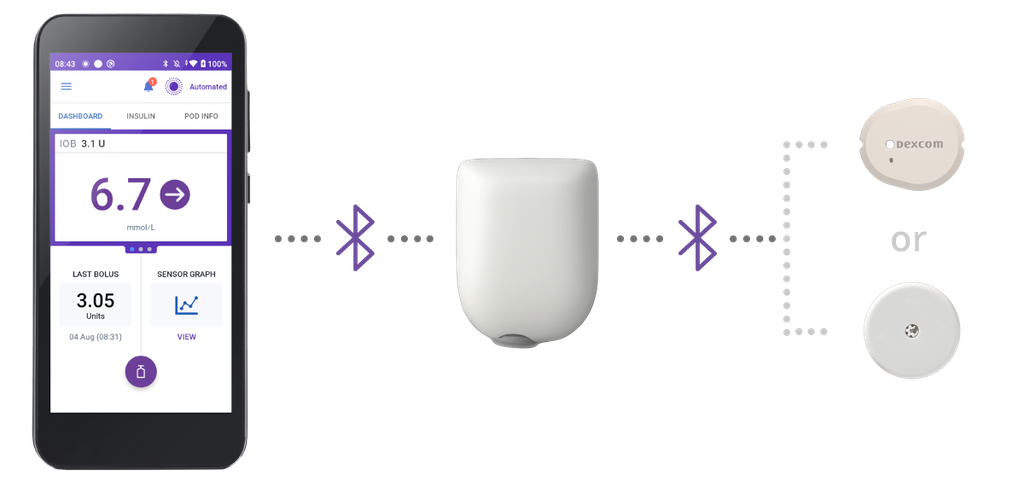


Omnipod 5, continuous glucose monitoring sensors and app © Insulet Corporation
A prospective pivotal trial involving 305 adults with type 2 diabetes reported an increase in time in range from 45% to 66%, equivalent to almost five additional hours per day, while mean HbA1c fell from 10.1% to 8.1% after 13 weeks of Omnipod 5 use.
The significance lies in the architecture: glucose measurement is connected directly to algorithmic interpretation and therapeutic action. The system turns a continuous physiological signal into an automated treatment response.
January AI operates primarily at the predictive layer. Twin Health extends metabolic modelling into personalised intervention. Insulet adds the control layer, closing the loop between measurement and treatment.
This is a more concrete expression of computable metabolism: the value of the data lies not only in describing metabolic state, but in enabling a system to respond to it.
Technology must earn its place in care
The evolution of CGM and AID systems is reshaping the architecture of medical devices.
Signal quality, algorithms, connectivity, cybersecurity, automation and clinical integration are becoming closely interdependent.
The value of a technology can therefore be assessed through the decision it improves and the clinical outcome that follows.
This applies equally to sensors, software, automated systems and emerging therapeutic platforms.
Technological performance acquires value when it translates into better care.
From treatment to biological modification
Pharmacology becomes cardiometabolic
The Standards of Care in Diabetes—2026 place pharmacological treatment within an approach that incorporates cardiovascular, renal and weight-related considerations.
Therapeutic choice is therefore increasingly informed by the patient’s metabolic profile and associated risk factors.
Type 2 diabetes sits within a cardiometabolic framework in which glycaemia, body weight, kidney function and cardiovascular risk contribute to a single therapeutic strategy.
Pharmacology is evolving accordingly: treatment is increasingly assessed across the patient’s overall health trajectory.
RJVA-001: intervening in metabolic function
Fractyl health is exploring a biotechnology pathway with Rejuva, its gene therapy platform, and RJVA-001, its lead candidate for type 2 diabetes.
In May 2026, Fractyl announced authorisation in the Netherlands for a Phase 1/2 first-in-human study. RJVA-001 uses an AAV-based approach designed to enable GLP-1 expression targeted to pancreatic beta cells. The company expects first dosing in the second half of 2026, subject to site activation.
The programme is entering the early stages of clinical evaluation. Its safety, tolerability, activity, immunogenicity and durability of effect remain to be established in humans.
The technological logic changes here: the platform seeks to biologically modify a metabolic function rather than simply observe or adjust it.
A single-dose gene therapy platform designed to enable long-term remission of obesity and type 2 diabetes by targeting pancreatic islet cells © Fractyl Health
Evidence becomes the industrial filter
Demonstrating clinical benefit
The more directly a technology intervenes in care, the more decisive the quality of evidence becomes.
A predictive model must demonstrate robustness and usefulness in a real clinical decision.
A digital platform must establish clinical benefit.
An automated system must combine glycaemic performance, safety and reliability in everyday use.
A gene therapy must establish safety, tolerability, biological response, immunogenicity, durability and clinical benefit.
These requirements sit alongside interoperability, data governance, integration into care pathways, acceptability and reimbursement conditions.
The transition from technology to care therefore depends on a chain of evidence, with each link determining the value of the next.
Nearly €930 billion in healthcare expenditure
According to the IDF Diabetes Atlas 2025, healthcare expenditure related to diabetes exceeded €930 billion in 2024, based on the reported global expenditure converted into euros. Europe accounted for approximately €177 billion. These expenditures represented 11.9% of global healthcare spending.
These figures do not represent the market for diabetes technologies. They indicate the scale of the healthcare system in which these technologies must demonstrate clinical and economic value.
Value creation can arise across diagnosis, risk stratification, monitoring, treatment adjustment, complication prevention and care-pathway efficiency.
For both industry and payers, the ability to connect innovation, clinical outcomes and cost of care is becoming a central criterion.
Metabolism becomes a technological object
CGM, artificial intelligence, digital twins, automated insulin delivery systems, cardiometabolic pharmacology and gene therapy belong to distinct technological fields.
Their convergence points towards a specific development: metabolism is becoming increasingly measurable, modelled, controllable and potentially modifiable.
Type 2 diabetes brings together several conditions that favour this transformation: chronicity, physiological heterogeneity, growing availability of longitudinal data, increasing computational capacity, and substantial health and economic impact.
DeepTech is progressively reshaping the chain connecting biological observation, modelling, therapeutic decision-making and intervention.
The central question is whether a more precise understanding of metabolism can be translated into better-informed decisions, better-adjusted interventions and durable clinical outcomes.
Type 2 diabetes is already becoming a major testing ground for this new architecture of care.
DeepTech is therefore beginning to turn type 2 diabetes into a physiological system that can be observed, modelled and increasingly controlled.