

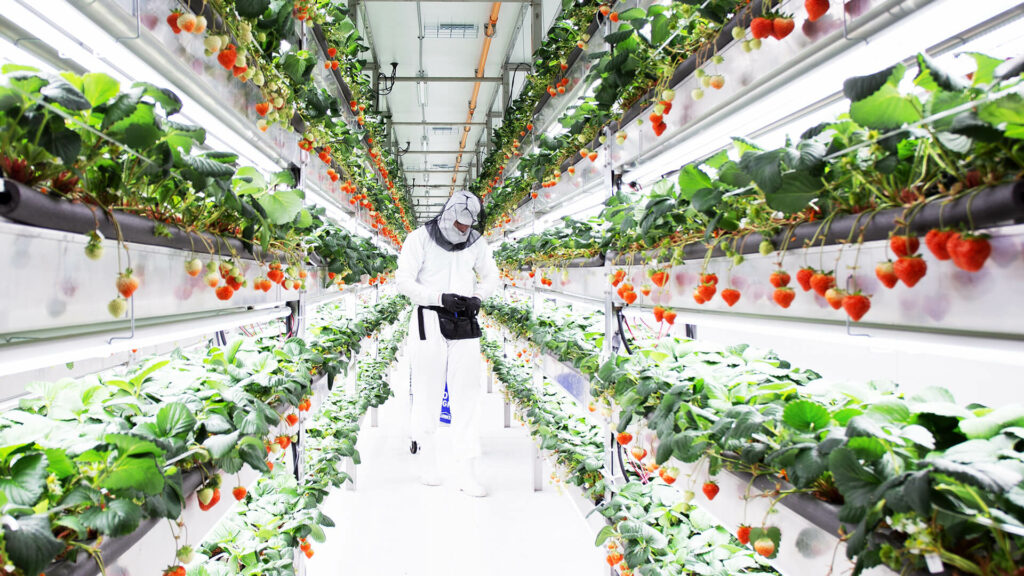
Vertical farming shields part of crop production from variations in weather, soil and seasonality. In doing so, it replaces that exposure with greater dependence on electricity, equipment, data and operational performance.
Sunlight becomes an energy input; water, a controlled flow. Outdoor weather becomes a variable in the building’s thermal balance.
Temperature, humidity, CO₂, light spectrum, irrigation, nutrition and airflow can all be tuned to crop requirements. Biological variability remains, within an environment that can be measured far more closely.
The industrial question therefore shifts to the value created by this degree of control: which crops justify having their climate designed, powered and maintained?
Reducing climate exposure in the agricultural equation
From the Nordics to the Gulf, different constraints
At high latitudes, limited winter light and short growing seasons restrict the local production of some fresh crops. In arid regions, heat, water scarcity and the availability of cultivable land impose a different set of constraints.
Vertical farming addresses both through the same principle: aligning growing conditions with an agronomic specification rather than with the external environment.
Swedish company SweGreen develops its systems across Nordic markets and, in May 2026, signed an agreement with Urban Agritechs for the potential deployment of 15 units in the United Arab Emirates over 24 months, including within residential, commercial and mixed-use developments.
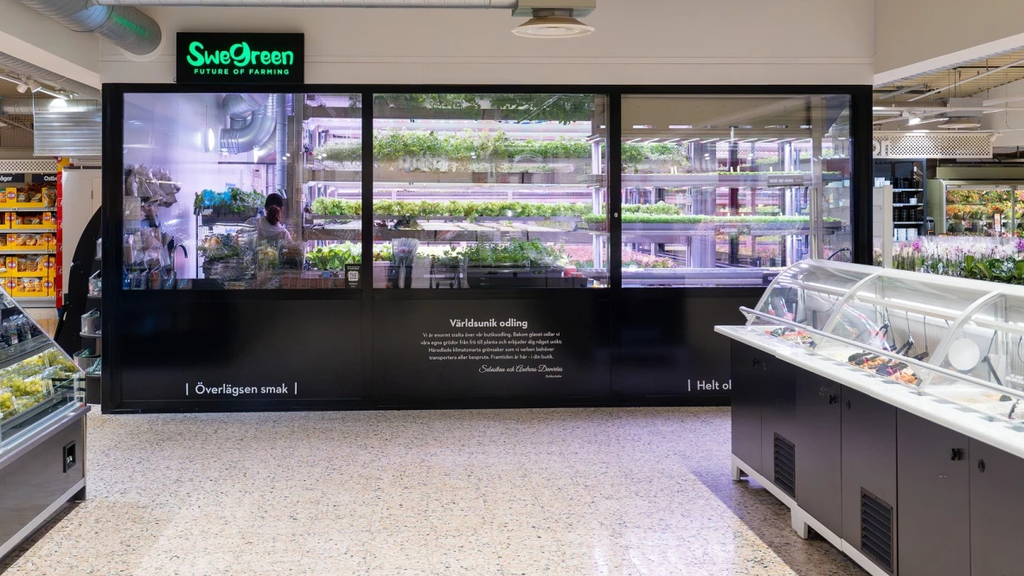
At Maxi ICA Stormarknad Ängelholm in Sweden, SweGreen’s Freja system integrates production directly into the store: 160 m² of growing area within a 60 m² footprint, producing an average of 450 plants harvested each day and placed directly on the shelves. © SweGreen / Maxi ICA Stormarknad Ängelholm
The geographic contrast is revealing. In one case, the system compensates for a short light season. In the other, it mitigates heat and water constraints. The external climate changes. The parameters required by the crop remain measurable and reproducible.
That control still depends on the building that creates it. A cold spell or heatwave may never reach the crop directly, yet still alter the thermal requirements of the facility.
Weather therefore does not disappear from the system. It changes its point of entry.
An environmental footprint shifted rather than erased
The same displacement applies to environmental impact.
Soilless cultivation and controlled water circulation can reduce direct agricultural land use and certain local water requirements. Electricity, materials, equipment and their service life consequently carry greater weight in the overall footprint.
A life-cycle assessment conducted in Finland provides a useful measure of that shift. For the lettuce system studied, the scenario combining vertical farming, renewable electricity and heat recovery reached approximately 1.0 kg CO₂e per kilogram of produce. Using an average electricity mix without heat recovery increased that impact by around 150%. In the same study, the conventional greenhouse reached 3.3 kg CO₂e/kg with the average energy mix and 2.0 kg CO₂e/kg with renewable energy.
The analysis also introduces an important qualification: outcomes vary according to the indicator considered. The authors identify different trade-offs in areas including mineral and metal resource use and water scarcity.
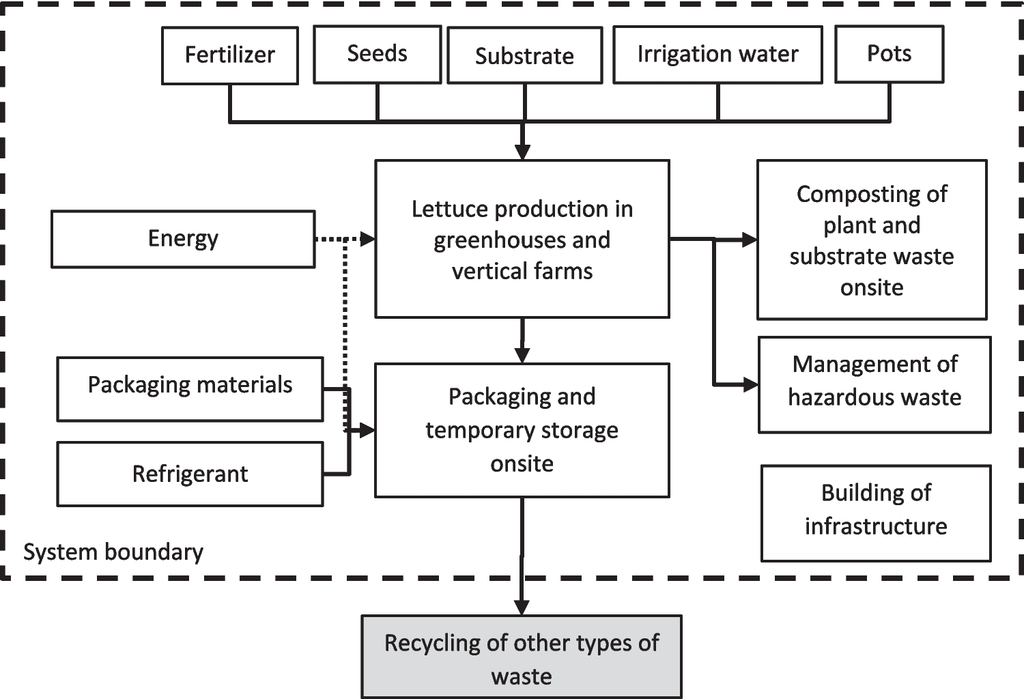
System boundaries for the life-cycle assessment comparing greenhouse and vertical-farm lettuce production in Finland, from inputs and infrastructure through to the farm gate. © Joensuu et al., 2024, The International Journal of Life Cycle Assessment, CC BY 4.0
The publication Vertical farming as a resource nexus solution for sustainable agriculture,
referenced by the European Commission in 2026, takes precisely this systems view: energy, water, land, materials and economic viability need to be considered together.
Vertical farming therefore concentrates certain agricultural functions within a smaller physical footprint while extending part of its impact into the infrastructure required to sustain that concentration.
Energy, the economic frontier?
Photons become an industrial input
In a facility with little or no meaningful natural light, photosynthesis begins with electrical conversion.
Lighting sits alongside dehumidification, cooling, heating, ventilation and pumping.
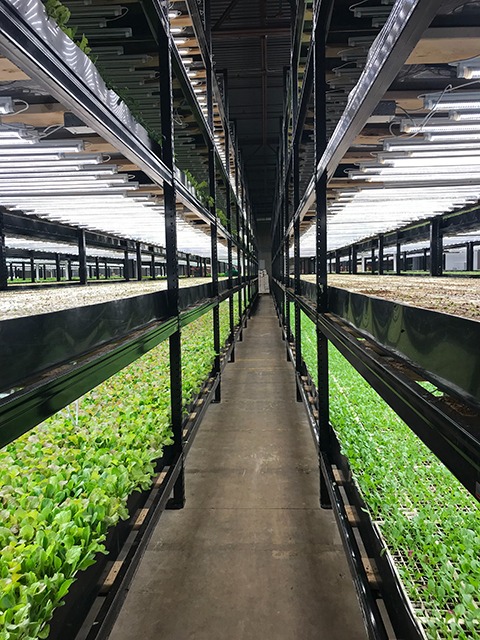
The USDA Agricultural Research Service identifies artificial lighting and HVAC systems among the principal energy and economic constraints facing vertical farms.
The relevant performance metric therefore extends beyond yield per square metre to electricity consumed per saleable kilogram, per plant or per production cycle.
Interior view of a vertical farm in Minneapolis, Minnesota: stacked crops grown under artificial lighting in a controlled environment. © USDA Agricultural Research Service, photo by James Altland, D4686-1
In Phillipsburg, New Jersey, Oishii operates Amatelas Farm across more than 237,500 ft², around 22,000 m², next to a 50-acre solar field. The site includes a purification system that allows most of the water used in production to be recycled.
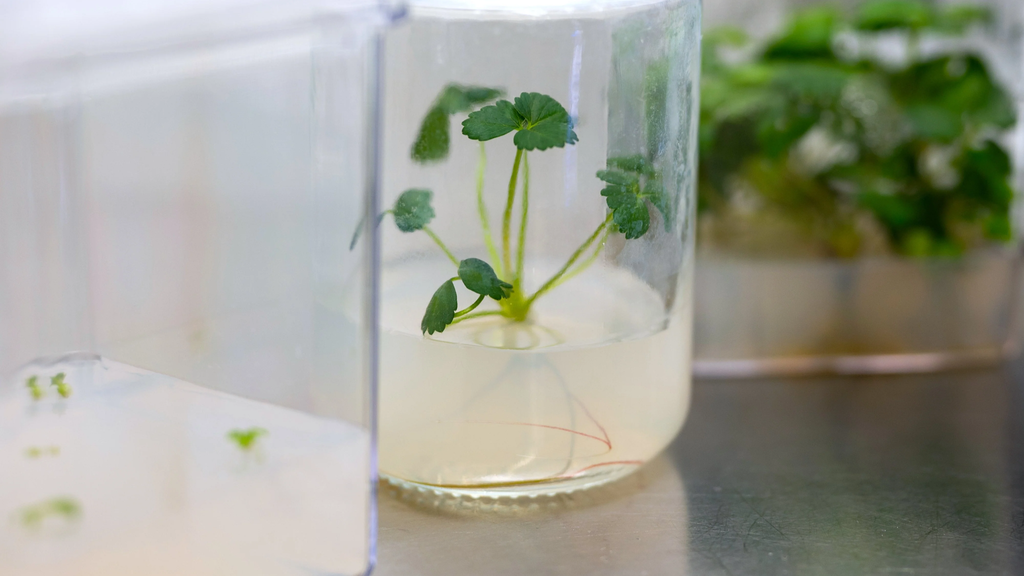
At Oishii’s propagation lab, plants are multiplied and raised in-house before being transferred to the farms, where flowering and fruit production begin. © Oishii
Oishii states that its new-generation LEDs consume 14% less energy per plant than those deployed in its previous farms.
Performance therefore depends on photon efficiency, thermal management, pump efficiency, water recovery and equipment lifetime.
Using energy at the right time
Electrification creates another degree of freedom: part of energy demand can be shifted over time.
A crop requires a given quantity of light and defined ranges of temperature and humidity. Those biological constraints can still leave flexibility over exactly when energy is consumed.
A 2026 study published in Applied Energy modelled the participation of plant factories with artificial lighting in electricity reserve markets. Across the configurations studied, the authors found potential energy-cost reductions of up to 87%, averaging 82% across several climates, driven primarily by modulation of HVAC and lighting.
These are modelling results: they indicate potential rather than directly transferable commercial performance.
Beyond the level of savings modelled, the study primarily demonstrates that part of the electrical load can be flexible. Agronomic control can therefore incorporate electricity prices, renewable availability, grid capacity and heat recovery.
Energy consequently becomes part of process control.
From data to operational flow
Measuring biological response
A controlled environment makes it possible to relate a given setpoint to an observed biological response at an unusually fine level of granularity for agriculture.
At Oishii, robots analyse, according to the company, up to 60 billion data points each year. Temperature, humidity, CO₂, airflow and light are among the variables monitored across its facilities.
In parallel, the USDA is developing an experimental vertical-farming platform combining hyperspectral imaging, programmable environmental control and AI-assisted analysis. The work includes early detection of plant stress and optimisation of water and energy use.
Data shortens the loop between observation, comparison and adjustment from one growing cycle to the next.
The objective is not to reduce a plant to a perfectly deterministic model. It is to define more precisely the ranges within which its response can be reproduced.
BKCC: bringing the crop to the workstation
The economics of a vertical farm extend beyond kWh per kilogram. They also depend on the time required to load, inspect, irrigate, harvest, clean and move each crop.
This is precisely the issue addressed by Seungwan Lee, founder of Farmers Lab and inventor of BK Conveyor Culture (BKCC). After more than thirty years working on Controlled Environment Agriculture and greenhouse projects across several regions of the world, he has increasingly focused on system standardisation, workflow design and operational repeatability.
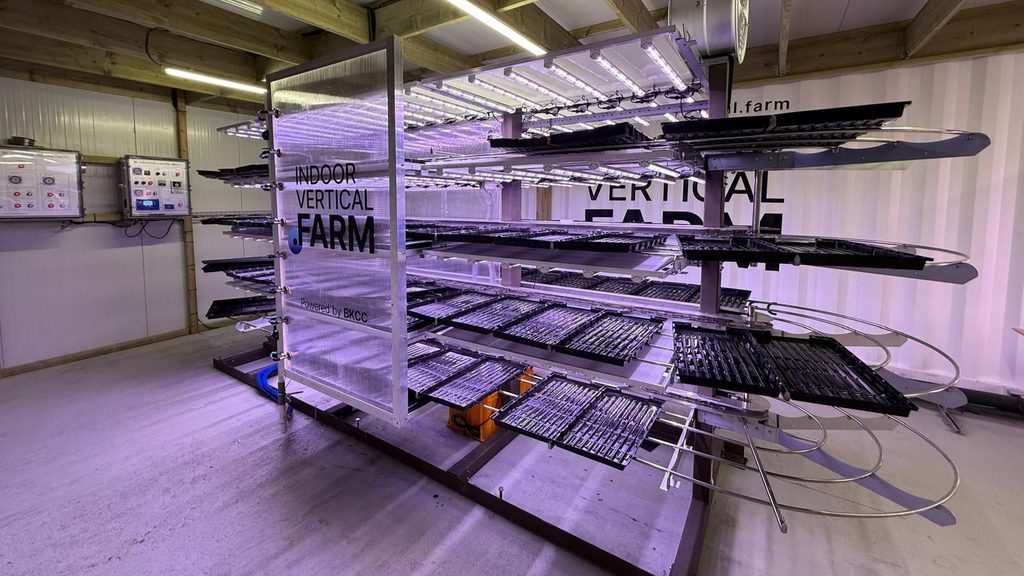
Its architecture moves growing trays towards dedicated work and irrigation points rather than requiring operators to move repeatedly between fixed racks.
The geometry of work therefore becomes a design variable in its own right.
In August 2026, the first BKCC system installed in Europe entered service at the Indoor Vertical.Farm Experience Centre in Hasselt, Belgium. The site is now used for cultivation, testing and system demonstrations.
Operational flows therefore become part of process design, alongside lighting, irrigation and climate control.
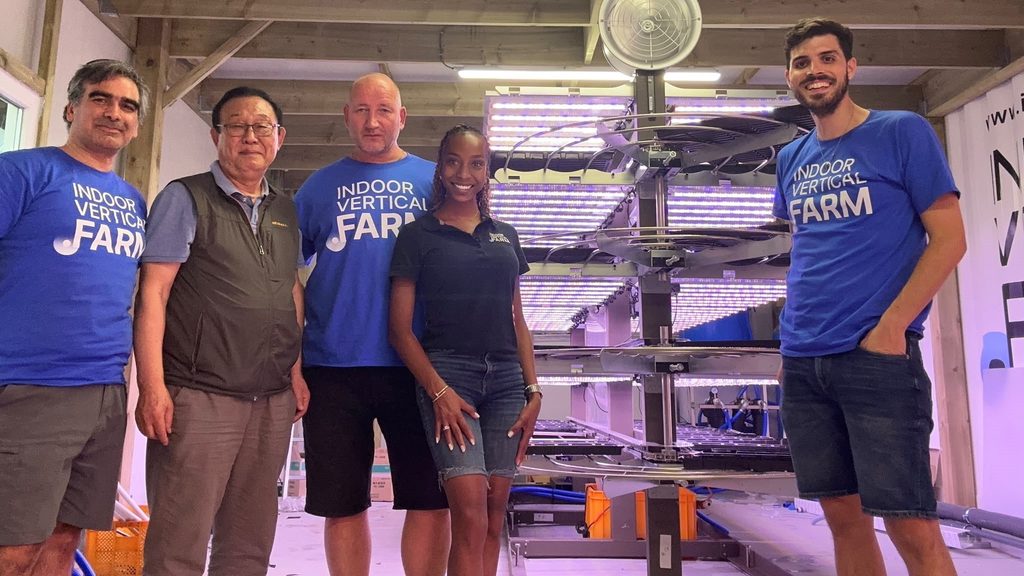
The first BK Conveyor Culture, BKCC, system operating in Europe, in Hasselt, Belgium, dedicated to cultivation, testing and demonstration, under the leadership of CEO Seugwan Lee. © Indoor Vertical.Farm / BKCC
BK Conveyor Culture, BKCC: developed by Farmers Lab, the system moves growing trays to dedicated workstations to streamline operations and reduce handling. © Farmers Lab / BKCC
Scale-up selects architectures
Concentrating or distributing production
Concentrating or distributing production
In Richmond, Virginia, Plenty designed its strawberry farm to produce more than 4 million pounds a year, around 1,800 tonnes, within less than 40,000 ft², using growing towers close to nine metres high.
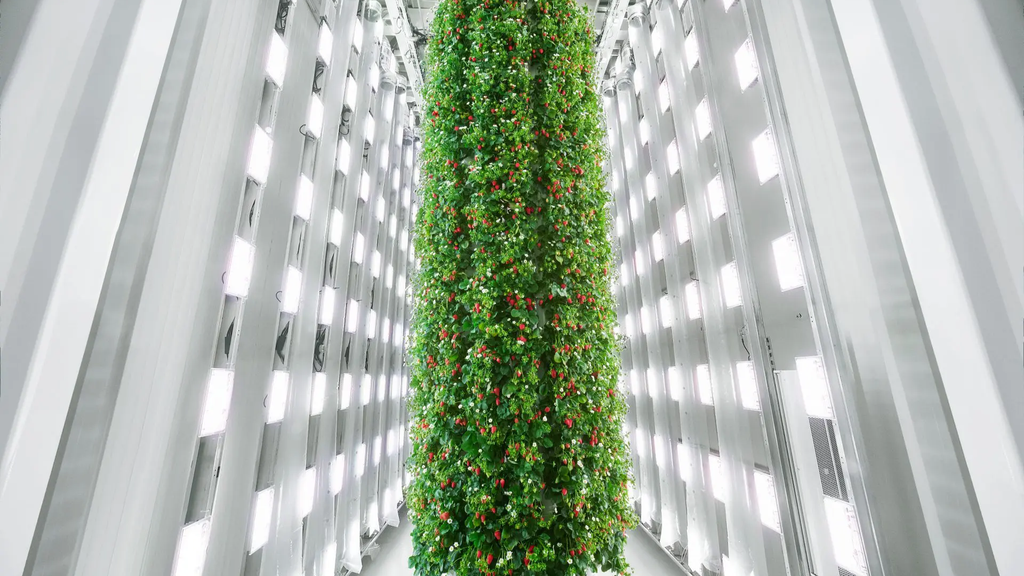
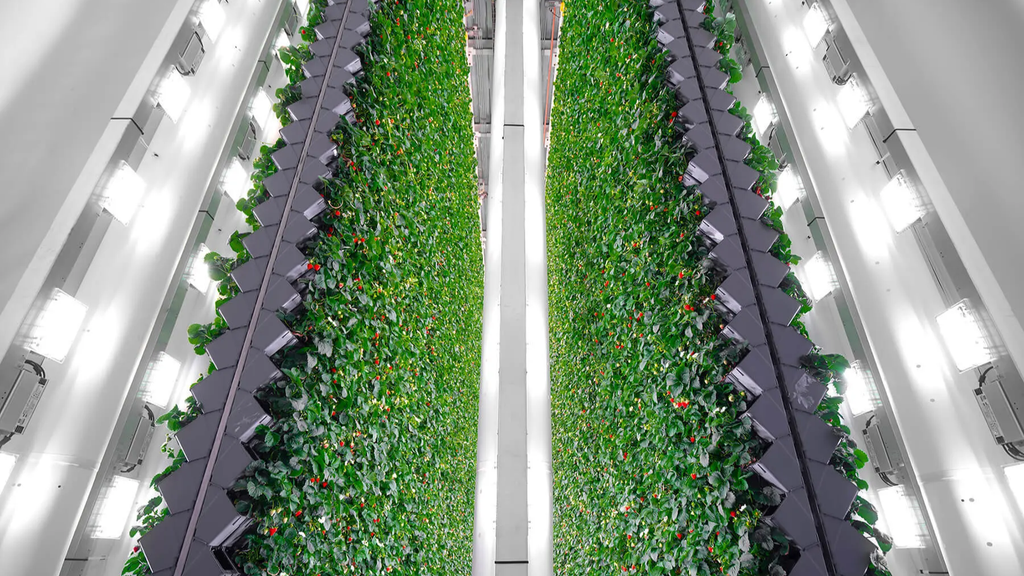
At Richmond, Plenty grows strawberries year-round in a controlled vertical environment, with light and climate managed to stabilise quality and production. © Plenty
SweGreen follows a different trajectory. At ICA Maxi Ängelholm, in Sweden, its Freja system occupies 60 m² of floor space for 160 m² of growing area and can produce an average of 450 plants per day directly inside the store.
In September 2026, the contract was renewed for a further seven years. The retailer reports that, since installation, sales of fresh lettuce have risen by 55%, with herb sales up 37%. These figures are published by SweGreen using store data and do not constitute an independent assessment of the system’s profitability.
Plenty concentrates production and equipment within a specialised facility. SweGreen places a standardised unit close to the point of sale.
One pursues economies of scale. The other, an economy of distance.
Their relevance depends on the product, logistics, property costs, level of automation and the ability to replicate the installation.
A manufactured climate selects its crops
Plenty’s recent history also illustrates the financial discipline behind these technical choices.
Following the opening of Richmond, the company voluntarily entered Chapter 11 in March 2025, backed by $20.7 million in restructuring financing. It emerged in May 2025 with an organisation refocused on premium strawberries.
The episode highlights the discipline imposed by cost structure even in technically sophisticated systems.
Cycle length, saleable yield, density, selling price, energy cost, labour cost, equipment utilisation, proximity to the customer and demand stability together determine the level of controlled-environment intensity a crop can economically support.
Across US Controlled Environment Agriculture, a category that also includes greenhouses, tomatoes, lettuce and cucumbers still accounted for 60 to 70% of crops produced in 2009 and 2019, according to the USDA Economic Research Service.
Strawberries are now shifting that frontier towards higher-value, more perishable crops capable of supporting greater technological intensity.
A vertical farm can technically grow a far broader range of plants than its economics can sustain. Its industrial maturity lies precisely in that selection.
Control of living systems creates value when the value it unlocks exceeds the energy, capital and operating costs required to sustain it.