

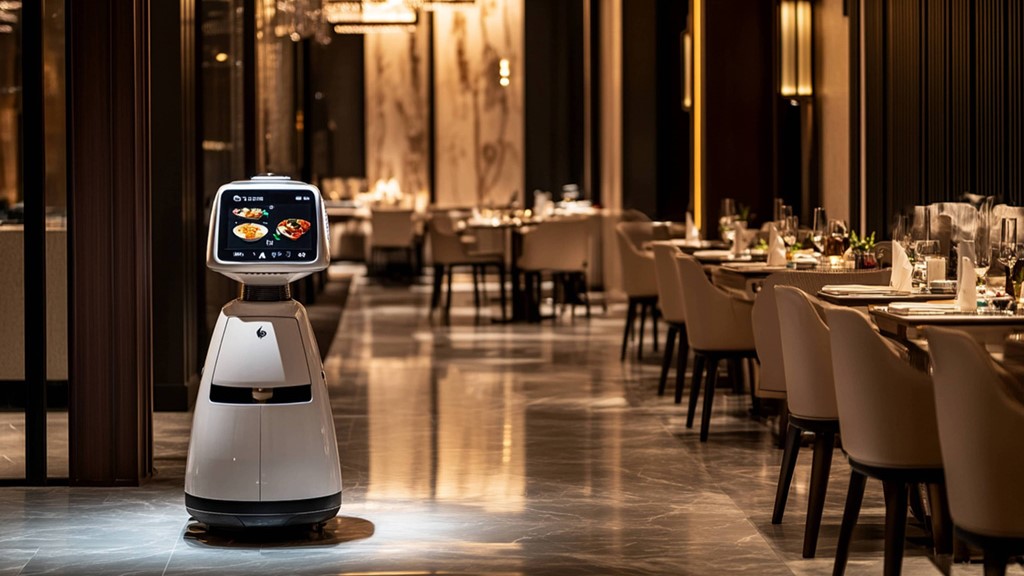
In March 2018, Hôtel Monville in Montreal introduced H2M2, a room-delivery robot. Over its first 27 months, it completed more than 10,000 deliveries, according to its supplier, Relay Robotics.
In January 2026, the hotel replaced it with a FlashBot Max from Pudu Robotics, integrated by Fractal Robotique and retaining the H2M2 name. Capable of making up to four deliveries in a single round, the robot summons the lift and phones guests when it reaches their room. According to the integrator, it was already breaking its predecessor’s delivery records by its second month in service.
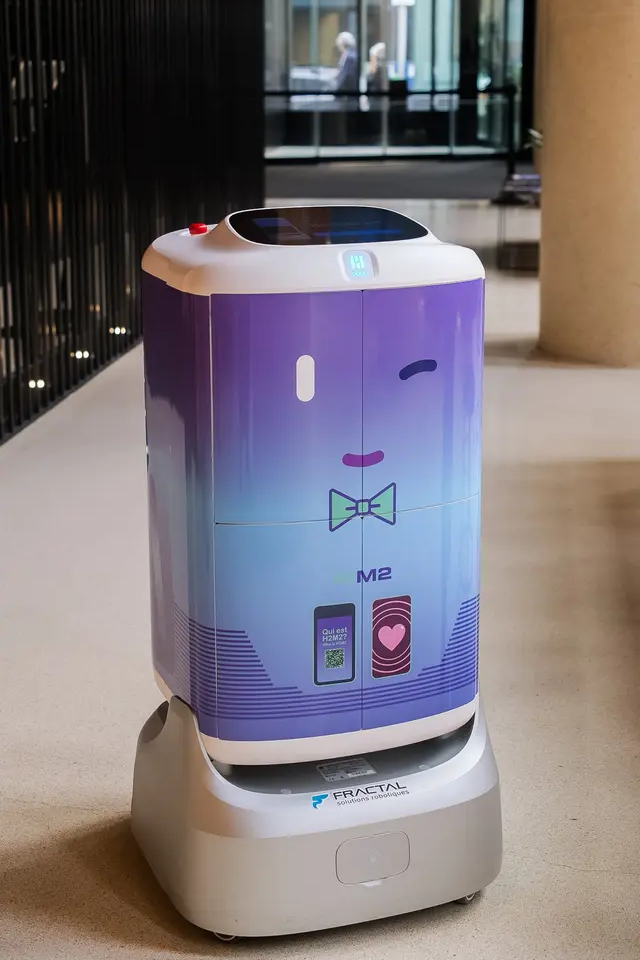
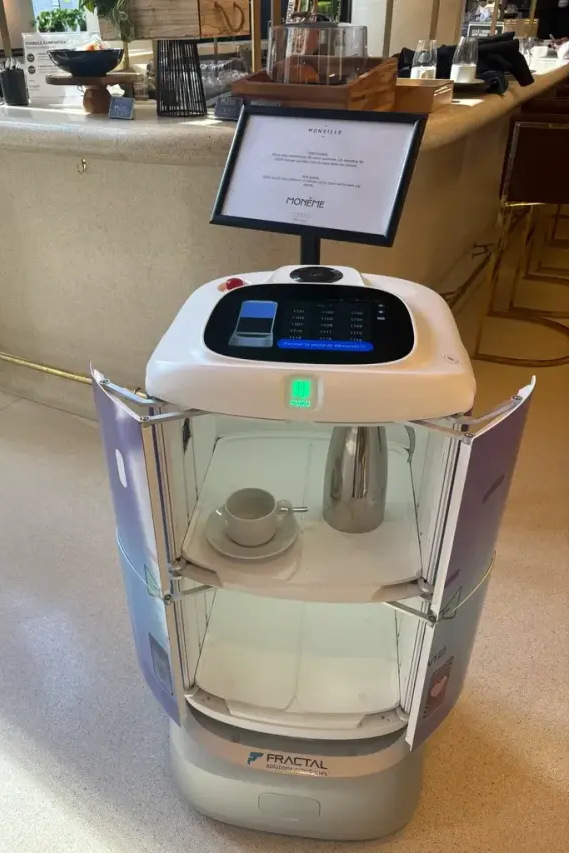
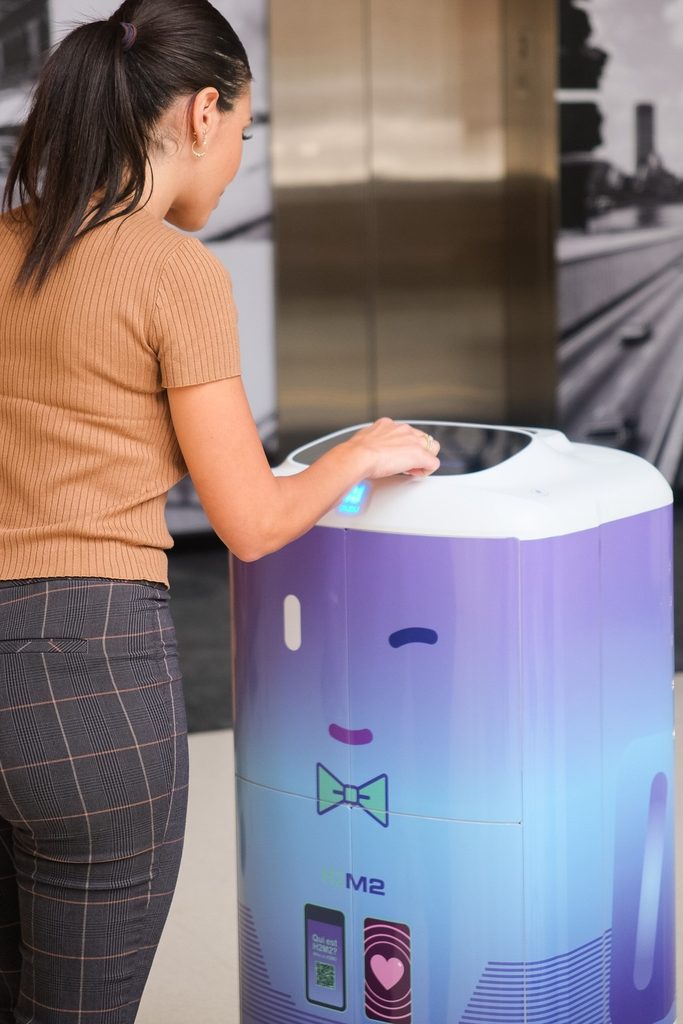
The hotel team named the robot H2M2, a nod to R2-D2 and the initials of Hôtel Monville. © Fractal Robotique
From reception desks and kitchens to guest rooms and back-of-house areas, robots are taking on an increasingly wide range of hotel duties. Humanoids are being trialled at reception, industrial robotic arms prepare meals, and mobile robots carry luggage, deliver orders and clean communal areas.
Their tasks must fit into existing hotel systems and staff workflows. Moving around the building means navigating lifts, controlled access points and shared corridors. Coordinating these movements affects how services are organised, how hotels are designed and how much they cost to run.
According to the International Federation of Robotics, nearly 250,000 professional service robots were sold worldwide in 2025, up 24% on the previous year. Hospitality applications accounted for 22% of sales, behind transport and logistics (47%). The same year, around 7,000 large humanoid robots, standing more than 1.4 metres tall, were sold for professional use.
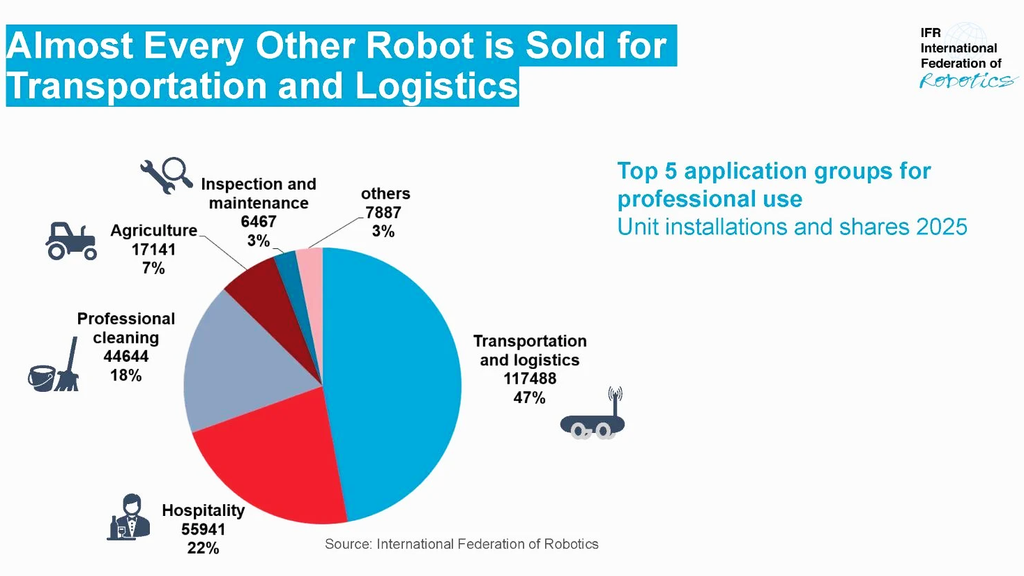
Global sales of professional service robots by application in 2025. © International Federation of Robotics (IFR), World Robotics 2026.
From kitchens to guest rooms, robots get to work
A chef engineered to fit
Since April 2026, the Hella Globe Hotel in Lippstadt, Germany, has been using a robotic kitchen developed by goodBytz.
Within a unit occupying just 8 m², an industrial robotic arm from FANUC handles pans across eight cooking zones, alongside integrated refrigeration and washing systems. The system can prepare around 180 different dishes.
Software controls ingredient quantities, temperatures, cooking times and the arm’s movements.
Staff remain responsible for restocking and maintenance. Using a standard industrial robot provides access to established spare-parts supply chains and maintenance procedures.
Enzo, the robotic chef at the Hella Globe Hotel. © avitea Industrieservice / goodBytz.
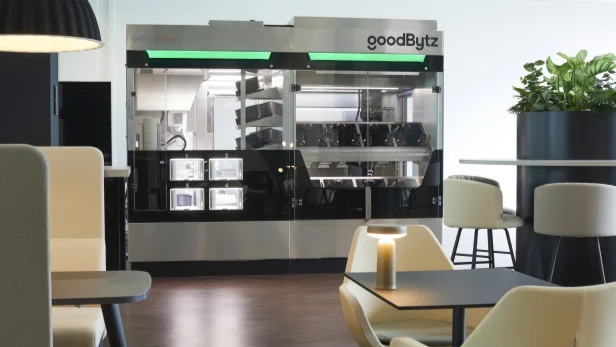
In September 2026, goodBytz unveiled emma., a model the company says is 40% more compact than previous systems with comparable capabilities, with a stated output of 80 to 120 meals per hour.
The system assembles meals, adds garnishes and dispenses finished dishes. Components can be accessed from one side, while interchangeable ingredient modules simplify restocking and make the equipment easier to accommodate in existing kitchens.
The system assembles meals, adds garnishes and dispenses finished dishes. Components can be accessed from one side, while interchangeable ingredient modules simplify restocking and make the equipment easier to accommodate in existing kitchens.
Meet emma. The next generation of autonomous cooking.
One last look before check-in
On 21 October 2026, Bellboy Robotics unveiled its Live Learning Lab in Berlin, designed to train artificial intelligence models using robots operating in occupied buildings.
According to the company and its property partner Aroundtown, 22 robots had accumulated more than 10,000 operating hours and completed 24,000 guest-room inspections across seven hotels, including properties operating under the Marriott, Hilton, Hyatt, IHG and OYO brands.
Each inspection generates data linking sensor readings to the actions performed and their outcomes. These records help evaluate the models and identify errors.
Fully preparing a room for its next guest requires additional capabilities, from handling linen and moving objects to cleaning spaces left in different conditions after every stay.
Billie, a hotel service robot that checks the condition of guest rooms and helps improve AI models. © Bellboy Robotics, 2026
When buildings talk to robots
Lifts under software control
At Osaka’s Hotel Keihan Universal Tower, the busiest nights can generate up to sixty room-delivery requests, according to Otis. Robots handle some of these deliveries, alongside cleaning, disinfection and monitoring duties.
Their movement between floors relies on Otis Integrated Dispatch, an interface connecting robots to the lift system.
They can summon a lift, select their destination, enter and leave the car without human assistance.
At Hotel Keihan Universal Tower, a service robot communicates directly with the lifts, summons a car, selects its floor, boards and exits independently, then delivers items to guest rooms. © Otis
KONE’s Service Robot API offers comparable functions. A robotic application can request a lift journey and check the car’s position, direction of travel, door status and the progress of its request.
Lift availability, access permissions and the movement of guests all affect the robots’ journeys. An inaccessible door or a lift taken out of service can bring a mission to a halt.
Software does the casting
The PUDU Open Platform allows tasks to be assigned to robots, their status to be monitored and notifications to be received as work progresses.
Its technical documentation distinguishes between robots that are available, busy, disconnected or temporarily unable to carry out a task.
A request can be assigned to a particular robot or a compatible group. If the robot is occupied, the task enters a queue. Five priority levels determine the order in which requests are handled.
Each task receives a unique identifier so that its progress can be tracked, it can be cancelled or its completion confirmed. The platform can also interface with hotel systems holding booking information, room availability and service requests.
The robots retain their own navigation systems, while lifts and access controls operate through separate interfaces. Completing a task depends on these components being able to communicate.
Robots join forces
A specialist fleet in Shanghai
On 29 October 2025, KEENON Robotics announced the deployment of a robotic fleet at Traders Hongqiao Airport, Shanghai, a 520-room property belonging to the Shangri-La Group.
The XMAN-R1 humanoid operates at reception. The C40, S100, T10, T3 and W3 platforms handle cleaning, luggage transport, food service and room deliveries.
When a guest checks out, their room becomes available for servicing. Preparing it for the next arrival may involve transporting linen, cleaning, restocking and a final inspection. Assigning these tasks depends on where the robots are, whether they are available and how far the preceding work has progressed.
Several robots may need the same lift, pass through the same corridor or reach a charging station simultaneously.
KEENON reports that its robots have been integrated into the hotel’s operations, although no independent assessment is yet available to measure their collective productivity.
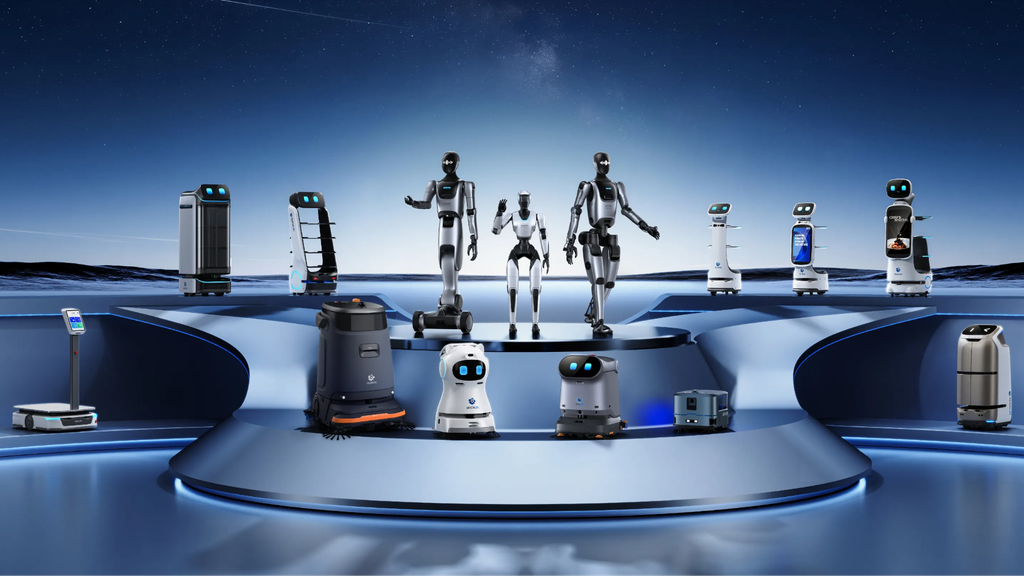
KEENON Robotics joins forces with the Shangri-La Group to create what the partners describe as the world’s first smart hotel. Video © KEENON Robotics
Robots in sync
In August 2026, at the World Robot Conference in Beijing, KEENON unveiled KOM 3.0, an architecture combining visual perception, instruction comprehension and motion control.
It incorporates a latent world model designed to anticipate the physical consequences of actions. The demonstrations brought humanoids and specialist robots together to perform coordinated tasks.
Two humanoids demonstrated a sequence of linen handling and folding, while T10 delivery robots and C40 cleaning robots took part in other operations.
These demonstrations illustrate the coordination achieved under controlled conditions. Whether it can be replicated reliably, and at what cost, in a working hotel remains to be established.
A hotel designed for robots
In existing hotels, robots navigate corridors, doors, lifts and storage areas originally designed for people. Integrating them may require additional interfaces, suitable network coverage and dedicated charging facilities.
In June 2026, Pudu Robotics and Shenzhen Culture & Tourism Industry Development announced a 44-room hotel on the western artificial island of the Shenzhen–Zhongshan Link in China.
Reception, deliveries, food service, cleaning and monitoring are intended to be handled by different categories of robot, operating through a shared technical infrastructure.
The building is being designed around robotic service routes, access points and communications infrastructure. Trials were scheduled for late 2026, ahead of a phased public opening. The project remains under development.

The 44-room hotel project developed by Pudu Robotics and Shenzhen CTID in China. The property is designed to incorporate robots into reception, deliveries, food service and cleaning. © Pudu Robotics, 2026
The realities of running robots
Six months for a spare part
Japan’s Henn na Hotel, which opened near Nagasaki in 2015, was recognised as the first hotel staffed by robots. Mechanical dinosaurs and humanoids greeted guests, an industrial robotic arm handled luggage, and voice assistants were installed in the rooms. The concept aimed to reduce staffing costs while offering a futuristic guest experience. At one stage, the hotel had as many as 243 robots. In January 2019, it removed more than half of them.
Voice assistants mistook background noise for instructions. Robot porters struggled to navigate certain corridors. Staff regularly had to step in to resolve problems.

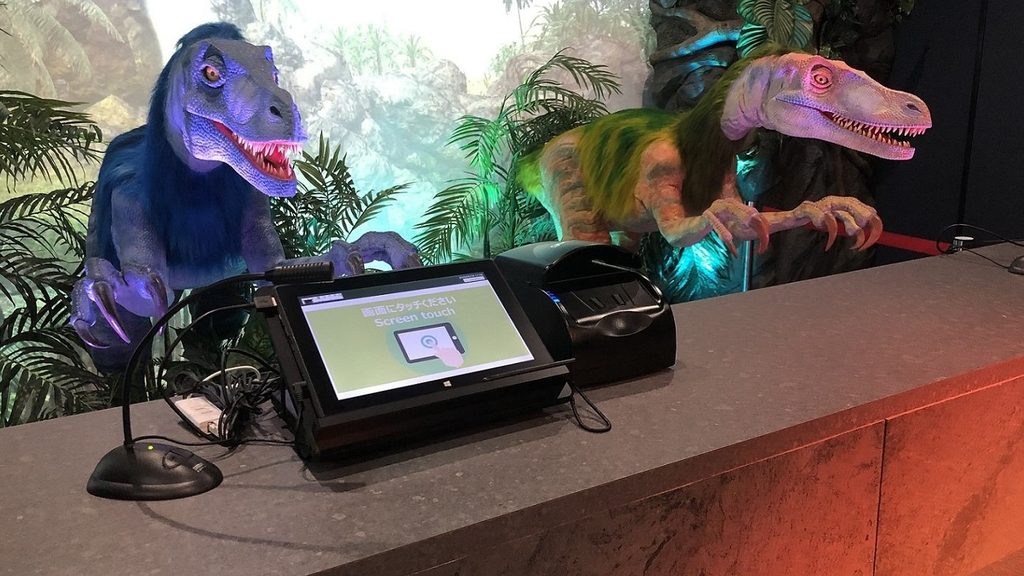
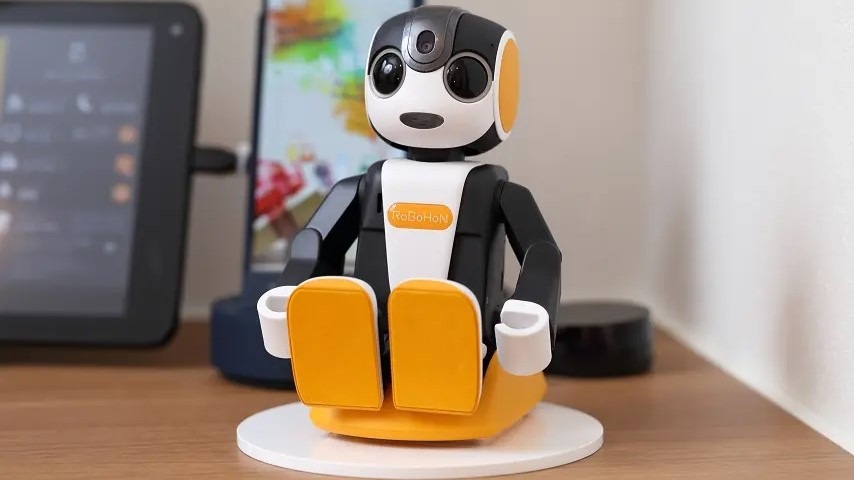
Across the Henn na Hotel chain, humanoids, robotic dinosaurs and small service robots illustrate different approaches to automated reception. © Henn na Hotel
A 2025 study published in Cornell Hospitality Quarterly, based on interviews with ten hospitality industry executives and eight representatives of robotics suppliers, examines why hotels retain or abandon service robots.
One interviewee reported a robot being out of action for six months because spare parts were unavailable. Bespoke mechanical components had to be manufactured to bring it back into service.
The researchers also highlight the lack of an established second-hand market for these machines. Their resale value depends on whether spare parts and technical support remain available.
The cost of getting the job done
In the same study, one industry professional estimated the success rate of their hotel’s delivery robots at around 95%. Some missions were recorded as failures when guests did not answer the door, even though the robot had reached the correct room.
At Monville, Relay Robotics quoted a historical rental rate of USD 3–5 per hour for the original H2M2. The supplier also reported that room-service volumes had doubled within a year, although the robot’s contribution to that growth could not be isolated.
For its replacement, installed in January 2026, Fractal Robotique reports operating costs of approximately $25 per day and an increase of more than 20% in order value. The robot can now deliver full meals and offer late-night snacks. These figures come from the integrator, which has not specified the currency or published details of what the operating costs cover or the period used for comparison.
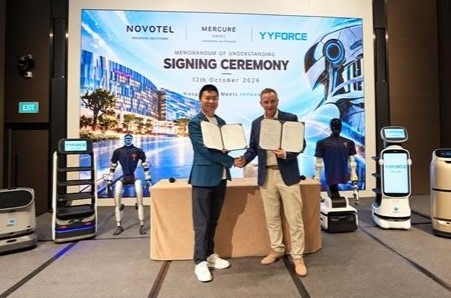
On 13 October 2026, YYForce, Novotel Singapore on Stevens and Mercure Singapore on Stevens announced a robotics programme covering 772 rooms across the two properties. On 29 October, YYForce announced the commercial deployment of 11 service robots under a 24-month contract.
Designed for room deliveries and internal logistics, the robots interface with the hotels’ lift and telephone systems to coordinate their movements and notify guests. The programme also envisages cleaning applications and, in a separate phase, research into humanoid robots.
Based on an estimate prepared before deployment, the partners anticipate a reduction of approximately 10% in monthly costs across selected housekeeping, concierge and food-service activities, including robot-related expenses.
These savings remain a projection. Actual results will need to be assessed against delivery times, robot availability, staff interventions and operating costs.
Representatives of YYForce, Novotel Singapore on Stevens and Mercure Singapore on Stevens at the signing of their memorandum of understanding on the integration of service robots. © YYForce Inc., 2026
When the tax base shifts
Automation can change the balance of expenditure between wages, equipment, software, maintenance and intangible assets.
Reception, food service, deliveries and manual handling have traditionally relied on paid employees, whose wages generate social security contributions and tax revenue. Automation may increase the share of physical and software capital involved in providing these services.
The consequences depend on productivity gains, changes in employment and the revenue generated. Providing more services, redeploying staff or reducing particular tasks can have different effects on value added, profits and tax receipts.
Will robots pay tax?
In South Korea, the debate over taxing automation has reached parliamentary institutions. On 30 March 2026, the National Assembly Research Service raised the possibility of introducing a ‘robot tax’ to redistribute some of the benefits generated by artificial intelligence. On 21 April, the National Assembly Futures Institute recommended opening a debate on a social security levy on exceptional AI-related profits.
The debate centres on several competing arguments. Supporters argue that taxing automation could help fund worker retraining and social protection while offsetting the effects of job losses. Critics warn of double taxation, reduced competitiveness and the risk of businesses moving operations overseas. Defining precisely what should be taxed remains another obstacle.
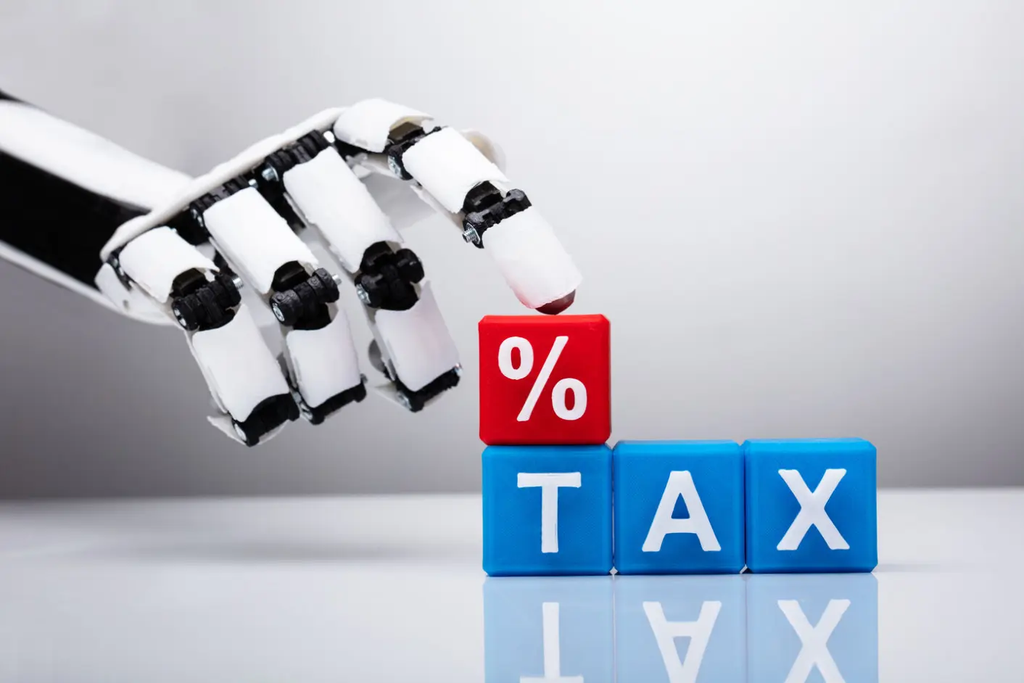
These proposals remain at the discussion stage. No general tax on robots has been introduced.
A robotic arm reaches towards dice marked ‘TAX’: should robots be taxed, or the value they help create? © Getty Images
A discussion convened by KPMG International in February 2026 examined the potential implications for taxes on labour and capital.
Value is created through a combination of machinery, software, AI models, data, infrastructure and human labour. Profits may also reflect commercial factors unrelated to automation, making it difficult to determine how much value can genuinely be attributed to robots.