

Thermal comfort is becoming a key issue in the climate adaptation of buildings. Between passive cooling, thermal storage, artificial intelligence and new cooling infrastructure, a new approach is emerging: generating hours of effective cooling rather than simply consuming more energy.
A building’s climate performance will be measured by its ability to generate, maintain and distribute hours of effective comfort, without placing the entire burden on the electricity grids.
Heat alters the true value of buildings and directly calls into question their ability to guarantee sustainable thermal comfort.
A building may comply with a standard, demonstrate good annual performance, incorporate energy-efficient materials, and yet become difficult to use during critical hours. A school may look good on paper but be uncomfortable by the end of the day. An office may reduce its average consumption whilst shifting its vulnerability to periods of peak electricity demand. A hospital, a hotel, a railway station or a campus may depend on an efficient cooling system as long as energy remains available, affordable and manageable.
This situation calls for a more precise metric to assess the actual thermal comfort of buildings, going beyond the annual kilowatt-hour or the overall carbon footprint alone: the hour of effective cooling.
A ‘useful hour of coolness’ refers to the length of time during which a building maintains an acceptable level of thermal comfort when outdoor conditions become unfavourable, without relying on immediate excessive energy consumption or a fully available grid.
This concept functions here as a decision-making framework, rather than as a prescriptive indicator. It requires us to link together elements that indicators often treat separately: thermal comfort, health, humidity, air quality, energy efficiency, system resilience and continuity of use.
A well-designed building knows where cooling needs to be generated, how it is maintained, when it becomes necessary, at what energy cost and for what purposes.
Thermal comfort: cooling becomes a resource to be managed
Cooling has become one of the key areas of concern in the global building sector.
Ensuring sustainable thermal comfort is now one of the main challenges in the climate adaptation of buildings.
The International Energy Agency reports that energy demand for space cooling has risen by an average of around 4 per cent per year since 2000. The IEA describes this as one of the fastest-growing energy uses in the building sector, driven by heatwaves, urbanisation, rising incomes and increasing access to air conditioning.
The climate context highlights the scale of the issue. The Global Status Report for Buildings and Construction 2024/2025, published by UNEP and the Global Alliance for Buildings and Construction, attributes 32 per cent of global energy consumption and 34 per cent of global CO₂ emissions from energy and processes to the buildings and construction sector. The Global Cooling Pledge aims for a 68 per cent reduction in emissions from cooling by 2050, whilst improving access to sustainable cooling.
The tension becomes clear: buildings will need more cooling to protect people, activities and certain equipment, but this cooling will have to use less energy, cause fewer power peaks and limit heat emissions into the city.
The trade-off therefore extends beyond the city itself.
The decision-making process therefore goes beyond simply choosing an air-conditioning system. It concerns the building envelope, air, humidity, usage patterns, the network, storage and operation.
Cooling is now part of building management.
Passive cooling: preventing heat is better than dealing with it
The first decision is made before the equipment is chosen. Passive cooling relies primarily on architectural choices rather than mechanical systems.
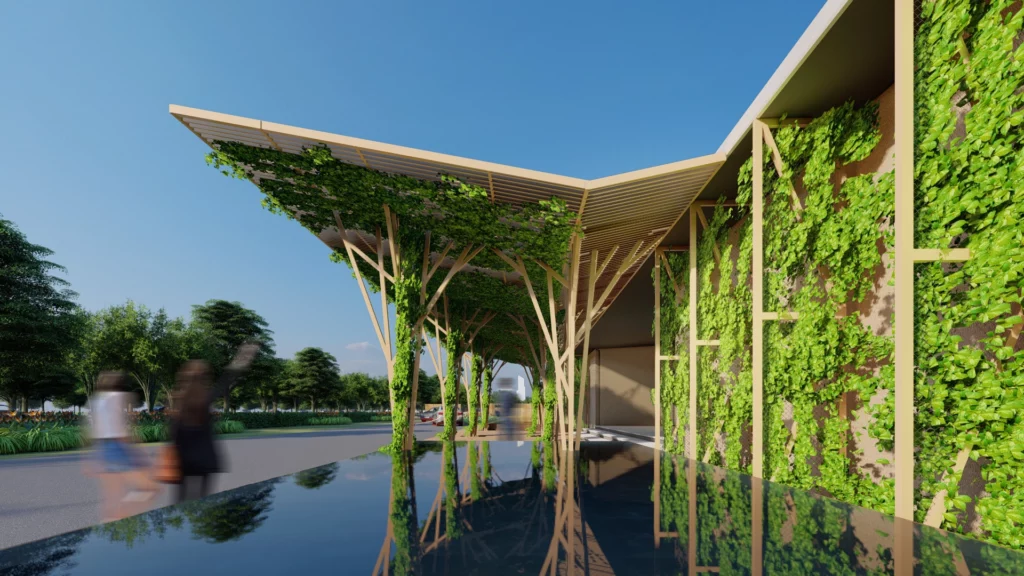
Orientation, façade depth, solar shading, thermal mass, materials, patios, overhangs, glazing, walkways and ventilation determine a significant proportion of the hours of comfort before any active equipment is required. A façade that allows too much solar radiation to enter subsequently turns the cooling system into a permanent corrective measure.
The building envelope becomes a climatic interface. This approach forms one of the foundations of passive cooling and contributes directly to the building’s thermal comfort.
SageGlass’s dynamic glazing illustrates this function. The electrochromic glazing modulates light transmission and solar gain. The architectural benefit lies in striking a balance between natural light, glare, visual comfort and cooling load.
Radiative cooling is further changing the role of surfaces. SkyCool Systems is developing panels capable of radiating heat away into the sky. The ARPA-E programme presents this approach as a way of reducing the energy requirements of certain commercial and industrial cooling systems.
In Hong Kong, i2Cool, a spin-off from the City University of Hong Kong, is developing paints and coatings that utilise passive radiative cooling. The principle involves reflecting some of the solar radiation and emitting heat within an infrared window, enabling heat exchange with the sky.
These solutions are not universally applicable. Their performance depends on the local climate, humidity, cloud cover, available surface area, exposure, maintenance and how they are integrated into the building.
Their value lies elsewhere: they demonstrate that a building’s envelope can help reduce the amount of heat that needs to be managed, rather than transferring it to mechanical systems.
In Hong Kong, it’s always hot and humid in the summer, and the temperature indoors can even be higher than outdoors. Air-con is a solution, but electricity bills are so high, and it’s environmentally unfriendly! © i2cool
Humidity plays a part in thermal comfort
Temperature alone is not sufficient to describe perceived heat. Thermal comfort also depends on humidity, air velocity, radiant temperature, the occupants’ activity and their clothing.
The ASHRAE 55 standard formalises this approach by combining environmental and human factors to assess acceptable thermal conditions. This distinction changes how we view innovations.
In hot and humid climates, a significant proportion of the energy used for air conditioning is spent removing moisture from the air. Several companies are therefore seeking to separate dehumidification from cooling more precisely.
Transaera, which grew out of research at MIT, uses metal-organic framework materials to remove moisture from the air before cooling. Blue Frontier is developing a desiccant-based air-conditioning system with integrated storage, a technology that combines cooling, dehumidification and storage.
This represents a significant shift in thinking. The aim is not to produce cold air uniformly, but to address the physical components of comfort in the correct order.
In certain climates, removing moisture using less energy can be just as important as lowering the temperature.
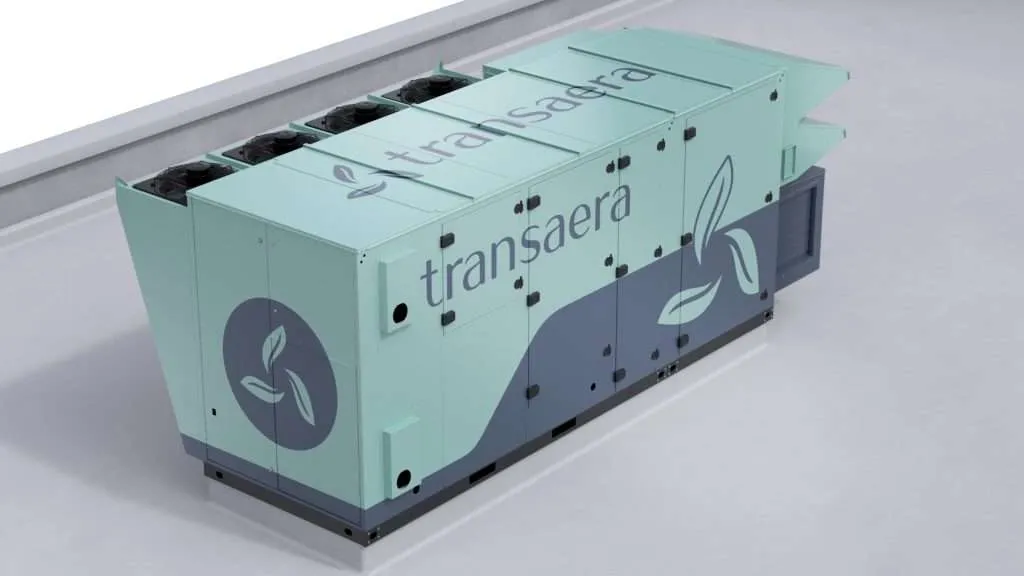
Advanced rooftop units remove humidity before cooling the air. This cuts the energy use and emissions needed to keep buildings comfortable. © Transaera
Thermal storage: producing cooling at the right time
Cooling has a strategic advantage: it can be shifted over time.
Heat peaks also become peaks in electricity demand. When many buildings are cooled simultaneously, the problem moves beyond the building and affects the grid. The issue is no longer just about installed capacity. It is about when cooling is produced, stored and consumed.
Thermal storage addresses this challenge.
Nostromo Energy develops ice-based thermal storage systems for commercial and industrial buildings. In 2024, the US Department of Energy announced a conditional loan guarantee commitment of up to $305.54 million to fund Project IceBrick, a virtual power plant project linking up to 193 thermal storage installations in commercial buildings across California.
This approach transforms the building into a source of flexibility. Cooling can be generated when the grid is under less strain, and then used during peak demand periods. At the scale of a campus, a hospital, an airport or a property portfolio, hours of useful cooling become a plannable resource.
Both the operator and the owner stand to benefit from this reasoning. It helps to reduce the power demand during peak periods, improve continuity of use and make comfort less dependent on the exact moment when the need arises.
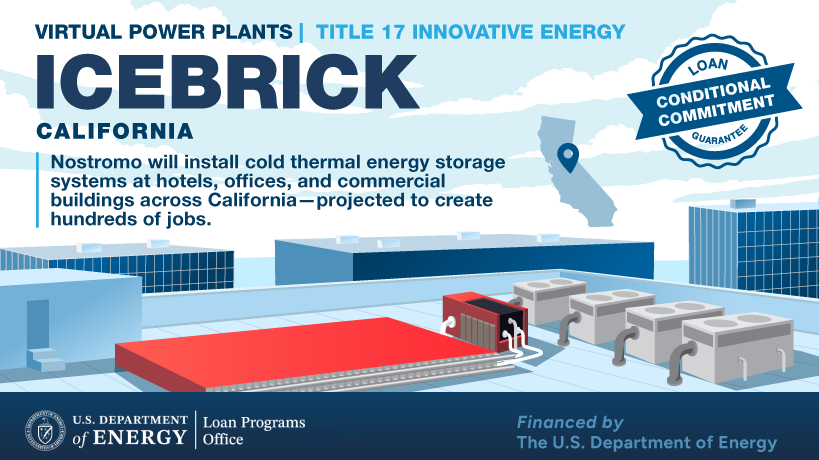
On December 9. 2024, LPO announced a conditional commitment for a loan guarantee of up to $305.54 million to finance Project IceBrick, a VPP consisting of up to 193 cold thermal energy storage installations at commercial buildings across California. © U.S. Department of Energy
Managing thermal comfort using data and artificial intelligence
Buildings already have equipment, sensors, control systems and data. Their weakness often lies in coordination.
A ventilation system may operate at the wrong time. Sunshades may remain open before a heatwave. A cooling system may compensate for heat that the building envelope could have limited. Areas may be cooled when unoccupied, whilst others become uncomfortable.
Artificial intelligence-driven control platforms and digital twins tackle this operational inefficiency.
BrainBox AI is developing an autonomous optimisation platform for HVAC systems.
PassiveLogic is working on physical models, digital twins and autonomous control systems for buildings.
Value is realised when the data helps to improve a practical decision: pre-cooling at the right time, closing sun blinds before critical exposure, ventilating when the outside air becomes favourable again, adjusting setpoints according to actual occupancy, and relocating certain activities to the most comfortable areas.
This digital layer also introduces new requirements. The performance figures provided must be verified on site. Models must remain understandable to operators. Cybersecurity, data quality, maintenance and the ability to take manual control are becoming prerequisites for use.
Controlled cooling is therefore a matter of operational governance. It requires both a decision-making framework and a technical framework.
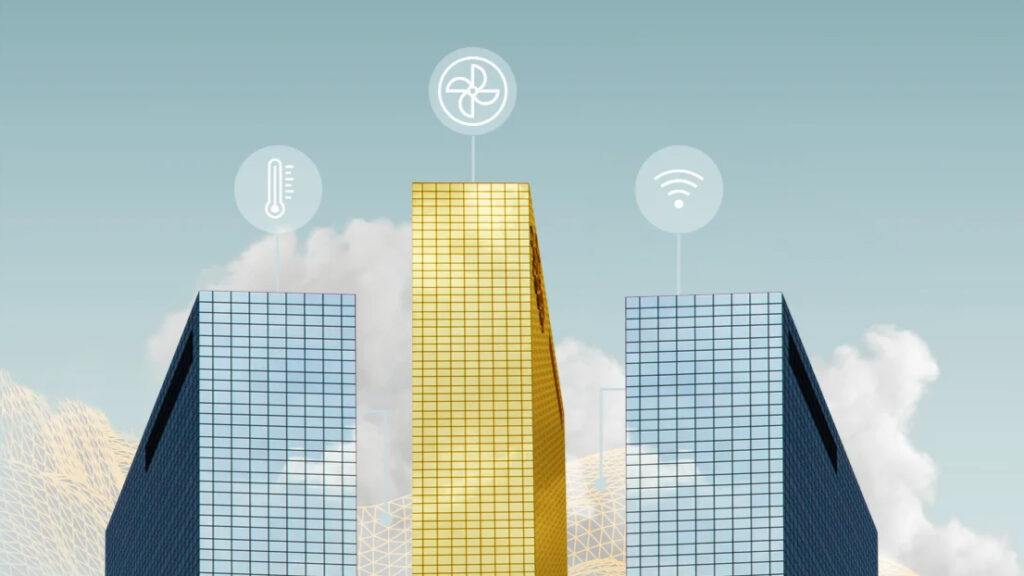
The future of building management is in the cloud. © BrainBox AI
Climate adaptation: when cooling becomes infrastructure
Some needs extend beyond the individual building. Dense neighbourhoods, hospitals, museums, railway stations, campuses and business centres can access shared cooling via district cooling networks. Such infrastructure does not preclude architectural choices; it simply changes the scale of the solution.
In Toronto, Enwave operates the Deep Lake Water Cooling system, which uses the cold waters of Lake Ontario to cool hospitals, data centres, campuses, public buildings, and commercial and residential properties in the city centre.
In Singapore, SP Group presents district cooling as an urban service distributing chilled water to multiple buildings. Its Marina Bay network illustrates a shared-resource approach in a hot and humid climate, where space, energy and service continuity are major constraints.
In Paris, Fraîcheur de Paris operates an urban cooling network that provides collective cooling for more than 800 buildings. The French example is just one among many here; it is useful for understanding the infrastructure rationale, but secondary in the context of a global issue.
These networks demonstrate that cooling can be planned, distributed and prioritised. It depends on water, subsoil, heat exchangers, networks, surface materials, shade, land uses and local governance.
Architecture does not disappear into the infrastructure. It connects with it.
Factors influencing thermal comfort in buildings
The thermal comfort of buildings depends on several complementary factors. No single solution can address the challenges of climate adaptation on its own. The most resilient buildings generally combine:
- passive cooling to limit heat gain;
- high-performance building envelopes and solar shading;
- humidity control to improve thermal comfort;
- energy-efficient cooling systems;
- thermal storage to shift cooling demand;
- smart control of equipment using data;
- district cooling infrastructure where the scale of the area permits.
The aim is no longer simply to produce cooling, but to maintain thermal comfort in the long term whilst reducing energy consumption and improving buildings’ climate adaptation.
The ‘useful cooling’ chain
The ‘useful cooling’ chain can be broken down into seven functions.
Firstly, measure the hours of overheating.
Then, reduce solar gain.
Delay heat build-up.
Manage humidity.
Generate cooling using less energy.
Store or shift demand.
Distribute cooling to priority uses.
This chain changes the trade-offs. Dynamic glazing, radiative paint, a thermal battery, AI-controlled systems or a cooling network should not be compared as competing solutions. They do not operate in the same way. Their value depends on their function, the climate in which they are used, how they are integrated and their ability to reduce critical hours.
It also avoids a common mistake: thinking solely in terms of average performance. The climate exposes buildings to specific periods. It is these periods that reveal the true robustness of a building’s design.
The key question then becomes: how many hours of comfort can a building provide when outdoor conditions become unfavourable, and what are the associated energy consumption, reliance on the grid, air quality and accessibility for occupants?
This question alters the trade-offs faced by the client, the architect, the engineer, the operator, the insurer, the local authority and the end user.
Designing for habitable hours to enhance thermal comfort
Low-carbon construction remains essential. Climate adaptation now adds a further requirement: to sustainably maintain thermal comfort despite more frequent and intense heatwaves.
The most robust solutions do not promise unlimited coolness. They reduce the amount of heat that needs to be managed, produce cooling more efficiently, shift part of the demand, protect critical functions and connect the building to wider infrastructure where relevant.
This new architectural requirement lies in this capacity: to create habitable hours.
Hours for sleeping, learning, working, caring for others, waiting, welcoming people and producing. Hours that prevent every heatwave from turning into an energy crisis. Hours that give the building an active role in climate management.
Cooling is becoming a key design consideration.