


In the decision-making sphere, success is often measured in terms of financial results. But for a child born with a rare medical condition, success is defined by a step taken, a word spoken or a social bond re-established. Today, Medtech and pediatric innovations are profoundly transforming the way children’s health is understood, diagnosed and treated. The challenge goes beyond the medical sphere to touch on the heart of our responsibility: restoring dignity to children by refusing to reduce them to a diagnosis, in order to unleash their full potential.
Neglected for a long time in favour of more mature markets such as the silver economy, pediatric medicine is undergoing a structural revolution. In 2026, Medtech will no longer be satisfied with treating patients: it will repair life trajectories. Investing in children’s health means protecting the only asset whose value is infinite: tomorrow’s human capital. This choice transforms a public health cost into a high-yield societal investment, unlocking the potential of caregiving families in the process.
Medtech refers to all innovative medical technologies incorporating artificial intelligence, robotics, connected devices and digital therapies. Applied to pediatric medicine, Medtech is driving a new generation of pediatric medical devices and digital innovations. This dynamic is part of the broader bioconvergence movement, where biology, data and engineering converge to transform healthcare models in a sustainable way.
Medtech and data for early diagnosis and rare diseases
It all starts with removing uncertainty. Medtech is now using artificial intelligence to reduce diagnostic uncertainty. The company Healx exemplifies this new generation of pediatric innovations by repositioning molecules for orphan diseases affecting children. This approach accelerates research that would previously have taken decades, thanks to artificial intelligence. It also reduces development times by capitalizing on existing safety data, a major advantage for pediatric populations that are often neglected by conventional clinical trials.
At the same time, with Butterfly Network, Medtech is miniaturizing medical imaging and democratizing diagnosis with pocket-sized ultrasound scanners that allow immediate visualization at the patient’s bedside. This technological breakthrough transforms every doctor’s surgery into a precision imaging center, avoiding critical waiting times in overcrowded hospitals.
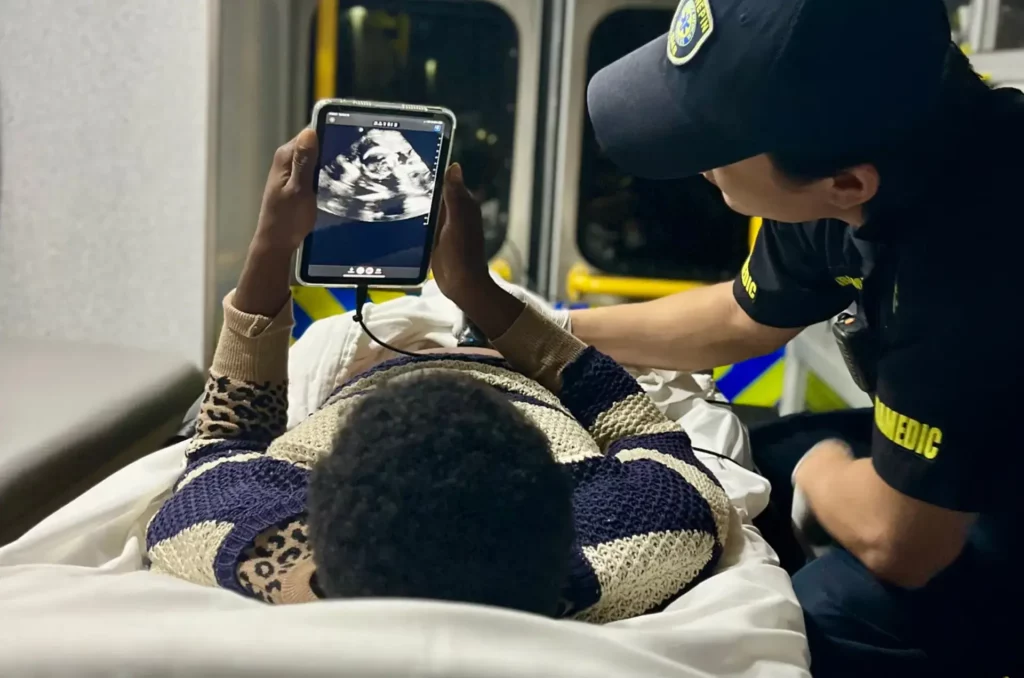
In partnership with Butterfly Network, Hennepin EMS has integrated pre-hospital ultrasound to optimize diagnosis and care. © Butterfly Network
By miniaturizing complex technology, innovation eliminates the anxiety associated with invasive examinations and enables agile care. This speed is the first link in a value chain where every second saved is a victory over fate, drawing on data from NORD (National Organization for Rare Disorders) and Global Genes to target the most urgent needs.
Emotional convergence: making healthcare a driver of fulfilment
According to the WHO (World Health Organisation), around 20% of young people suffer from mental or neurodevelopmental disorders. Treatment should no longer be a constraint, but a catalyst for independence. The challenge is to orchestrate solutions that respect the psychological integrity of the patient. In the field of digital pediatric innovations, Akili Interactive is redefining children’s mental health through its digital therapies. Their platform, EndeavorRx®, is the first video game treatment authorized by the Food and Drug Administration (FDA). By targeting neural networks through sensory stimuli, the technology transforms treatment into a natural extension of a child’s playful world, ensuring unprecedented compliance. Their digital therapy demonstrates that Medtech can transform treatment into an engaging experience.
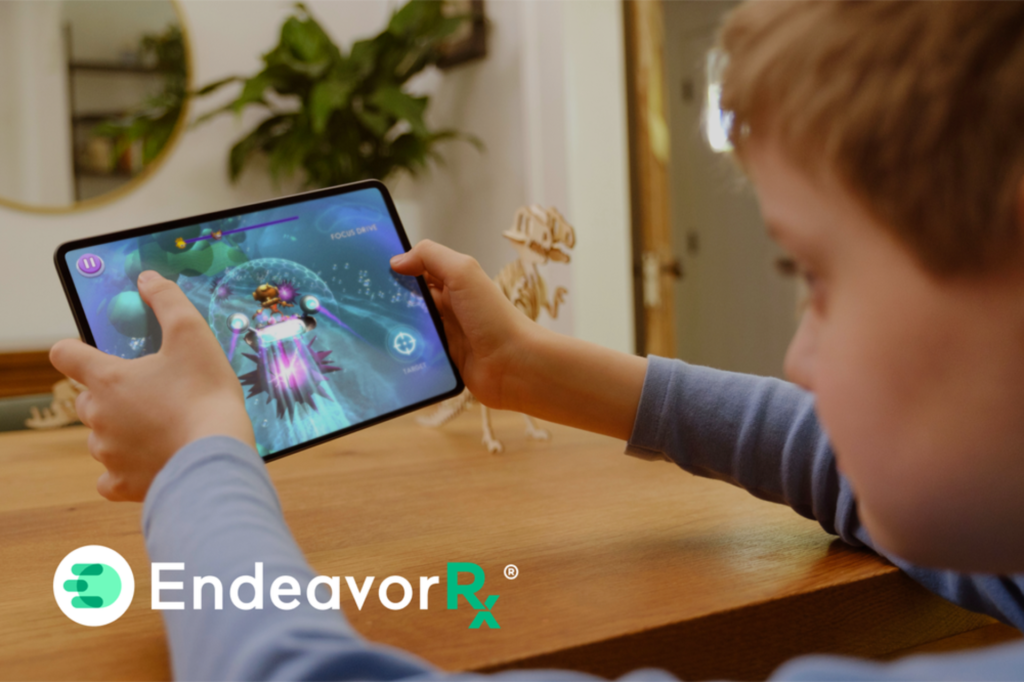
Developed by Akili Interactive, this device is the only medically prescribed video game treatment for children with ADHD (Attention Deficit Hyperactivity Disorder). © Akili Interactive
For neuroatypical profiles, Moxie Robot‘s companion robot named Moxie uses emotional artificial intelligence to break social isolation. By acting as a safe space for social interaction, it allows for more social-emotional learning sessions without overburdening the healthcare system’s often stretched human resources.
The story of Moxie, the companion robot with emotional AI, 18 February 2026. © Moxie Robot. Inc
Medtech and pediatric medical devices: restoring independence
The ultimate holistic goal is to guarantee patient independence by replacing the notion of disability with that of identity. While the WHO highlights the urgent need for 30 million people to access medical devices, Open Bionics illustrates how Medtech is becoming a vehicle for identity: by reinventing the connection to the body through the prism of wonder.
By incorporating the aesthetic codes of universal heroes such as Gwen Stacy and Spiderman, their pediatric medical devices become vehicles for ‘superformance’ in the eyes of those around them: the child no longer wears an aid, but an attribute of identity that arouses admiration rather than embarrassment. This aesthetic and psychological transformation is the final stage of inclusion.
Medtech does not replace traditional medicine: it enhances it.
Through these pediatric medical devices and digital innovations, technology is redefining diagnosis, treatment, inclusion and independence.
By radically changing social perceptions, this dynamic does more than simply replace a limb; it restores irreversible social pride. This allows the child to permanently leave behind the status of patient and become a citizen, in control of their own narrative and proud of their uniqueness. This allows the child to permanently leave behind their status as a patient and become a citizen, in control of their own story and proud of their uniqueness.
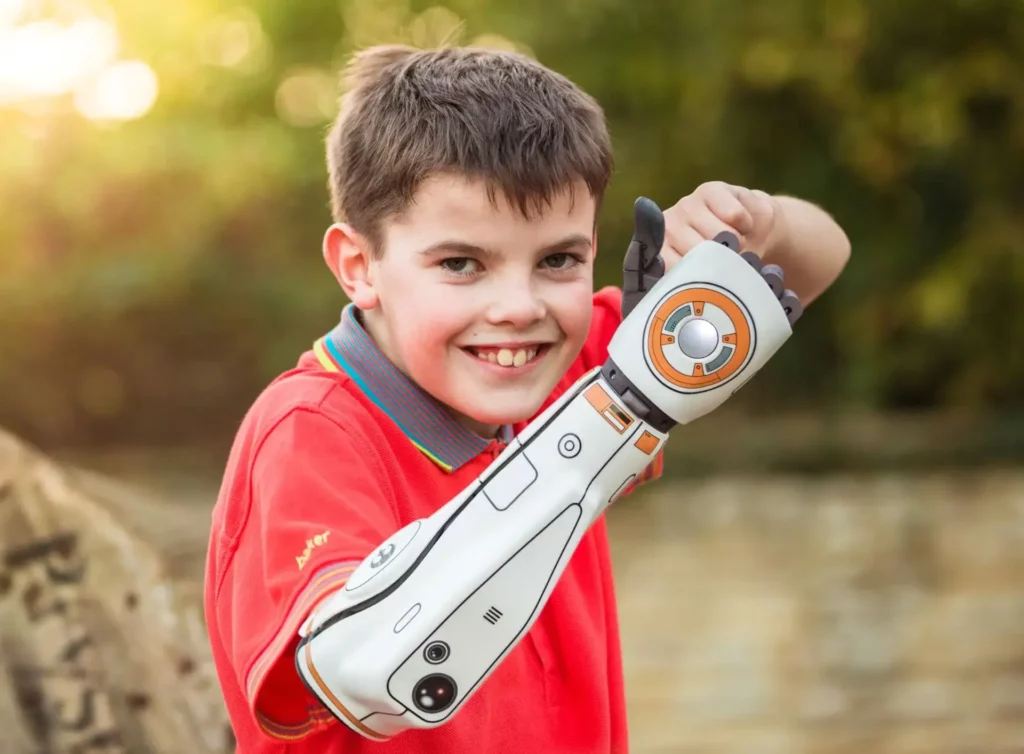
Cameron said: “I love the Hero Arm and these new covers. I feel a lot like Luke Skywalker, my favourite Star Wars character, because he has a bionic hand too.” © Open Bionics
Checklist: Reshaping the future
Leaving behind the status of patient to enable children to write their own stories.
- Reducing uncertainty and shortening diagnosis times to end the wandering. Healx / Butterfly Network
- Healing without trauma: transforming medical constraints into a fun and rewarding experience. Akili Interactive
- Breaking out of isolation: restoring interaction skills and social connections through technological empathy. named Moxie
- Reconnecting with pride: replacing medical devices with heroic attributes to change how others see them… then finding a cape! Open Bionics