


In the decision-making sphere, success is often measured in terms of financial results. But for a child born with a rare medical condition, success is defined by a step taken, a word spoken or a social bond re-established. Today, Medtech and pediatric innovations are profoundly transforming the way children’s health is understood, diagnosed and treated. The challenge goes beyond the medical sphere to touch on the heart of our responsibility: restoring dignity to children by refusing to reduce them to a diagnosis, in order to unleash their full potential.
Neglected for a long time in favour of more mature markets such as the silver economy, pediatric medicine is undergoing a structural revolution. In 2026, Medtech will no longer be satisfied with treating patients: it will repair life trajectories. Investing in children’s health means protecting the only asset whose value is infinite: tomorrow’s human capital. This choice transforms a public health cost into a high-yield societal investment, unlocking the potential of caregiving families in the process.
Medtech refers to all innovative medical technologies incorporating artificial intelligence, robotics, connected devices and digital therapies. Applied to pediatric medicine, Medtech is driving a new generation of pediatric medical devices and digital innovations. This dynamic is part of the broader bioconvergence movement, where biology, data and engineering converge to transform healthcare models in a sustainable way.
Medtech and data for early diagnosis and rare diseases
It all starts with removing uncertainty. Medtech is now using artificial intelligence to reduce diagnostic uncertainty. The company Healx exemplifies this new generation of pediatric innovations by repositioning molecules for orphan diseases affecting children. This approach accelerates research that would previously have taken decades, thanks to artificial intelligence. It also reduces development times by capitalizing on existing safety data, a major advantage for pediatric populations that are often neglected by conventional clinical trials.
At the same time, with Butterfly Network, Medtech is miniaturizing medical imaging and democratizing diagnosis with pocket-sized ultrasound scanners that allow immediate visualization at the patient’s bedside. This technological breakthrough transforms every doctor’s surgery into a precision imaging center, avoiding critical waiting times in overcrowded hospitals.
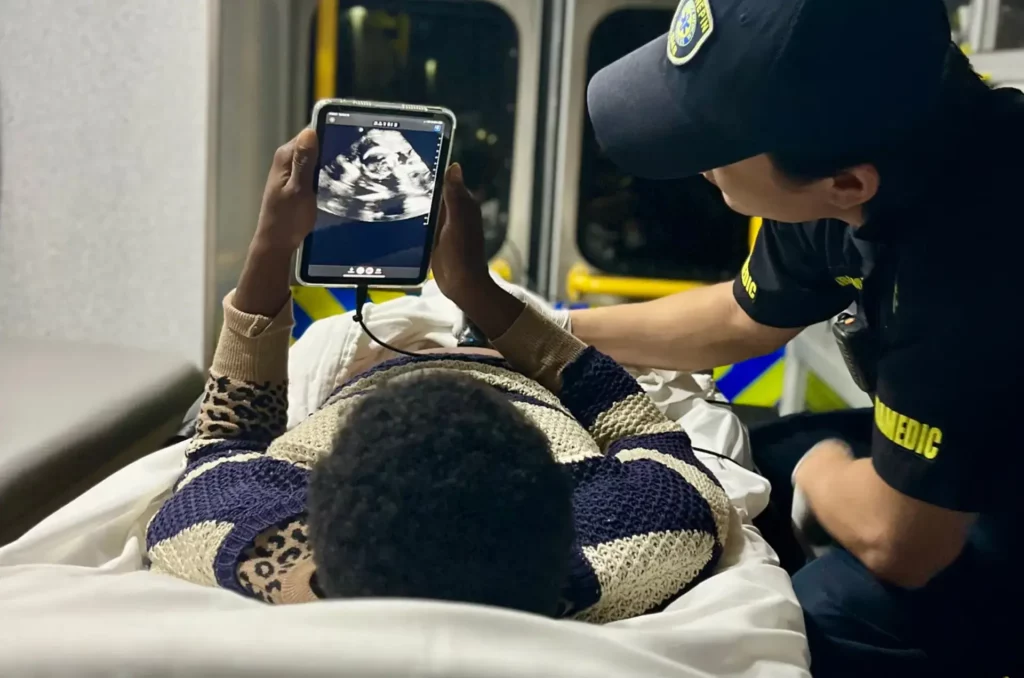
In partnership with Butterfly Network, Hennepin EMS has integrated pre-hospital ultrasound to optimize diagnosis and care.
By miniaturizing complex technology, innovation eliminates the anxiety associated with invasive examinations and enables agile care. This speed is the first link in a value chain where every second saved is a victory over fate, drawing on data from NORD (National Organization for Rare Disorders) and Global Genes to target the most urgent needs.
Emotional convergence: making healthcare a driver of fulfilment
According to the WHO (World Health Organisation), around 20% of young people suffer from mental or neurodevelopmental disorders. Treatment should no longer be a constraint, but a catalyst for independence. The challenge is to orchestrate solutions that respect the psychological integrity of the patient. In the field of digital pediatric innovations, Akili Interactive is redefining children’s mental health through its digital therapies. Their platform, EndeavorRx®, is the first video game treatment authorized by the Food and Drug Administration (FDA). By targeting neural networks through sensory stimuli, the technology transforms treatment into a natural extension of a child’s playful world, ensuring unprecedented compliance. Their digital therapy demonstrates that Medtech can transform treatment into an engaging experience.
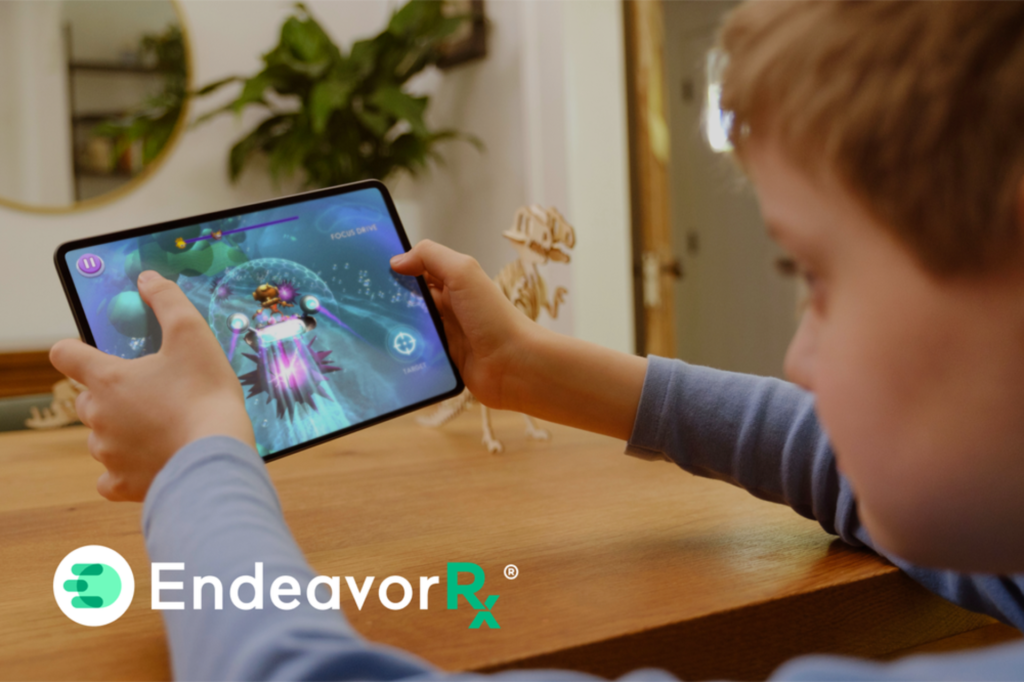
Signé Akili Interactive, ce dispositif est l’unique traitement par jeu vidéo sous prescription médicale destiné aux enfants avec un TDAH (Troubles du Déficit de l’Attention avec ou sans Hyperactivité)
Pour les profils neuroatypiques, le robot compagnon Moxie d’Embodied utilise une intelligence artificielle émotionnelle pour briser l’isolement social. En agissant comme un laboratoire social sécurisant, il permet de multiplier les sessions de social-emotional learning sans surcharger les ressources humaines, souvent saturées, du système de santé.
L’histoire de Moxie, le robot compagnon doté d’une IA émotionnelle, 18 février 2026
Medtech, robotique et inclusion : restaurer l’autonomie
L’objectif holistique ultime est de garantir l’autonomie du patient en substituant la notion de déficit par celle d’identité. Alors que la WHO souligne l’urgence pour 30 millions de personnes d’accéder à des appareillages, Open Bionics illustre comment la Medtech devient vecteur d’identité : en réinventant le lien au corps par le prisme du merveilleux.
En intégrant les codes esthétiques de héros universels comme Gwen stacy et Spiderman, le dispositif devient un vecteur de “superformance” aux yeux de l’entourage : l’enfant n’arbore plus une assistance, mais un attribut d’identité qui suscite l’admiration plutôt que la gêne. Cette mutation esthétique et psychologique est le stade final de l’inclusion.
La Medtech ne remplace pas la médecine traditionnelle : elle l’augmente.
À travers ces innovations pédiatriques, la technologie redéfinit le diagnostic, le traitement, l’inclusion et l’autonomie.
En changeant radicalement le regard social, cette dynamique ne se contente pas de remplacer un membre ; elle restaure une fierté sociale irréversible. On permet ainsi à l’enfant de quitter définitivement le statut de patient pour celui de citoyen, maître de son récit et fier de sa singularité.
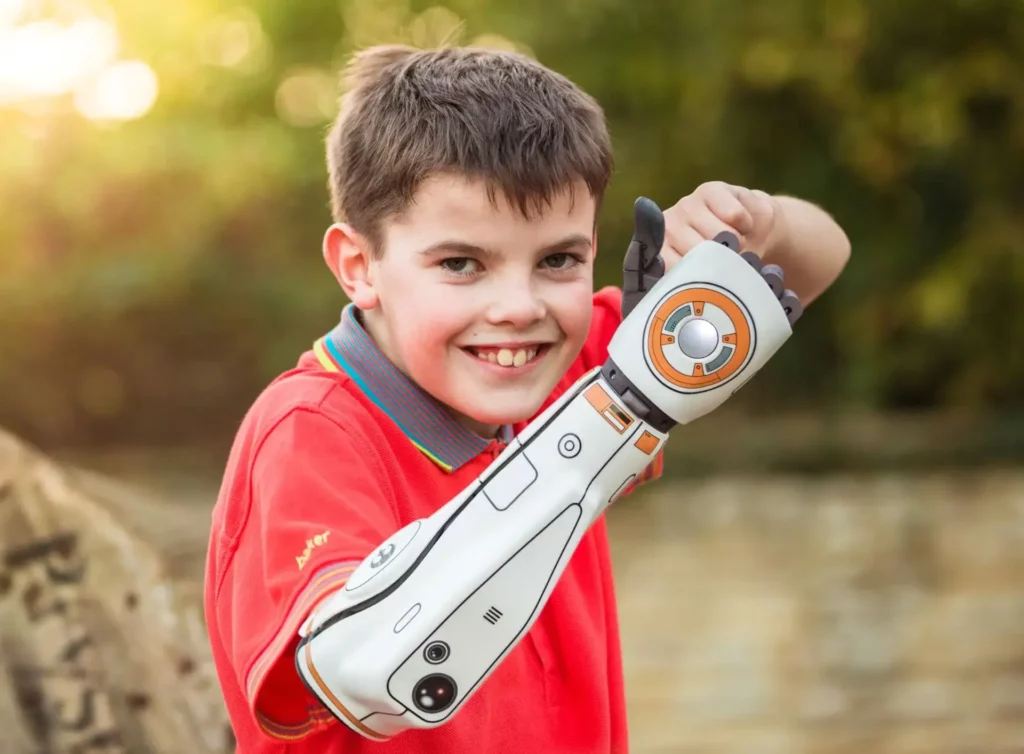
Cameron témoigne : « J’adore le Hero Arm et ces nouvelles coques. Je me sens très proche de Luke Skywalker, mon personnage préféré de Star Wars, car lui aussi a une main bionique. »
Checklist “Redessiner l’horizon”
Quitter la condition de patient pour permettre à l’enfant d’écrire son propre récit.
- Résorber l’errance en réduisant les délais de diagnostic et le poids de l’incertitude. Healx / Butterfly Network
- Soigner sans trauma : transformer la contrainte médicale en une expérience ludique et valorisante. Akili Interactive
- Sortir de l’isolement : restaurer les capacités d’interaction et le lien social par l’empathie technologique. Embodied
- Renouer avec la fierté : remplacer le dispositif médical par un attribut de héros pour changer le regard des autres… puis trouver une cape ! Open Bionics