

N°4 – A series of articles on deep tech innovation between France and South Korea
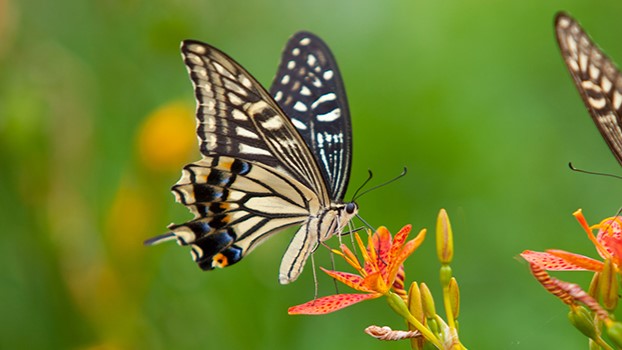
“I believe I can fly, I believe I can touch AI!”: After that poetic flight of fancy, here’s a bit of substance in the service of global deep tech. For entomologists, the study of insects is evolving into a blueprint for the most disruptive nanometric architectures. It forms one of the foundations of biomimicry, capable of guiding the software and optics sectors, particularly in the field of advanced photonics. Today, this biomimicry is emerging as a key driver of transformation for deep tech.
This analysis explores how these fragile wonders of nature are redefining our paradigms, from cutting-edge South Korean laboratories to French centers of excellence. It recalls the framework of the Global Partnership for the 21st Century, established in 2004 and reinforced by a strategic roadmap (2021–2025). This document, supported by the Ministry for Europe and Foreign Affairs, establishes technological sovereignty and innovation as pillars of the bilateral relationship. Between French expertise in biophotonics and South Korea’s industrial agility, the butterfly becomes the vehicle for a shared scientific ambition. The biomimicry of the butterfly thus becomes a strategic field of exploration at the intersection of science, culture, and innovation, particularly in photonic technologies inspired by living organisms.
Biodiversity in Decline: The Reality
The warning signs are systemic: the decline in moth populations directly threatens the foundation of our technological breakthroughs. According to consolidated data from the European Environment Agency (EEA), the meadow butterfly index in the European Union plummeted by 50% between 1991 and 2023.
This decline is particularly critical for specialist species. Unlike “generalists,” these insects depend on a single host plant or a very limited habitat, making them extremely vulnerable to even the slightest disruption of their ecosystem. The EEA report identifies two main drivers of this collapse:
- Agricultural intensification: through the massive use of agrochemicals that destroy host plants.
- Land abandonment: leading to the irreversible fragmentation of natural habitats.
From an engineering perspective, each extinction represents an irretrievable loss of data: millions of years of natural R&D are erased before we have even recovered the code. This decline directly undermines butterfly biomimicry, a critical source of innovation, particularly for advances in biomimetic photonics.
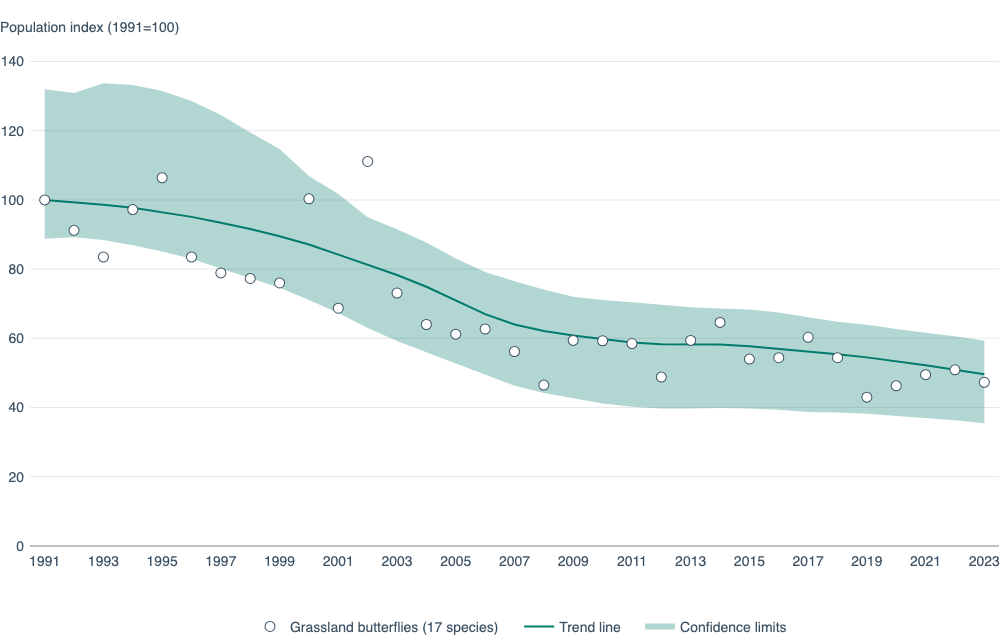
EU grassland butterfly index 1991-2023 Technical report, Butterfly conservation Europe, European butterfly monitoring scheme partnership, EMBRACE project. © European Environment Agency
At the same time, climate projections reveal phenological shifts. This desynchronization between the hatching period of caterpillars and the peak flowering period of their host plants disrupts fundamental life cycles. In South Korea, the National Institute of Biological Resources (NIBR) (국립생물자원관) highlights a similar urgency: recent data show a 34% decline in the distribution of endemic butterfly species over the past two decades, driven by rapid urbanization.
A major study published in 2025 in the Journal of Asia-Pacific Entomology documents this urgency. By analyzing a century of data (1928–2024), researchers reveal that fifteen species are experiencing a drastic contraction of their range. The findings are unequivocal: three species—Aporia crataegi, Plebejus subsolanus, and Burara striata—have not been observed since 1998, indicating near-certain local extinction. The study identifies two critical factors: the STI (Species Temperature Index) and habitat type. Species specialized in open environments and adapted to cold conditions (low STI) are the hardest hit by thermal disruption and land fragmentation. This decline confirms a systemic shift.
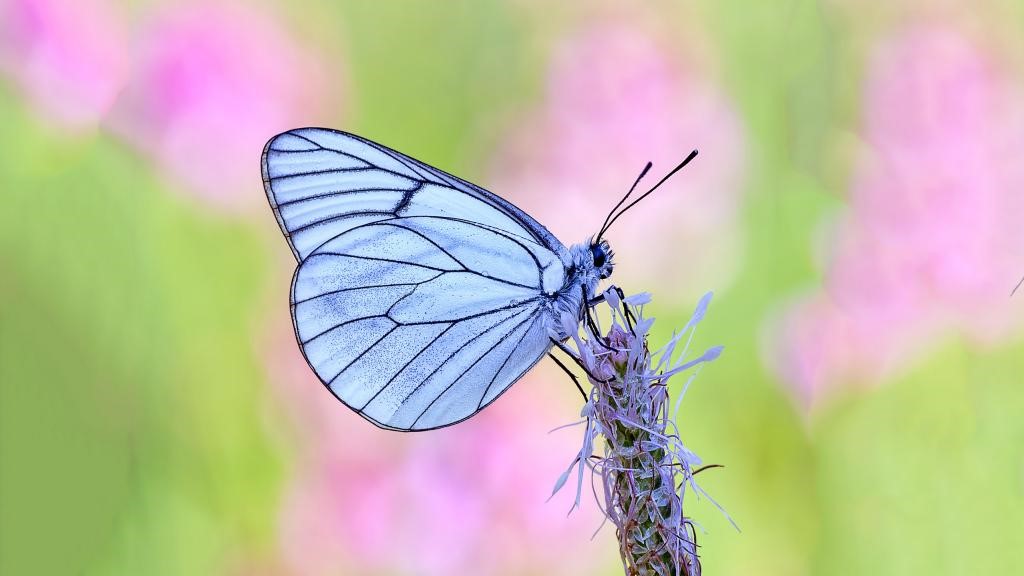
Aporia crataegi — The species has not been sighted in the British Isles since 1925 or in Korea since 1998. © Butterfly Conservation
In response to this decline, the KBR, National Biodiversity Center (국가생물다양성센터) is implementing its National Biodiversity Strategy. Similarly, the European Commission is tightening its regulatory framework with the new Nature Restoration Regulation, (NRR). This legislation specifically targets the restoration of agricultural ecosystems, where intensification and fragmentation have the most detrimental effects.
It now mandates mandatory restoration pathways by 2030, transforming the meadow butterfly index into a true regulatory KPI (Key Performance Indicator) for member states. For deep tech, this regeneration is a measure that is as ethical as it is necessary to preserve the source of innovation.
The Sacred Insect: From the Legacy of Seok Ju Myeong (석주명) to the Roots of Deep Tech
In Korea, the butterfly (나비) embodies a millennia-old symbolism of prosperity, joy, and longevity. An object of fascination during the Joseon Dynasty, it permeates art and classical narratives as an omen of happiness or an incarnation of souls (source : The Korea Times).
This intimate relationship between humans and insects reached its scientific peak in the work of Seok Ju Myeong (석주명), nicknamed the “Butterfly Doctor (나비박사).” His classification work, culminating in the publication of his synonymic list in 1940 by the Royal Asiatic Society, revolutionized local entomology: by demonstrating that many “species” identified during the colonial era were merely individual variations, he reduced the national count from 921 to 248 species (source: Penn State University). This legacy, in which academic rigor dispelled the approximations of the past, forms the foundation of a unique national expertise.
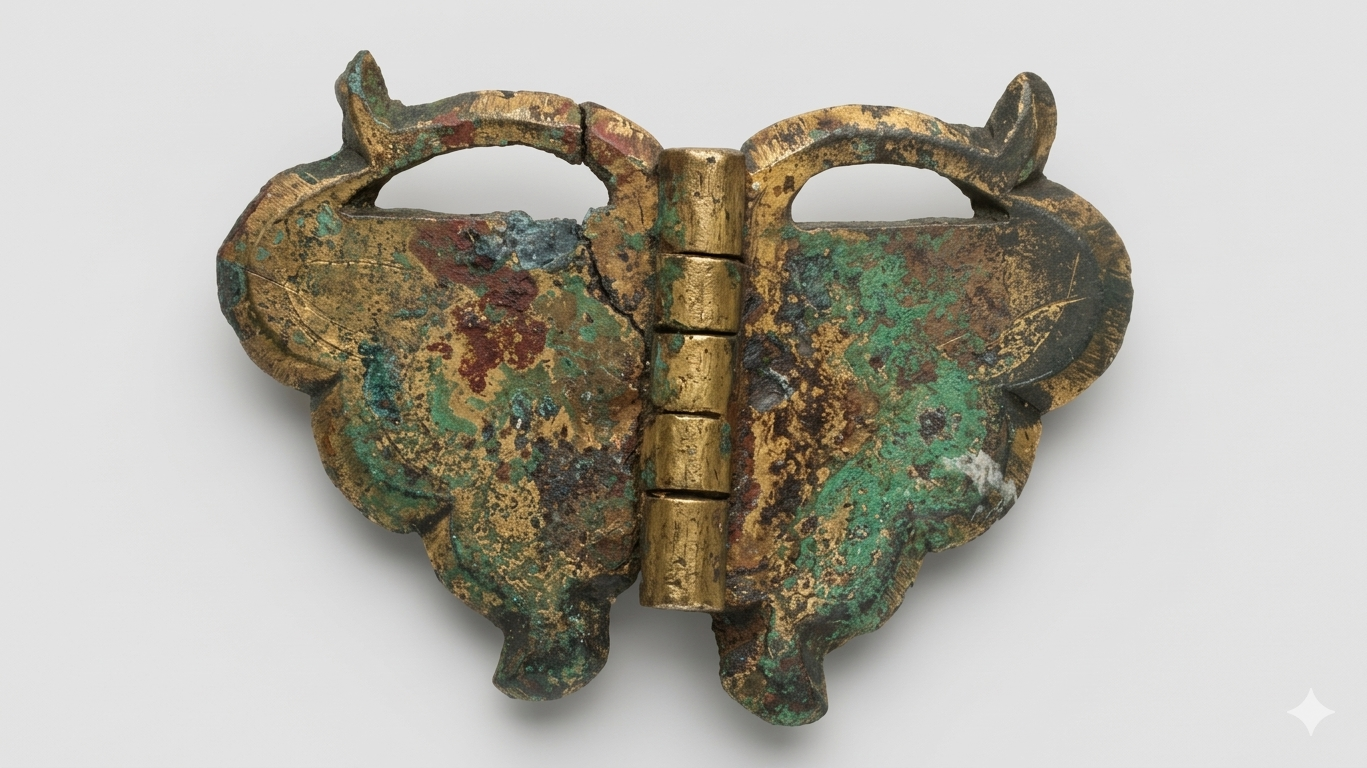
Gilt-bronze butterfly-shaped hinge, Goryeo dynasty – Copper alloy – 5,5 cm © National Museum of Korea
This blend of culture and science comes to life today at the Hampyeong Butterfly Festival (함평나비대축제). A global pioneer in eco-friendly celebrations, the event transforms 1,090,000 square meters of farmland each year into a living sanctuary where tens of thousands of butterflies flutter over fields of rapeseed and phlox. As highlighted by Mokpo MBC Newsdesk (목포MBC 뉴스데스크), the 28th edition culminates in a butterfly release where educational wonder meets scientific observation: in the ecology halls, sixty native species reveal their complete life cycle, from caterpillar to adult, offering a total immersion in the mechanisms of metamorphosis.
Beyond this poetry and cultural fervor, the butterfly is a constant challenge to the laws of physics. Its light wings conceal photonic architectures and mathematical patterns of such efficiency that supercomputers are only just beginning to mimic them. It is this structural efficiency that fuels fundamental research. This approach perfectly illustrates the power of biomimicry applied to algorithmic architectures.
“Butterfly Children Are Real! Butterfly Release Ceremony,” 28th Hampyeong Butterfly Festival © Mokpo MBC Newsdesk – 목포MBC뉴스데스크
The Butterfly Effect: From Geometry to Signal
Macro Scale
To address the explosive growth in computational demands, engineers at Samsung Research (삼성리서치) are using matrix structures known as butterfly patterns. The name derives from the interlaced flowcharts used in signal processing.
This co-design of software and hardware enables a decisive technological breakthrough: it transforms the quadratic growth of the attention mechanism (where doubling the data quadruples the computational effort) into a nearly linear progression (where the computational effort scales almost proportionally with the volume of data). By replacing the brute force of dense models with this hierarchy of sparse connections, Samsung Research (삼성리서치) achieves unprecedented performance:
- Computational acceleration: 10.2 to 66.2 times faster than industry standards.
- Parameter compression: volume reduction by a factor of 2.1 to 22.
- Edge AI efficiency: maintaining optimal accuracy on lightweight mobile chips.
This approach mirrors the frugality of living organisms. It marks the end of energy waste in favor of agile intelligence, modeled after the efficiency of insects.
Photonics: The Structural Brilliance of the Morpho
Micro-scale
Among the fields most impacted by biomimicry, photonics has emerged as a major frontier for innovation. In this field, the Morpho butterfly has become a global benchmark. The butterfly’s biomimicry thus serves as a scientific benchmark for designing next-generation optical materials, at the heart of applied photonics. This pursuit of biomimicry is actively led by KAIST (한국과학기술원), the Korea Advanced Institute of Science and Technology (한국과학기술원), which has published groundbreaking research on the biomimetic reconstruction of butterfly scale nanostructures.
Researchers have successfully replicated these complex architectures to design optical devices and high-resolution reflective displays. By physically mimicking the geometry of the scales, this technology enables the display of vivid colors without the use of polluting chemical dyes, while minimizing the energy consumption of future devices.
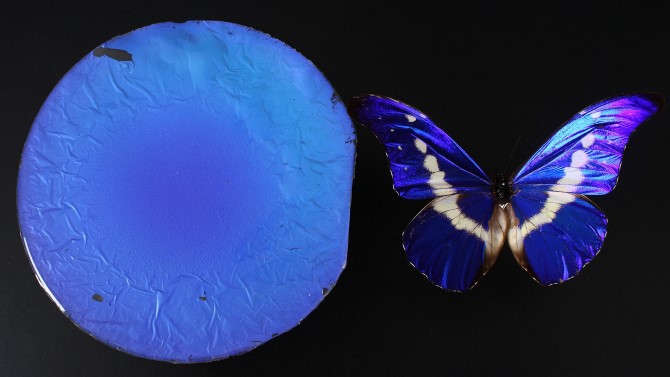
The biomimetic display and a Morpho butterfly © KAIST
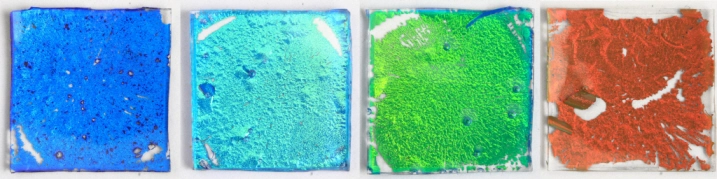
The biomimetic film can express many different color.© KAIST
Beyond iridescence, researchers are exploiting the “quasi-ordered” architecture of scales to design photonic glasses. This innovation, documented in Advanced Optical Materials, is based on a fusion of expertise: the use of cutting-edge numerical methods (coupled-wave analysis, finite element method) to model biological systems.
These simulations optimize complex manufacturing processes—such as electron beam lithography or chemical vapor deposition—to produce large-scale industrial replicas. By mimicking this natural disorder, this technology simplifies the production of high-performance light diffusers. The result: a new generation of LEDs and displays offering optimal brightness and color accuracy from all angles, without excessive energy consumption.
Biophotonics: French Excellence
In France, physicist Serge Berthier of the INSP (Institut des Nano Sciences de Paris), a center of research excellence jointly administered by Sorbonne University and the CNRS (UMR 7588), is a world-renowned authority on biophotonics, a key subfield of photonics inspired by living organisms. His work within the Acoustics and Optics for Nanosciences team demonstrates that the Morpho’s iridescence results from a nanoscale “Christmas tree” structure.
This complex geometry creates constructive interference: it selectively reflects pure blue while absorbing other wavelengths, all without any pigment.
Impact and Industrial Applications
- Academic Expertise: Serge Berthier’s seminars at the Collège de France explore this photonic complexity of living organisms.
- Innovation: His research inspires industry to create “eternal” colors (UV-resistant) and ultra-sensitive gas sensors that mimic the porosity of the scales.
- Media coverage: He popularizes these concepts through documentaries on Arte and his seminal book, L’éveil du Morpho, published by Flammarion.
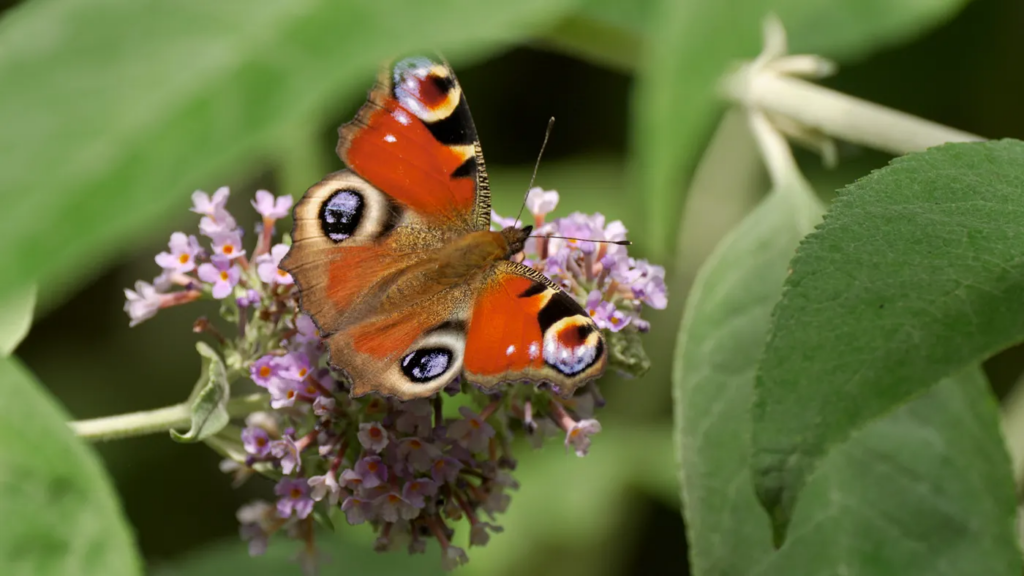
“Butterflies: Nature’s Superheroes,” a three-part documentary series featuring Serge Berthier. @ Arte
Anti-reflective coatings: the “moth-eye” effect
Unlike the Morpho butterfly, which reflects light to create color, the moth has evolved to absorb light completely in order to evade its predators. Its eyes feature a protruding structure, smaller than the wavelength of visible light, which eliminates any residual reflection.
This biomimetic innovation is at the heart of the advances documented by the leading journal Photoniques, published by the French Optical Society. By creating a progressive refractive index gradient between air and glass, these nanostructures “trap” photons instead of reflecting them, opening up new possibilities in industrial photonics.
Applications
- Mobile displays: drastic improvement in outdoor readability. The elimination of unwanted reflections extends device battery life by reducing the strain on panel backlighting.
- Photovoltaics: maximization of photon absorption, even at grazing angles. This submicron architecture ensures increased photonic efficiency in solar cells, converting every ray into useful energy.
- Precision optics: replacement of chemical treatments with a stable interface that performs well across a broad spectrum and is free of colored reflections.
Biomimicry: The Metamorphosis of Deep Tech
Nature is the world’s most sophisticated laboratory, operating under efficiency constraints that human industry is still learning to understand. The integration of lepidopteran structures into AI or photonics represents a significant breakthrough in engineering.
The future of technological sovereignty—whether French or South Korean—depends both on computing power and on our ability to preserve and decode the genome of natural innovation. This convergence of nature and technology is already evident in other sectors, such as medtech and femtech, where innovation is increasingly drawing on models inspired by living organisms.
The emergence of self-healing materials or autonomous environmental sensors suggests that the boundary between machines and living organisms is blurring. The question is no longer just what the butterfly can do for our AI, but how our AI becomes a tool that supports the preservation of life.